A wire mesh gauge chart converts a wire gauge number into a reference diameter in inches or millimeters. Identify the gauge system before using it: steel wire gauge, AWG and other systems assign different diameters to the same number. For a purchase specification, state the actual wire diameter and tolerance as well as the opening size.
Wire mesh gauge chart: commercial steel-wire equivalents
The values below follow selected commercial Washburn & Moen-based equivalents in the cited wire-mesh reference.[1] Use them to interpret a mesh description, then specify opening, alloy and dimensional tolerance separately. The chart does not establish a product’s strength.
| Gauge reference | Wire diameter, inches | Converted diameter, mm |
|---|---|---|
| 8 | 0.162 | 4.115 |
| 10 | 0.135 | 3.429 |
| 12 | 0.105 | 2.667 |
| 14 | 0.080 | 2.032 |
| 16 | 0.063 | 1.600 |
| 18 | 0.047 | 1.194 |
| 19 | 0.041 | 1.041 |
| 20 | 0.035 | 0.889 |
| 22 | 0.0286 | 0.726 |
| 24 | 0.023 | 0.584 |
| 26 | 0.0181 | 0.460 |
| 30 | 0.014 | 0.356 |
Millimeters are calculated as inches × 25.4 and rounded to three decimal places. That display precision is not a manufacturing tolerance. The source identifies its gauge equivalents as rounded references subject to wire tolerances.
Supplier tables can differ slightly. For example, 16 gauge may be listed as 0.0625 inch, while this commercial reference uses 0.063 inch. Those convert to approximately 1.588 mm and 1.600 mm respectively. Resolve the specified diameter with the supplier instead of treating the gauge label as an exact acceptance limit.
Measure the wire diameter before using a gauge table
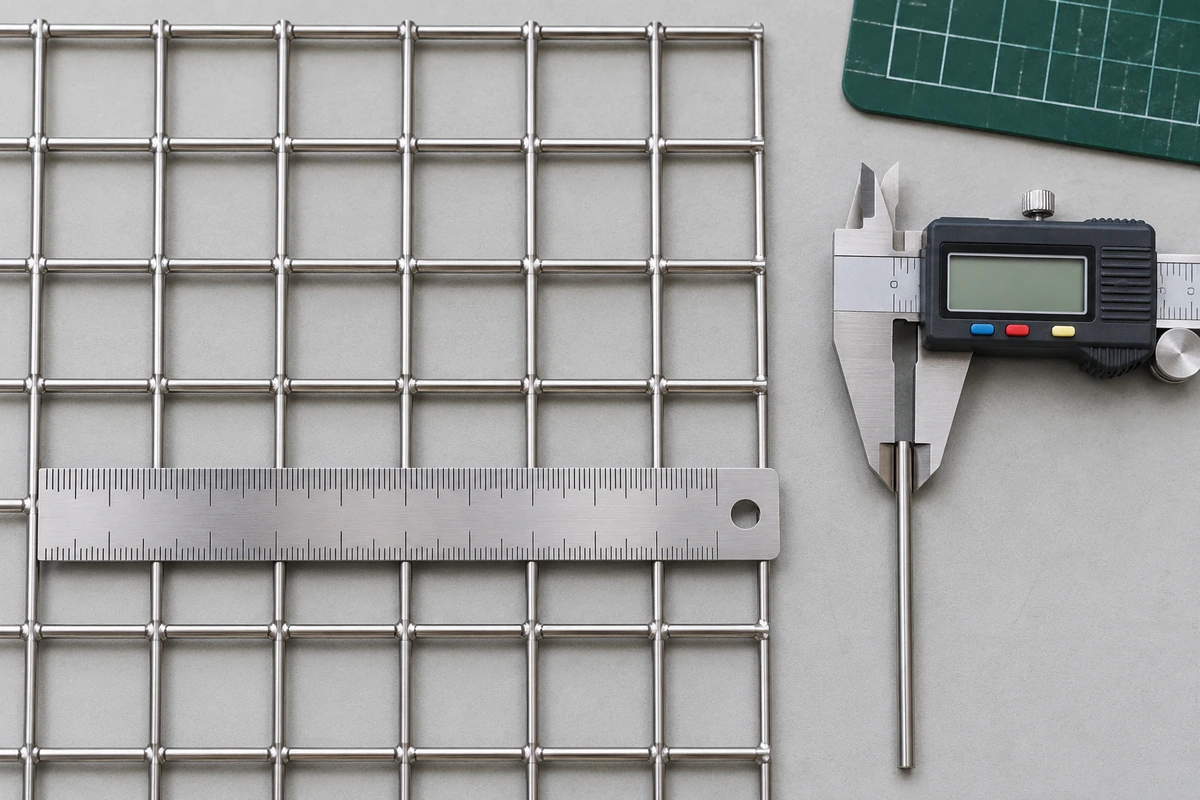
Measure the wire itself at a suitable straight section, away from a weld, crimp or flattened contact point. A micrometer provides a direct diameter measurement. Record the result in decimal inches or millimeters so it can be compared without ambiguity over the gauge system.[2]
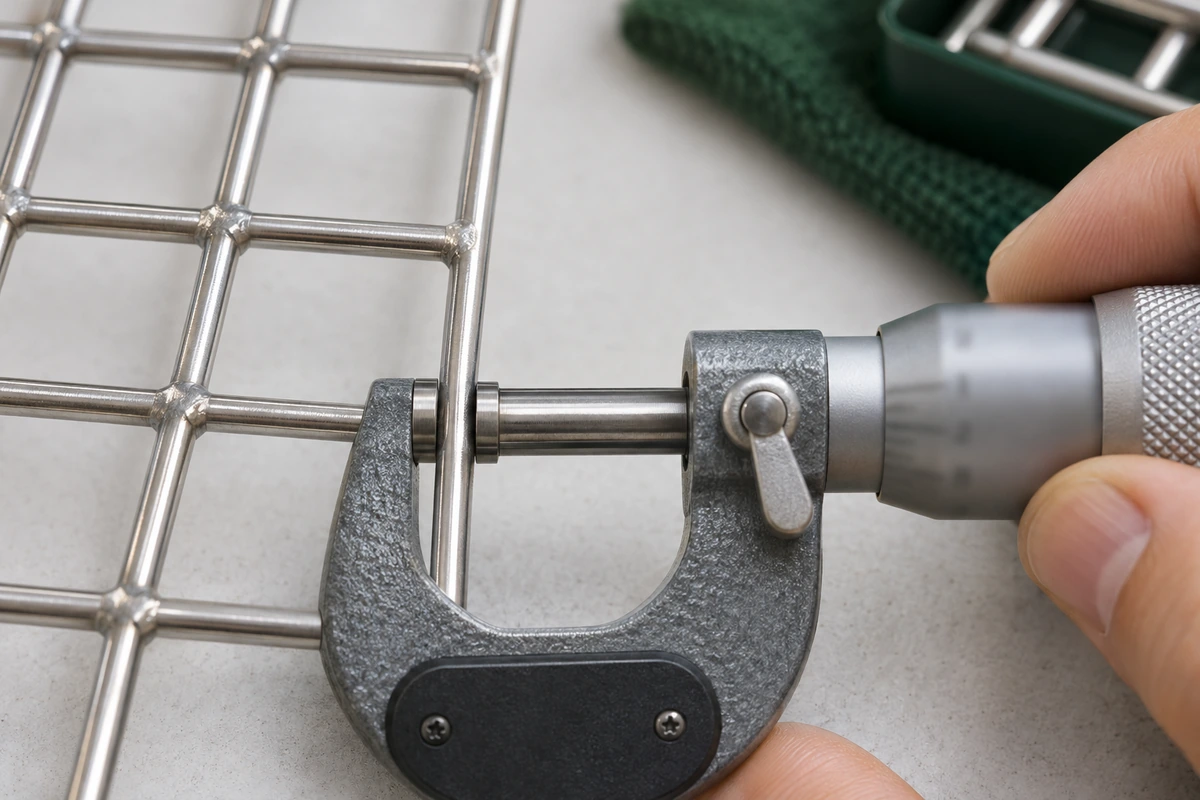
- Clean the measuring faces and the sample. Check the instrument’s zero and use a resolution appropriate to the wire size.
- Position the measuring faces square to a straight wire section. Use consistent, light measuring force rather than squeezing a fine wire.
- Take readings at several locations. If accessible, measure wires in both directions; warp and weft diameters may differ.
- Record whether the reading includes a coating. Do not infer the underlying steel diameter from a coated outside measurement without the coating information.
- Compare the measured values with the agreed nominal diameter and tolerance, then use the gauge table only as a descriptive reference.
A reading at a resistance-welded crossing can include local deformation. A reading at a crimp can also differ from the undeformed wire section. Flat and shaped wires need their width and thickness specified separately; a round-wire diameter chart is not a complete description of them.
Gauge systems must be identified before diameters are compared
Within the systems discussed here, a lower gauge number generally indicates a thicker wire. The numbers are not interchangeable across systems, and a decimal wire diameter is not itself a gauge number.
| System or label | What it describes | How to use it in a mesh order |
|---|---|---|
| Steel Wire Gauge / Washburn & Moen | A steel-wire gauge reference used in commercial mesh descriptions | Identify the system and confirm the supplier’s decimal diameter |
| American Wire Gauge, AWG | A different wire-size system; ASTM B258 addresses nominal AWG dimensions for solid electrical conductors | Do not substitute its diameters for an unspecified steel-mesh gauge |
| Standard Wire Gauge, SWG | Another numbered wire-size system | Request the applicable reference and actual diameter |
| Sheet metal gauge | A thickness reference for sheet material | Keep it separate from round-wire mesh gauge |
| W/D reinforcement-wire designation | A cross-sectional-area designation for plain or deformed reinforcement wire | Use the reinforcement specification; do not read it as an ordinary mesh gauge number |
For perspective, 16 AWG is about 1.291 mm in nominal diameter, while the 16-gauge commercial steel-wire equivalent in the first table is 1.600 mm. The AWG value follows the AWG sizing relationship; it is not a substitute for the steel-wire value.[3]
Once a quotation states the required wire as, for example, 1.00 mm nominal diameter with an agreed tolerance, the gauge becomes optional shorthand. That makes comparisons between suppliers and later inspection much clearer.
Keep wire gauge separate from mesh count and opening
Gauge describes wire thickness. Mesh count describes openings per linear inch, while clear opening describes the free distance between adjacent wires. You need more than one of these measurements to specify the mesh.
For a uniform square mesh with the same round-wire diameter in each direction:
Clear opening, mm = 25.4 ÷ mesh count − wire diameter, mm
Consider a hypothetical 4-mesh cloth. Its center-to-center pitch is 25.4 ÷ 4 = 6.35 mm. With 1.00 mm wire, the clear opening is 5.35 mm. With 1.60 mm wire, the clear opening is 4.75 mm. The mesh count stays the same even though the wire thickness and aperture change.
A specification such as “1/2-inch mesh” also needs clarification. It may refer to clear opening or spacing on centers. Request a drawing or a written definition. Our guide to wire mesh sizes covers these opening and count measurements in more detail.
For pre-crimped cloth, include the crimp style and edge condition with the dimensional information. The guide to crimped woven wire mesh explains how construction influences the finished fabric. A gauge chart cannot identify the weave.
Thicker wire changes open area, weight and handling
Increasing wire diameter changes several properties at once, but it does not create a complete strength rating for a mesh panel. Keep the comparison conditions explicit.
At a fixed mesh count, thicker wire reduces the clear opening and geometric open area. Using the hypothetical 4-mesh examples above, open area is about 71.0% with 1.00 mm wire and 56.0% with 1.60 mm wire. These figures come from (clear opening ÷ pitch)² × 100. They are geometric calculations, not measured ventilation or filtration results.
At the same material density, the mass per unit length of round wire scales with diameter squared. Changing from 1.00 mm to 1.60 mm gives a ratio of 2.56. A finished mesh panel’s actual mass also depends on total wire length, weave, crimp, coating, edge treatment and frame, so use the supplier’s product data for shipping or support calculations.
Panel behavior depends on aperture, wire properties, welds or weave, unsupported span, frame and fixings. There is no universal wire mesh gauge strength chart that can establish the safe load of every assembly. A thicker wire may improve stiffness in a given design, but a load-bearing or guarding application still needs appropriate engineering and verification.
Use a welded wire mesh gauge chart when comparing quotations
Compare like-for-like dimensions before comparing prices. Two “19-gauge mesh” quotations can cover different apertures, finishes and overall product sizes, even if their wire diameters are similar.
For stainless steel welded wire mesh panels, request the wire diameter in each direction, clear opening or center spacing, alloy, panel dimensions and edge condition. Include weld and dimensional requirements appropriate to the application.
For stainless steel woven wire mesh, state mesh count or clear aperture together with wire diameter, weave and roll or panel dimensions. Very fine filtration cloth is better described through its actual wire and opening specification than a gauge label alone.
Decorative work may use different wires in the two directions or a shaped wire section. Specify the approved pattern and sample alongside the dimensions when ordering stainless steel decorative mesh. Do not convert a visual sample into a single gauge number and expect the texture to remain defined.
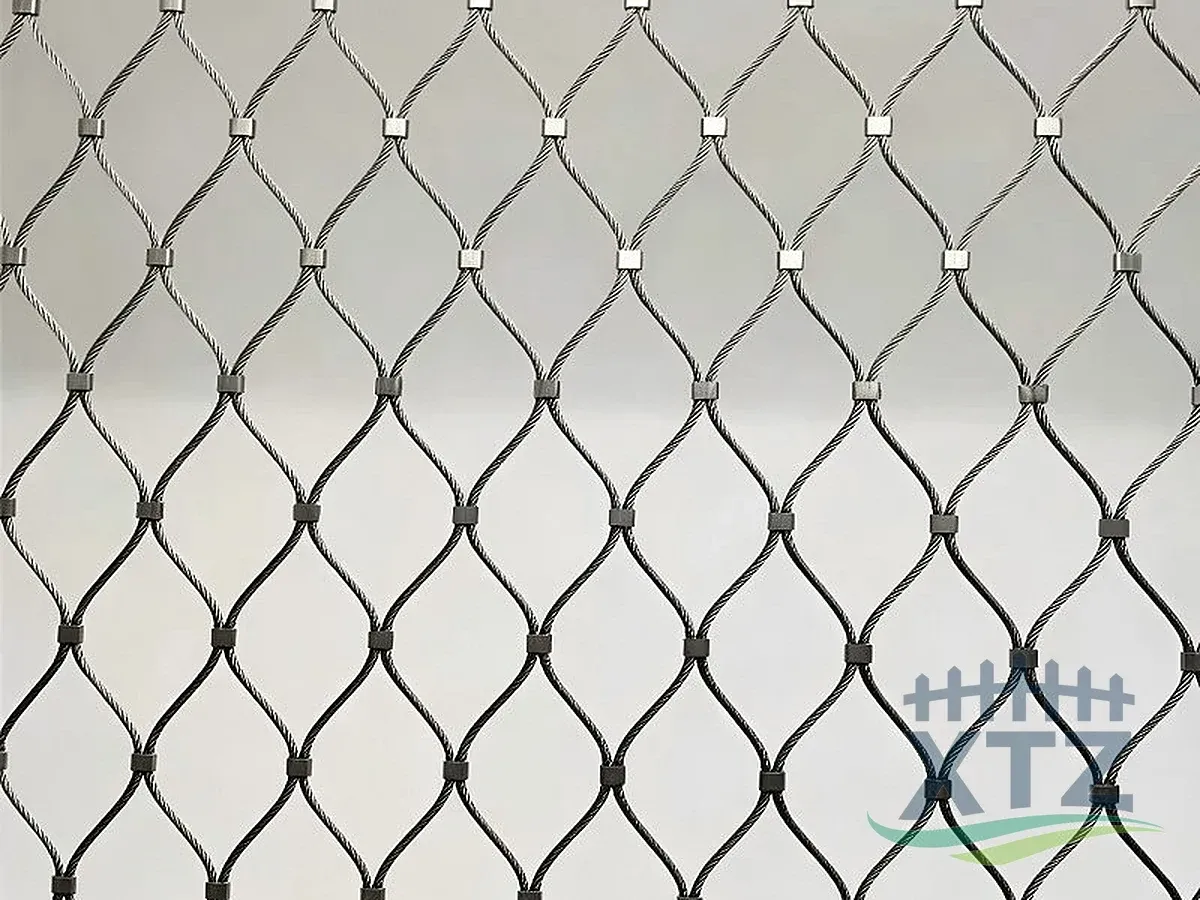
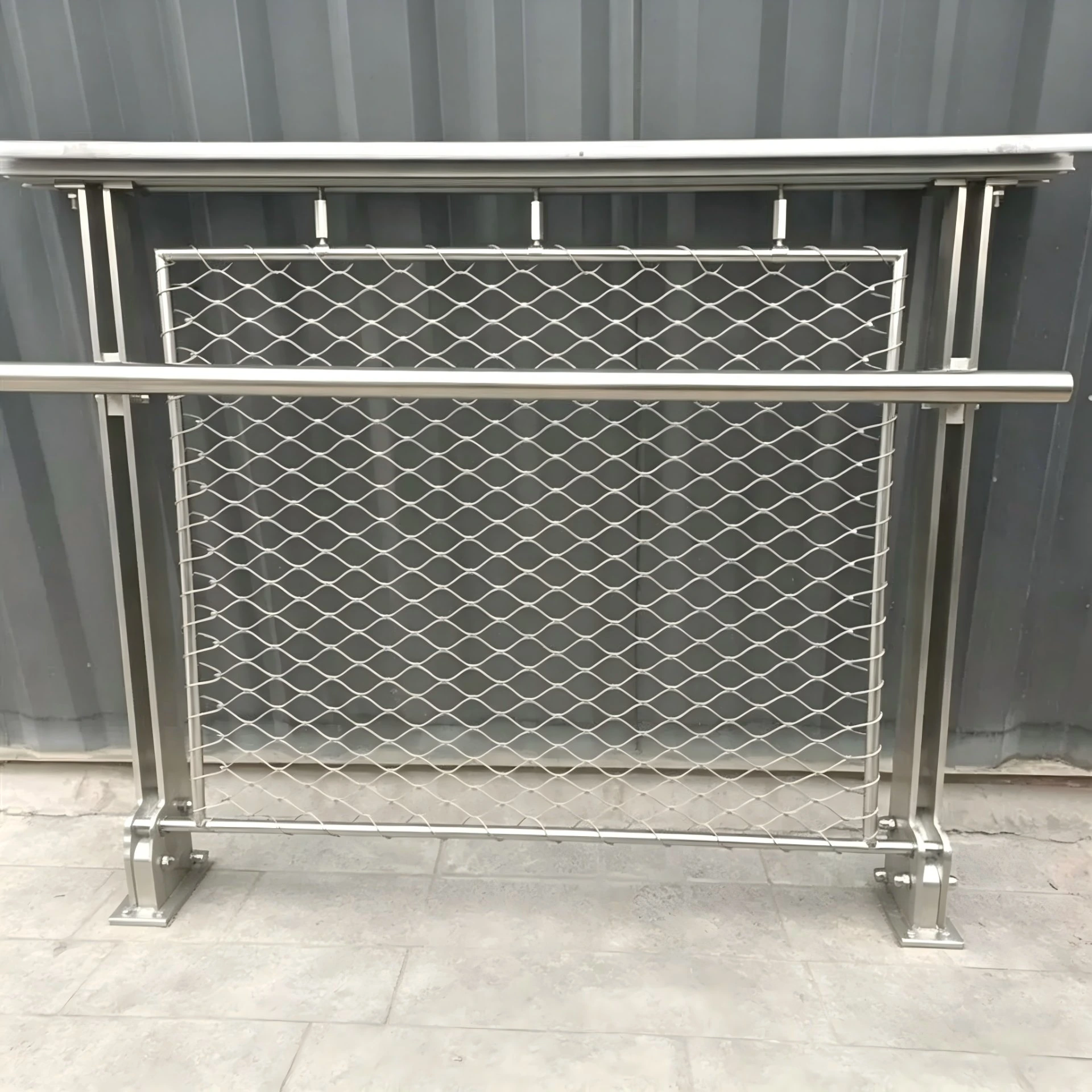
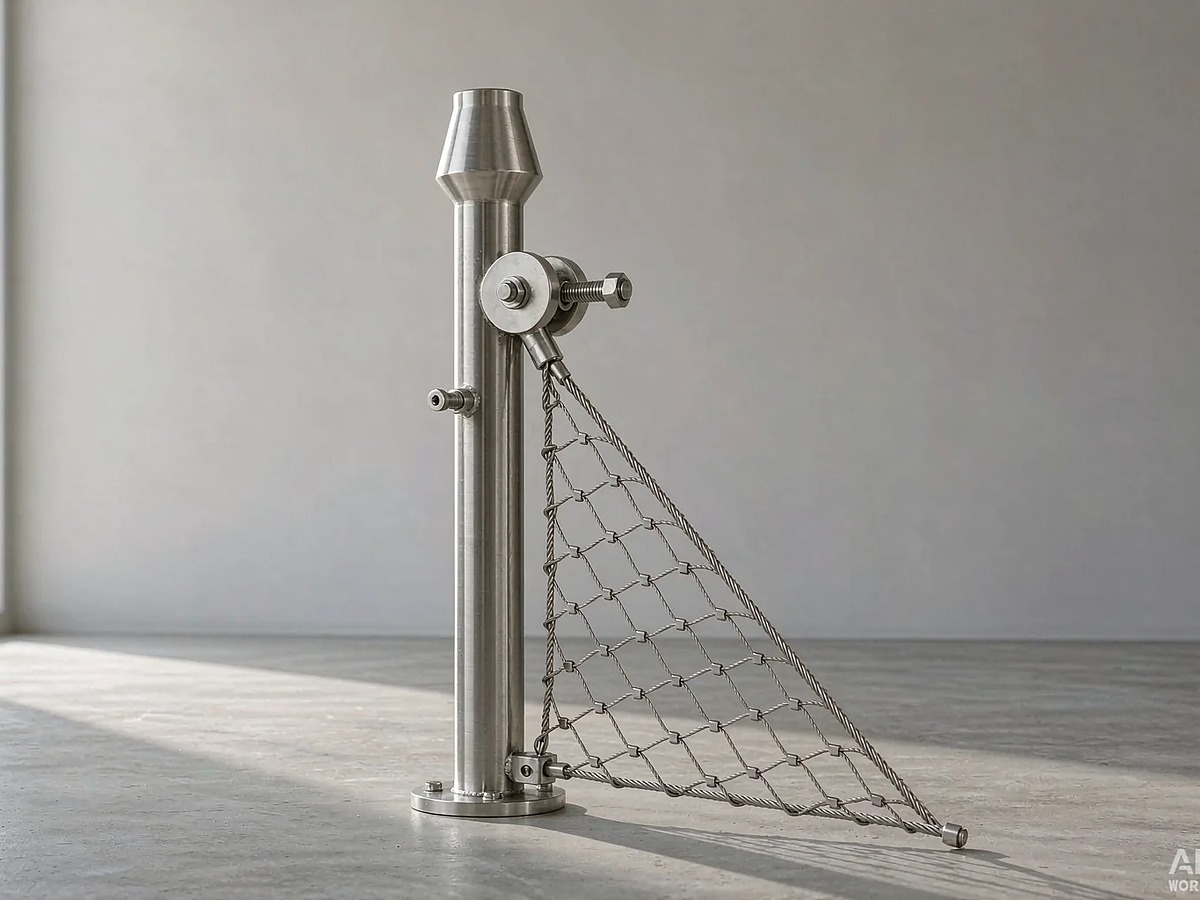
For stainless steel cable mesh, specify the assembled rope diameter, cable construction and diamond opening. A single-wire gauge chart cannot describe a multi-wire rope. An enquiry for a stainless steel rope mesh fence also needs the panel frame, post spacing and fixing details, so the quotation covers the required fence system.
For an XTZ Fence enquiry, send the actual diameter and tolerance, alloy, construction, opening dimensions, finished size and quantity. If the drawing gives only a gauge, include the original reference and ask for the decimal diameter to be confirmed before production.
Wire mesh gauge chart questions
Is 16-gauge wire mesh thicker than 19-gauge mesh?
Yes, when both numbers refer to the same gauge system. In the commercial steel-wire reference used here, 16 gauge corresponds to 0.063 inch and 19 gauge to 0.041 inch. Confirm the supplier’s stated diameters before comparing products. Different openings, frames and constructions can still give the finished panels very different behavior.
How many millimeters is 18-gauge wire mesh?
The commercial reference in this article pairs 18 gauge with 0.047-inch wire, which converts to approximately 1.194 mm. Other tables may use a slightly different nominal equivalent. The accepted diameter and tolerance should be stated on the quotation or drawing. The gauge does not tell you the mesh opening or the alloy.
Is wire mesh gauge the same as AWG?
Not necessarily. Mesh suppliers may use a steel-wire gauge reference, while AWG assigns different nominal diameters. For example, 16 AWG is about 1.291 mm, which differs from the 1.600 mm commercial steel-wire equivalent shown here. Ask for the gauge system and the decimal wire diameter instead of treating an unspecified gauge as AWG.
Can wire gauge tell me the opening size?
No. The same wire diameter can be used with different spacings, and the same mesh count can be woven with different diameters. For uniform square mesh, clear opening equals center pitch minus wire diameter. State the opening directly or provide enough dimensions to calculate it. Also confirm whether the supplier uses clear opening or spacing on centers.
Does a lower gauge always make a stronger mesh panel?
A lower number in the same gauge system indicates thicker wire, but panel capacity depends on more than diameter. Aperture, material, welds, weave, span, frame and fixing details all matter. Do not use gauge alone to select a walkway, safety barrier or structural reinforcement. Obtain the applicable design data and verification for that specific assembly.
How should coated wire mesh be measured?
Record whether the required dimension is the underlying wire diameter or the finished outside diameter including coating. A micrometer on an intact coated wire measures the outside size. It does not directly identify the steel core. Use the coating specification and an agreed inspection method, especially when comparing products with different coating thicknesses or processes.
Technical sources
- McNICHOLS: Wire Diameters and Wire Gauge Equivalents (commercial Washburn & Moen-based reference values and rounding notes).
- Darby: Wire Mesh Glossary (diameter, mesh count and clear-opening definitions).
- ASTM B258: Nominal AWG Diameters and Cross-Sectional Areas (the scope of the AWG conductor-size specification).