Stainless steel filtration mesh separates solid particles from a liquid or gas through controlled openings or pore passages. Choose it by the required particle retention, flow rate, pressure difference and cleaning conditions. Mesh count and alloy grade help describe the material; the installed filter also needs suitable support, seals and a defined acceptance test.
What is stainless steel filtration mesh?
Woven stainless steel wire cloth is a common medium for strainers, screen discs, baskets and process filters. Its intersecting wires form repeatable openings. A square weave has visible apertures; a Dutch weave uses a denser wire arrangement that creates passages through the cloth.
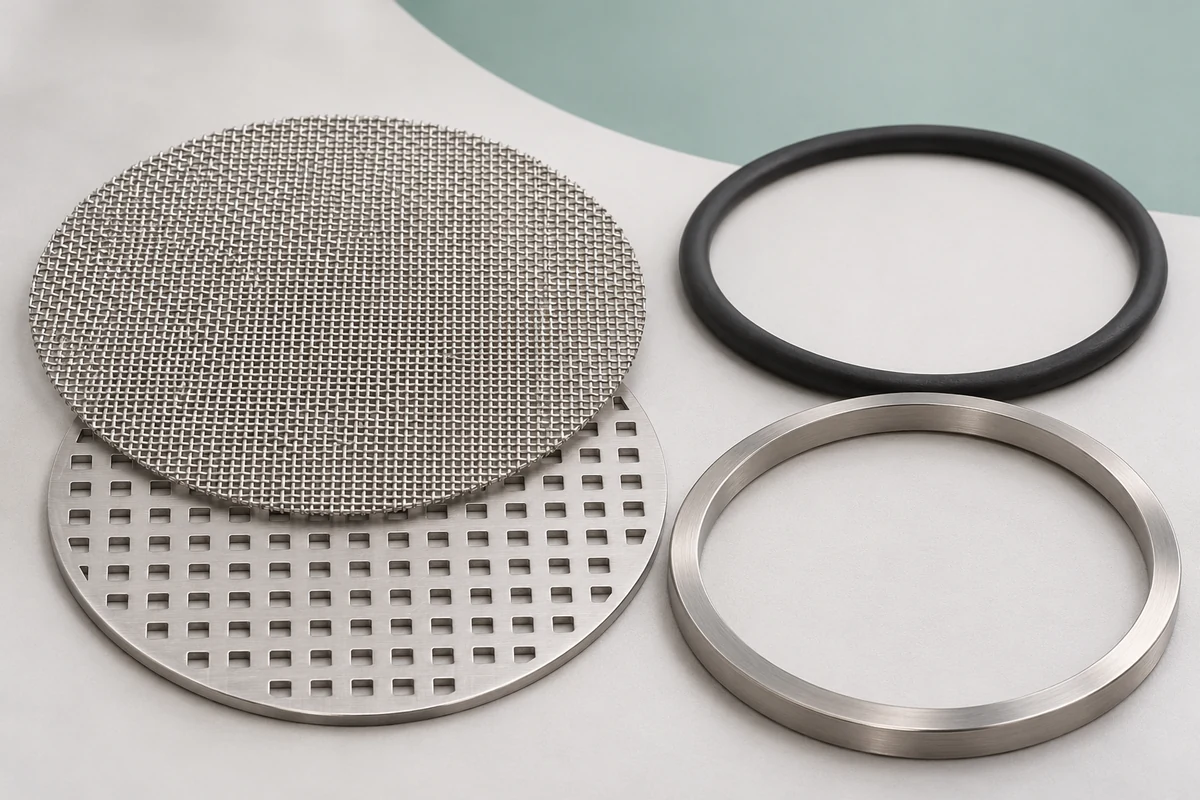
The mesh is one component of the filter. A retaining ring, support plate, housing and perimeter seal determine whether fluid passes through the active area or escapes around the edge. Two filters made from the same cloth can behave differently if those details change.
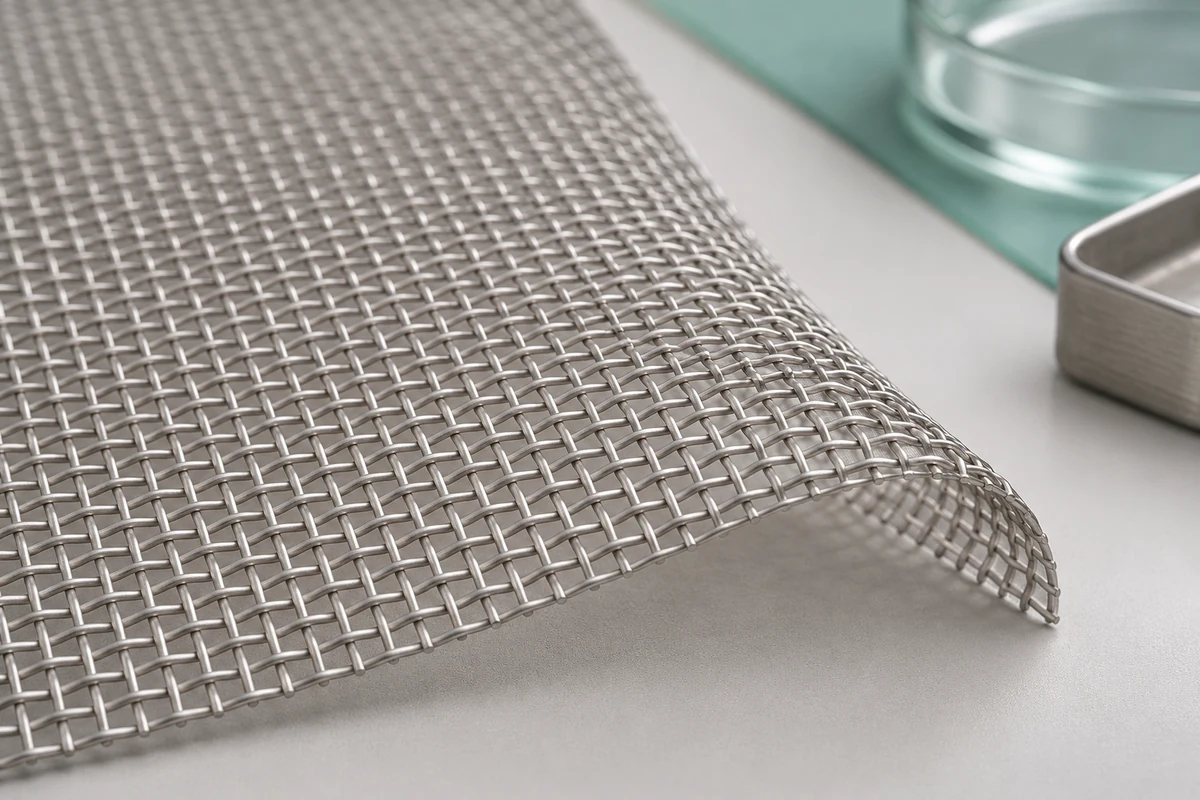
Keep the construction clear when discussing an enquiry with a stainless steel wire mesh manufacturer. Welded grids can provide coarse screening or backing, while fine particle retention commonly calls for woven filter cloth. Sintered laminates, etched screens and metal fibre media are separate constructions with their own specifications.
Micron rating, mesh count and aperture: what do they tell you?
A micron is a unit of length: 1 μm equals 0.001 mm. Mesh count describes the number of openings per linear inch in a conventional square weave. The aperture is the clear space between adjacent wires. Increasing mesh count usually reduces that space, but the wire diameter also changes the result.
For a regular square weave, aperture in millimetres is approximately 25.4 divided by mesh count, minus wire diameter in millimetres. A 200-mesh cloth made with 0.050 mm wire therefore has a calculated opening of about 0.077 mm, or 77 μm. This is a geometric example, not an installed retention rating. The existing guide to wire mesh sizes explains the dimensional checks.
Dutch weaves do not have the same simple square openings. Applying a square-mesh conversion chart to them can produce a misleading specification. Request the weave designation and the stated basis for pore size or retention.
Nominal versus absolute filtration ratings
A nominal rating describes retention under a supplier’s stated conditions, often at a stated efficiency. An absolute rating needs a defined limiting-particle or pore-size criterion and test method. The words alone do not establish a universal efficiency percentage across different suppliers.
Ask what was measured, which challenge particles or pore test were used, and whether the result applies to flat cloth or the finished element. ASTM’s explanation of woven filter-cloth specifications identifies bubble-point testing, glass-bead testing and modelling as possible acceptance approaches. Agree on the appropriate method for the duty. [1]
50 micron versus 100 micron stainless steel mesh
A 50 μm opening is finer than a 100 μm opening. Whether it improves the process depends on the particles that must be retained and the flow the system must maintain.
| Selection question | 50 micron stainless steel mesh | 100 micron stainless steel mesh |
|---|---|---|
| Geometric size | 50 μm equals 0.050 mm | 100 μm equals 0.100 mm |
| Reason to evaluate it | The process requires a finer separation than a 100 μm opening provides | Coarser separation meets the downstream requirement |
| Operating check | Verify clean pressure drop, solids loading and cleaning interval | Verify that smaller particles passing through are acceptable |
| Purchase specification | Define whether 50 μm is a geometric aperture, pore size or tested retention rating | Define the same basis before comparing quotations |
For example, a pump-protection strainer and a product-polishing filter may receive the same liquid but require different separation targets. Start with the equipment or product requirement, then test a suitable medium. Choosing the smallest available aperture can increase cleaning work without improving the finished product.
Particle shape matters too. Fibres, flakes and soft particles do not behave like rigid spheres. A sample trial should use representative material rather than relying entirely on a nominal particle-size label.
Which weave suits the filtration duty?
Choose a weave for its pore geometry, mechanical behaviour and measured performance in the process. A weave name by itself does not establish flow capacity or pressure resistance.
| Construction | Useful characteristic | What to confirm |
|---|---|---|
| Plain square weave | Regular visible openings make aperture inspection straightforward | Wire diameter, opening tolerance, available area and support |
| Twilled square weave | The over-under pattern accommodates different wire-to-opening relationships | Actual aperture and thickness rather than a plain-weave equivalent |
| Plain or twilled Dutch weave | Dense wires form pore passages through the cloth | Weave-specific pore or retention data and a compatible cleaning method |
| Multilayer or sintered mesh | A designed layer arrangement can combine a fine medium with supporting layers | Layer order, bonding, thickness, flow direction and assembly limits |
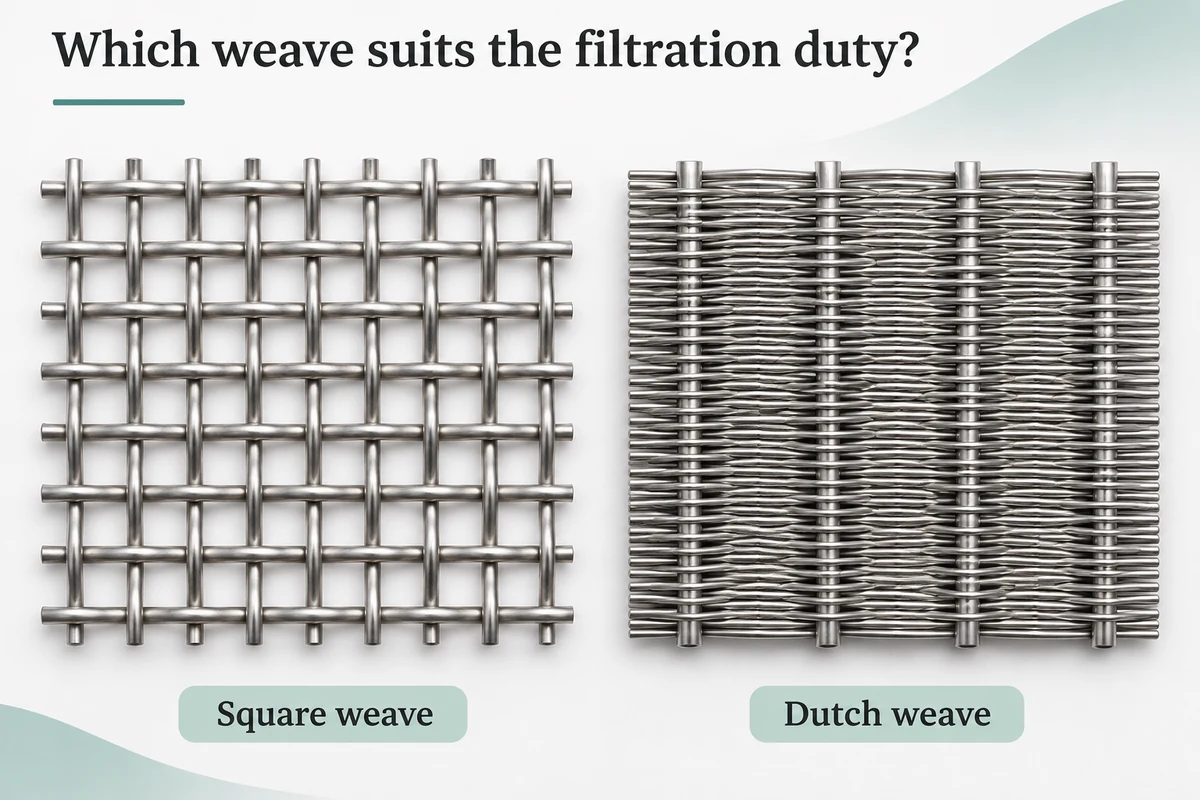
The guide to plain weave wire mesh gives construction background. A coarse pre-crimped screen and a fine filter cloth may both be woven, but their opening control and separation duties differ. State the required construction on the drawing.
Flow rate, pressure drop and support design
Evaluate the filter at its required flow, fluid viscosity and temperature. Compare clean pressure drop with the pressure difference allowed as particles accumulate. BOPP’s engineering guidance treats filter area, pressure loss and cleaning interruptions as connected design decisions. [2]
A finer opening, different weave or additional backing layer can change flow resistance. Increasing usable filter area may help, but the housing must distribute flow across it. Frame borders, seals and backing plates reduce the area available for flow; quoting total sheet area alone can overstate the active area.
Support spacing matters because the cloth carries a differential-pressure load. Check both normal flow and any reverse-flow cleaning cycle. A rigid backing layer should support the cloth without damaging it or obstructing more flow than the design allows.
A sudden loss of pressure drop is not always good news. It can indicate bypass, a torn screen or a failed seal. Investigate it alongside flow and particle measurements. A rising pressure difference may indicate loading, but its interpretation depends on the pump control and operating conditions.
304 or 316 stainless steel for filter mesh?
Choose the alloy against the process fluid and the cleaning chemistry. Temperature, concentration, chloride contamination and crevices can change corrosion behaviour. Type 316 merits consideration in many chloride-bearing environments, but neither 304 nor 316 is suitable for every chemical service.
Use corrosion information with the correct concentration and temperature, and assess the finished assembly. The British Stainless Steel Association notes that chemical mixtures and impurities can change results and that general corrosion tables may not account for localised attack. [3]
Include the support, welds, housing and seals in the review. A compatible cloth does not compensate for an unsuitable gasket. Material traceability and the required surface condition should appear in the order if the application needs them.
Cleaning and replacement: specify a repeatable process
Define the cleaning method before ordering a reusable screen. The medium, backing and seals must tolerate the selected chemical, temperature, contact time and cleaning pressure. Backwashing or ultrasonic cleaning can be options for suitable assemblies; they need validation for the actual construction.
Handle fine cloth carefully during removal. Scraping, aggressive brushing or a concentrated jet can deform wires and damage seams. After cleaning, inspect the screen and its seal, and compare operating performance at equivalent conditions. Persistent contamination, damaged wires or performance that fails the agreed acceptance criteria can justify replacement.
Screening particles is also different from removing dissolved salts or providing sterile filtration. Confirm the treatment objective before specifying a mesh for potable water, food processing or other controlled applications.
What to include in a filtration mesh enquiry
An enquiry becomes easier to assess when it describes the separation duty and the installation. Include:
- The process liquid or gas, temperature range and relevant chemical composition.
- The particles to retain, their shape and loading, and the required downstream result.
- The rated flow and allowable clean and loaded pressure differences.
- The proposed aperture or retention rating, weave, alloy and acceptance method.
- The active area, overall dimensions, support arrangement, seams and perimeter seal.
- The cleaning method, quantity and required material or inspection documents.
For a coarse backing grid, identify the opening, wire diameter and support span separately from the fine medium. XTZ Fence’s stainless steel welded wire mesh range includes custom rolls, sheets and cut panels. Send the process details and assembly drawing so XTZ Fence can confirm the applicable mesh construction and quotation scope. Fine micron-rated cloth and any required performance documentation should be confirmed for the specific enquiry.
Stainless steel filtration mesh FAQ
Does 200 mesh mean 200 microns?
No. In a conventional square weave, 200 mesh describes the number of openings per linear inch. The clear aperture depends on wire diameter. With 0.050 mm wire, the calculated aperture is about 77 μm. Dutch filter weaves require a different specification approach because their passages are not simple square openings.
Is 50 micron stainless steel mesh always better than 100 micron?
Choose the separation that the process requires. A finer opening can retain smaller rigid particles, but it may also increase resistance or shorten the cleaning interval. Compare both candidates at the required flow and solids loading, using the same rating basis and representative contamination.
Can welded wire mesh be used as a fine filter?
Welded wire grids are often used for coarse screening, guarding or support. A fine filtration duty commonly uses woven filter cloth or another engineered medium. Specify the particle-retention requirement first, then confirm the construction, opening tolerances, supporting layers and test evidence with the supplier.
What is the advantage of Dutch woven wire mesh?
Dutch woven wire mesh creates dense pore passages through a tightly arranged wire structure. It offers a route to finer filtration than many open square weaves. Compare the specific weave’s retention, flow resistance, mechanical limits and cleaning behaviour; the Dutch-weave label alone does not establish those values.
Can stainless steel filter mesh be washed and reused?
Many suitable assemblies can be cleaned and reused, provided the cleaning process does not damage the medium, joints or seals. Validate the method against the contamination and process requirements. Inspect the element after cleaning and replace it when damage or persistent contamination prevents it from meeting the agreed duty.
What should a filtration sample test include?
Test the installed configuration at representative flow, temperature and contamination. Record retention and pressure drop, check for bypass, and repeat relevant checks after cleaning. Agree on acceptance criteria before the trial so both the buyer and supplier can interpret the results consistently.