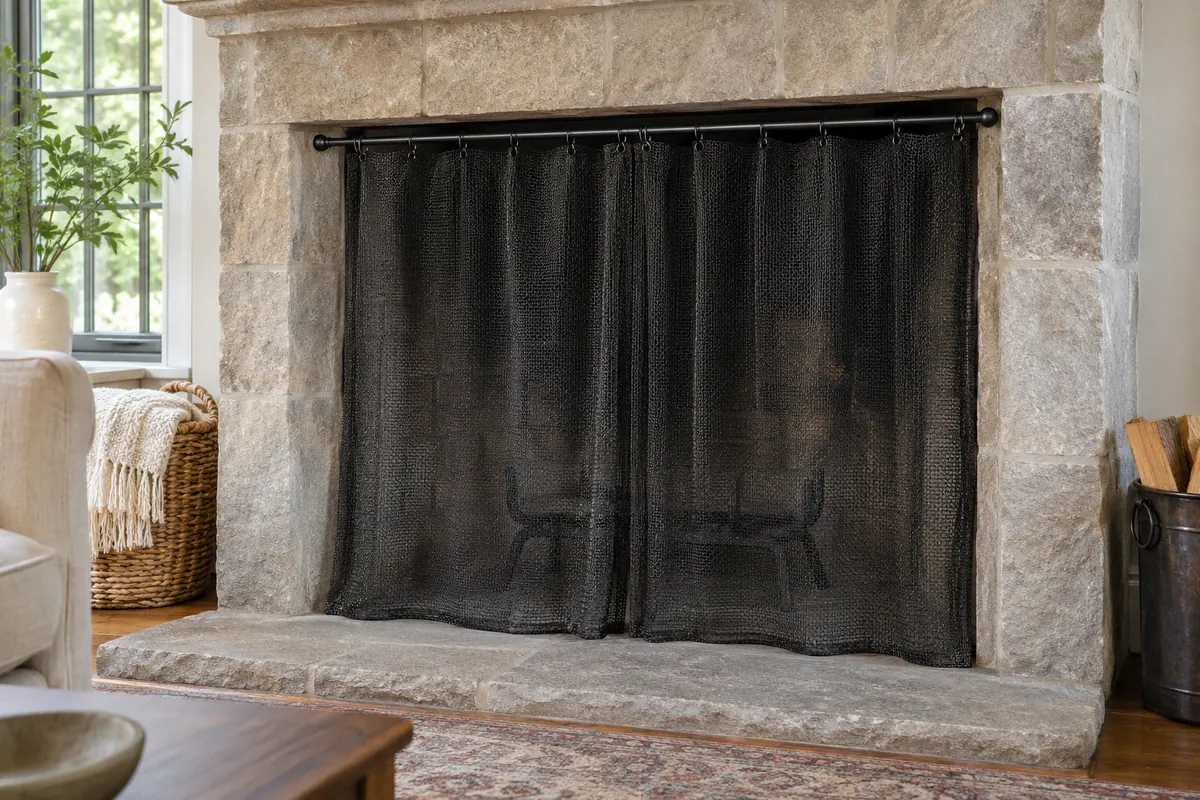
A fireplace mesh screen is a metal curtain or framed mesh assembly placed at a fireplace opening. Choosing one requires the screen type, finished dimensions, mesh construction and compatible mounting hardware. A spark screen for an open fireplace and a protective barrier for hot gas-fireplace glass have different purposes and replacement requirements.
Do you need a replacement curtain, a framed screen or an appliance barrier?
Identify the existing fireplace and screen assembly before shopping by width and height. Search results for “fireplace mesh screen” include complete accessories, replacement curtains and raw wire cloth. These products require different installation details.
| Screen type | How it is supplied | What to confirm first |
|---|---|---|
| Sliding mesh curtain | Flexible metal panels suspended from rings or other hangers | Finished drop, panel width, center overlap, ring size and rod compatibility |
| Rigid framed screen | Mesh retained in a fixed, hinged or freestanding frame | Opening coverage, frame stability, edge retention and access arrangement |
| Appliance-specific safety barrier | A screen assembly designed for a particular fireplace or insert | Appliance model, original part and manufacturer’s replacement instructions |
| Raw mesh or cut insert | Material for a fabricator to incorporate into a screen assembly | Approved material specification, frame detail and responsibility for the finished design |
A curtain must move freely and still cover its intended opening when closed. A rigid screen depends on the frame and its supports to remain in position. Raw mesh needs fabrication before it becomes a usable screen.
How to measure a replacement fireplace mesh curtain
Measure the existing arrangement when the fireplace is cold. Keep a record of the opening dimensions, the rod position and the screen dimensions as separate items. Photograph unusual hangers or brackets so the replacement supplier can identify them.
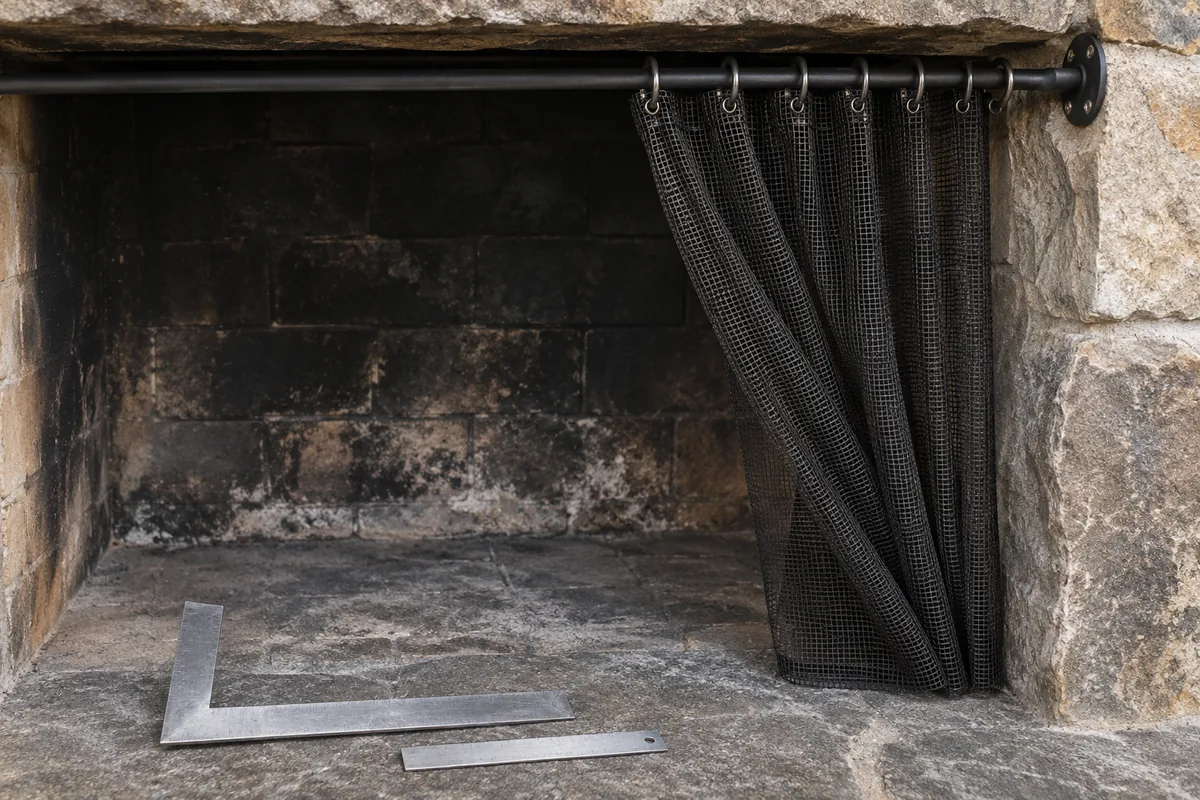
- Record the opening. Measure width and height at several locations if the masonry is uneven. Identify arches, sloping hearths or trim that restricts movement.
- Locate the hanging point. Measure from the reference specified by the screen maker, such as the top of the existing rod, to the intended lower edge.
- Separate mesh height from hanging height. Confirm whether the listed size includes rings or hangers.
- Check the curtain width. Establish the required drape and overlap for the actual system, plus the space needed when the curtain is drawn open.
- Confirm the hardware. Record rod diameter, ring dimensions, stops and pulls. Check that the replacement can be fitted using the approved arrangement.
Manufacturer conventions vary. Condar, for example, lists its standard curtain height without the half-inch hanging rings and gives different sizing instructions for an existing rod and a new rod-and-valance kit. Its custom worksheet also asks whether the ordered dimensions include rings and draping allowance. [1] Calculate the drop using the instructions for the selected screen and hanging kit.
If an existing curtain drags, simply ordering the same nominal height may reproduce the problem. Establish whether the old measurement included the hangers, whether the rod has moved and whether the hearth is level. For an appliance-specific assembly, order by the required part identification as well as checking dimensions.
Which materials are used in fireplace screen mesh?
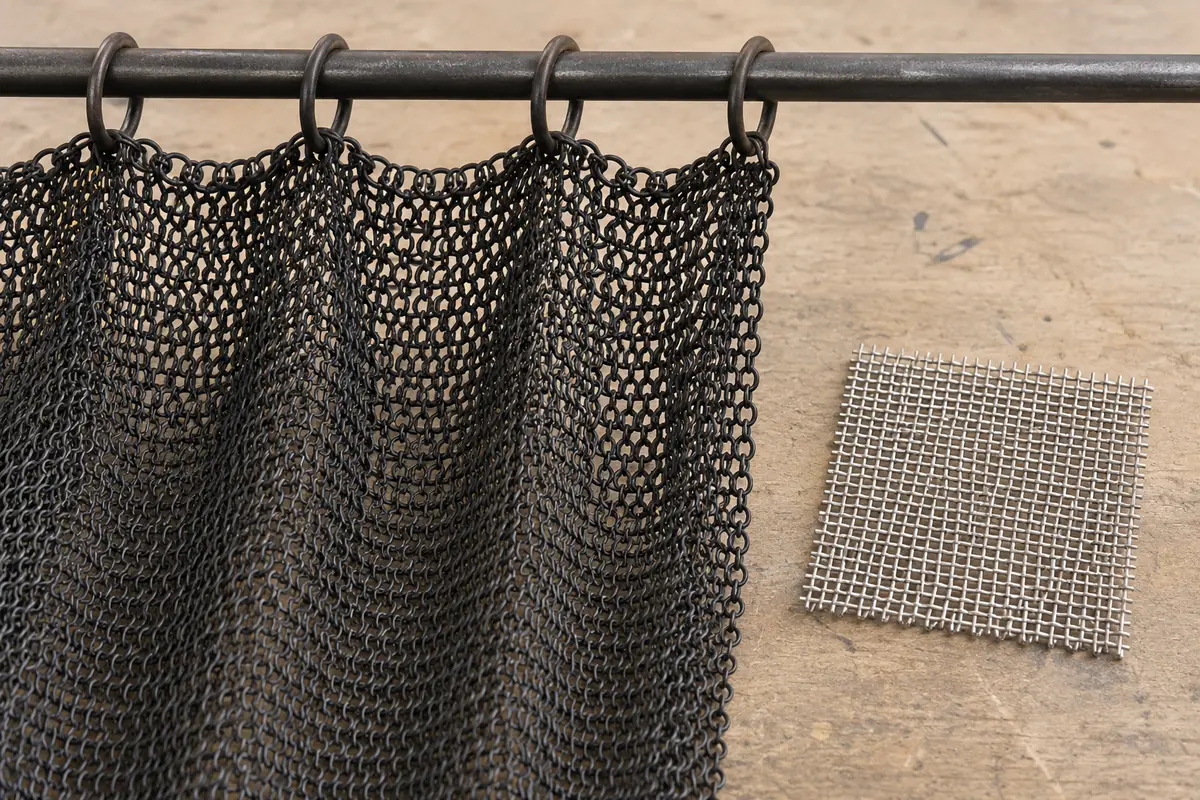
Steel and stainless steel appear in both curtain and framed-screen products, while brass and bronze are also offered for some fabricated screens. The construction and finish need to suit the intended assembly and service conditions.
| Material or finish | Selection consideration | Question for the supplier |
|---|---|---|
| Plain steel with a suitable finish | A dark screen appearance, with corrosion protection dependent on the specified finish and conditions | Is this complete mesh-and-finish combination intended for the proposed fireplace screen? |
| Stainless steel | A metallic appearance and material choice based on exposure | Which alloy, wire dimensions and surface condition are being supplied? |
| Brass or bronze | A warmer metal appearance that may change with service | Is the proposed alloy and construction suitable for the intended assembly? |
| Black or other surface coating | Appearance and an additional material specification | What service limitations and maintenance instructions apply? |
Darby’s fireplace-screen material guide describes several metals used in framed applications. [2] That range does not make every mesh made from those metals suitable for every fireplace. A metal’s melting point cannot establish the service rating of a thin wire, coating, joint or finished screen.
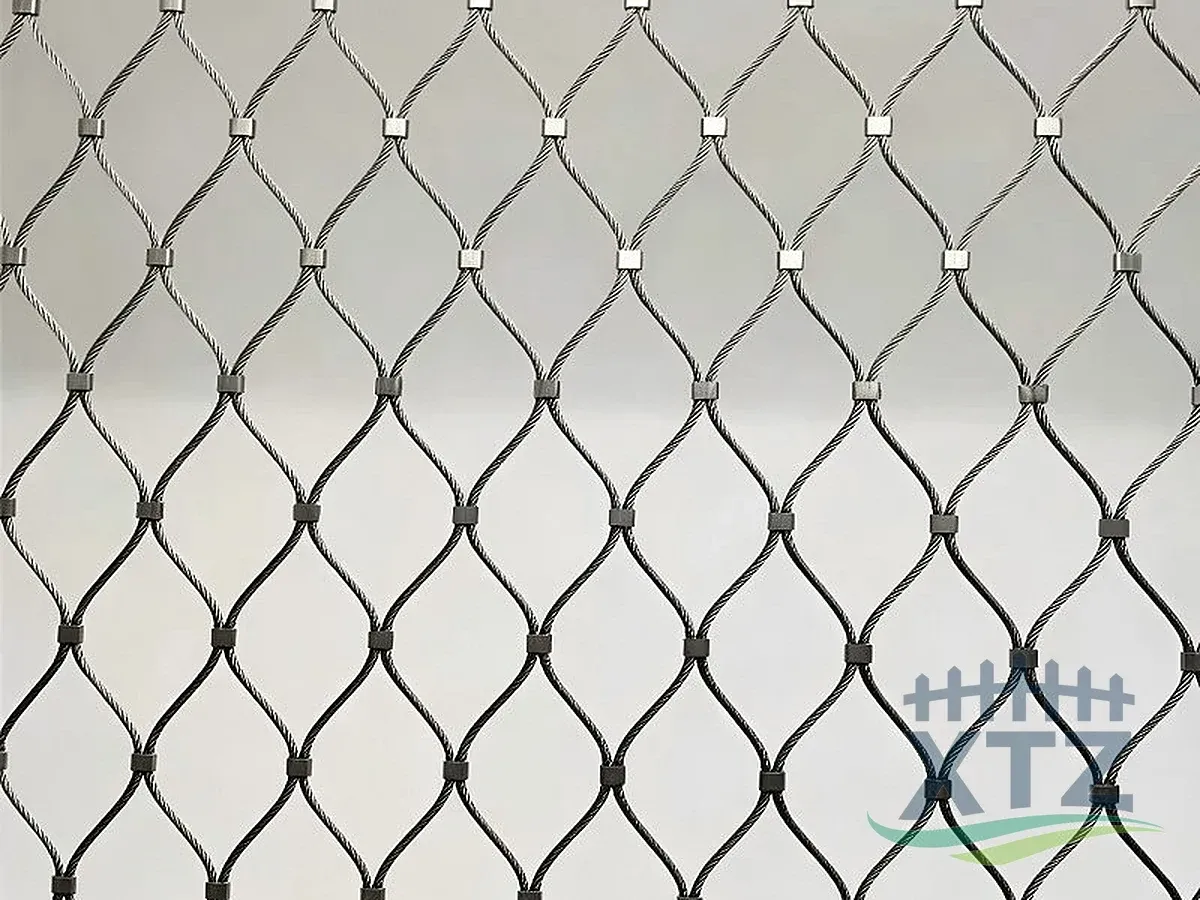
XTZ Fence’s range of stainless steel wire mesh for industrial use provides a starting point for discussing material and cut-panel requirements with a fabricator. Fireplace suitability still needs to be established for the proposed assembly. Specify that requirement explicitly in the enquiry.
What mesh size should a fireplace screen have?
There is no single opening size that establishes suitability across curtains, framed spark screens and appliance barriers. Obtain the mesh specification from the complete-screen supplier or approved design. Compare clear opening and wire diameter together.
Darby describes an opening around one-tenth of an inch, approximately 2.5 mm, and about 60% open area as a commonly requested combination for its framed-screen applications. [2] This manufacturer example applies to that context. Suitability for a new assembly needs to be confirmed separately.
Mesh count can obscure the actual opening. For a regular square mesh with a pitch of 25.4 divided by the count per inch, the approximate clear opening in millimeters is:
Clear opening = 25.4 ÷ mesh count − wire diameter.
As a geometric example, 8 openings per inch with 0.70 mm wire gives about 2.48 mm clear opening. Changing the wire to 1.00 mm reduces that opening to about 2.18 mm. These calculations describe geometry only. They do not demonstrate spark retention, operating temperature or appliance compatibility.
The mesh aperture calculator guide explains the dimensional relationship. If a fabricator proposes crimped woven wire mesh, ask for the actual opening and thickness. A visually attractive crimp may have openings quite different from the screen being replaced.
Why gas-fireplace safety barriers need model-specific replacement
Glass-fronted gas fireplaces can have a protective screen intended to reduce contact with hot glass. Its position, attachment and spacing form part of its design. A loose curtain or a generic mesh insert cannot be assumed to provide the same protection.
Heat & Glo instructs owners to keep its protective screen in place without alterations and uses model and serial information to identify replacement screens. [3] For another appliance, consult its own manual and authorized service route. If a required barrier is missing or damaged, have the correct replacement resolved before further operation.
The Hearth, Patio & Barbecue Association also distinguishes attachable screens from other physical barriers and advises checking aftermarket products with the hearth retailer or manufacturer. [4] A barrier can become hot itself. Continue to follow the appliance’s supervision and clearance instructions after a screen is installed.
Specify the frame, finish and access for a custom screen
For a custom framed screen, a fabricator needs a section through the perimeter. Show how the mesh is captured, how cut ends are covered and where the screen is supported. Include the proposed opening mechanism or removal method so routine fireplace access is considered before fabrication.
Leave the thermal movement and clearance detail to the responsible screen designer and the applicable instructions. A mesh held too tightly or attached to an unsuitable frame can change shape in service. The selected assembly needs an appropriate material and fixing design.
For decorative work around the hearth, XTZ Fence’s decorative stainless steel mesh may be discussed as a separate architectural component. Establish its position and exposure. An outer decorative panel should not be presented as a substitute for a required spark screen or appliance barrier.
A useful fabrication enquiry includes the fireplace type, any appliance identification, approved screen specification, opening photographs, finished dimensions, frame section, mounting details and quantity. Ask the supplier to state which components and records its quotation includes.
When should fireplace mesh screens be cleaned or replaced?
Inspect and handle the screen only after the fireplace has cooled. Check for broken wires, damaged rings, loose attachments, corrosion and changes in coverage. A curtain that no longer closes fully, or a framed screen that has become unstable, needs attention before use.
Follow the screen and appliance instructions for cleaning products and finishes. Ask the original supplier about damaged coatings instead of choosing a paint from its color alone. The U.S. Fire Administration recommends professional cleaning and inspection of heating equipment and chimneys each year. [5] Screen maintenance forms one part of that wider routine.
Cable mesh for the wider architectural project
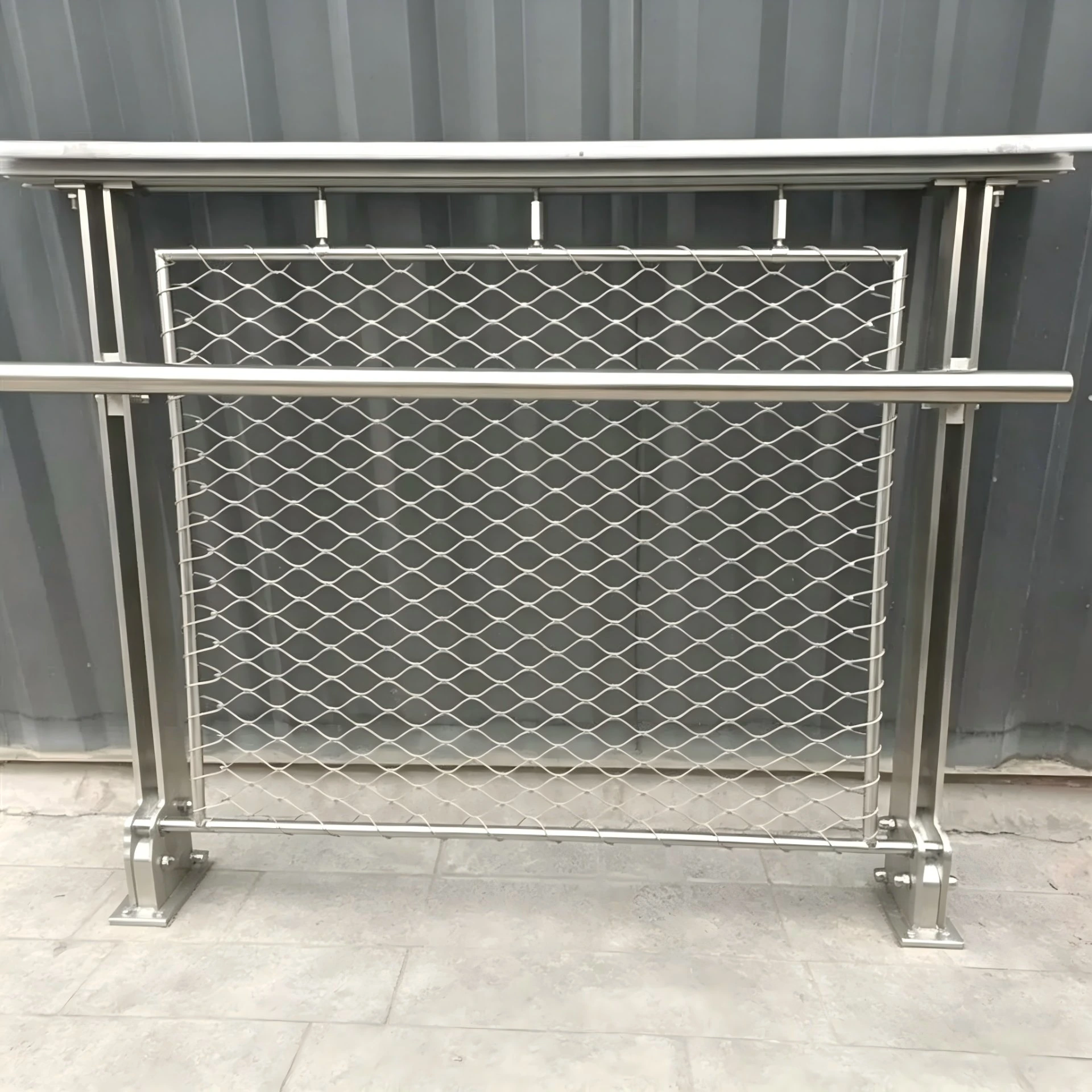
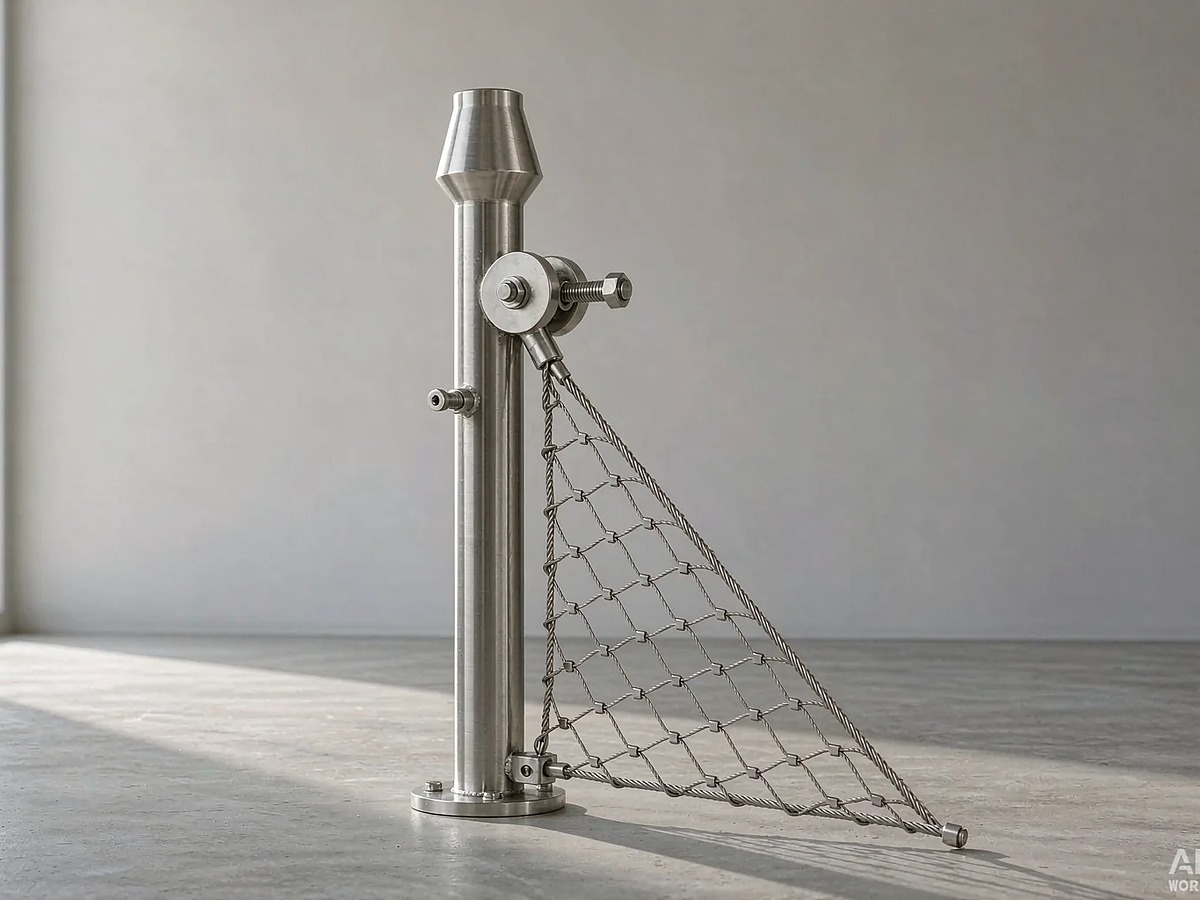
For balustrades, enclosures and architectural screens elsewhere in a project, XTZ Fence’s stainless steel cable mesh is available as rolls, cut panels or framed assemblies. Its stainless steel rope mesh fence range brings the rope mesh, perimeter frame, posts and fixings together for a coordinated barrier layout.
These products serve separate enclosure and architectural requirements. The fireplace’s spark screen or hot-glass barrier still needs its own suitable mesh construction and approved mounting arrangement.
Frequently asked questions about fireplace mesh screens
Can I replace only the fireplace mesh curtain?
Some screen systems are designed for replacement curtain panels. Confirm the maker’s sizing convention and compatibility with the existing rod, rings and stops. If the fireplace uses a model-specific safety barrier, obtain the required replacement assembly through its manufacturer or authorized dealer. A similar overall size does not establish compatibility.
Does the stated screen height include the rings?
It depends on the product. Condar’s standard curtain listings exclude its hanging rings from the named mesh height. [1] Other products may use different references. Ask for both the mesh-only height and the finished hanging drop, then compare those dimensions with the cold fireplace and the maker’s installation instructions.
Is stainless steel automatically the best fireplace mesh?
Stainless steel may suit a particular screen specification, but the alloy name alone is insufficient. Opening, wire diameter, joints, frame, finish and exposure all need consideration. For an appliance barrier, use the required part. For a fabricated screen, have the responsible designer establish the complete specification before selecting material.
Can ordinary insect screen replace fireplace mesh?
Use material explicitly suitable for the approved fireplace-screen design. An insect screen’s fine appearance does not establish its heat suitability or ability to remain secure in the frame. Its substrate, coating and construction may differ substantially. Obtain the specified replacement instead of judging compatibility by how small the holes look.
Can a mesh screen replace fireplace glass?
Follow the appliance instructions. A glass assembly and a mesh barrier perform different functions in many fireplaces. Do not remove required glass and assume a mesh screen can take its place. Give the make, model and damaged-part details to the manufacturer or authorized service provider to identify the proper repair.
Does XTZ Fence supply a ready-to-fit fireplace safety barrier?
XTZ Fence’s published ranges cover mesh materials and project supply options. A ready-to-fit, model-specific fireplace barrier has not been verified in that range. Send a fabricator-approved specification for custom material enquiries. For an existing appliance barrier, use the appliance manufacturer’s replacement process and required components.
For a custom metal-screen project, send XTZ Fence the approved material requirements, cut sizes and edge detail. Confirm feasibility and the exact supply scope with the quotation. Keep responsibility for the finished fireplace screen and its compatibility clear between the appliance supplier, designer and fabricator.
References
- Condar — How to Select Your Fireplace Mesh Screen and Custom Screen Worksheet. Primary sizing instructions for Condar products.
- Edward J. Darby & Son — Fireplace Screen. Manufacturer application guidance on framed-screen mesh and materials.
- Heat & Glo — Fireplace Safety and Request a Safety Screen. Original manufacturer instructions and replacement identification.
- Hearth, Patio & Barbecue Association — Safety Products. Trade-association guidance on protective barriers for hot glass.
- U.S. Fire Administration — Heating Fire Safety. Public fire-safety and maintenance guidance.