Copper mesh is an open metal material supplied as woven wire cloth, knitted wire or slit-and-expanded sheet. Its construction determines whether it suits a defined screen opening, a compressible gap filler or an engineered conductive layer. Select it by material grade, geometry, dimensions and the requirements of the finished application.
A search for copper mesh can bring up a window screen, a pest-exclusion roll and a shielding material on the same results page. They need different specifications. Start by identifying which product you actually need.
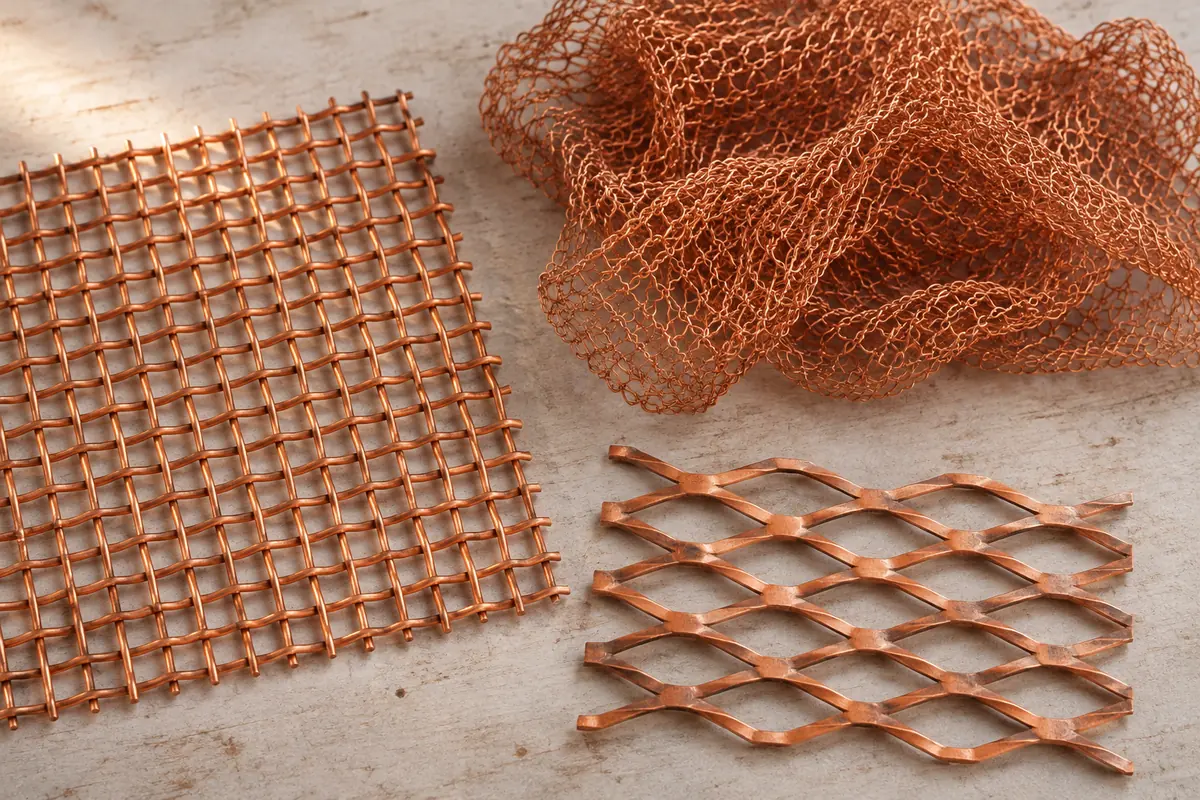
Woven, knitted and expanded copper mesh are different products
Woven copper mesh has wires crossing over and under each other. Knitted mesh uses interlocking loops and can be compressed into irregular spaces. Expanded copper starts as sheet or foil that is slit and stretched to form connected openings.
| Copper mesh construction | What defines it | Typical purchasing questions |
|---|---|---|
| Woven wire cloth | Regular woven wires, often with square openings | Mesh count, wire diameter, clear aperture, weave and edge support |
| Knitted copper mesh | Interlocking wire loops, often supplied as a flattened tube | Wire form, width, supplied length, compressed condition and retention |
| Expanded copper mesh | Continuous slit-and-stretched sheet or foil | Material thickness, strand width, opening dimensions and orientation |
The manufacturing distinction matters. CThru Metals’ expanded copper description explains that expanded material is made from a continuous piece, without woven joints or welds. It should be specified using its own geometry rather than a woven mesh-count label.
Do not infer composition from colour. Ask whether the material is solid copper, a copper alloy or copper-coated wire. Copper, brass and bronze may be grouped together by a seller, but they are different materials. State the grade or composition needed for the job and request the relevant material documentation.
Copper mesh sizes: mesh count, aperture and open area
For regular square woven mesh, mesh count describes the number of openings per linear inch. It does not fully describe the clear opening because the wires occupy part of each repeating pitch. Request the count and wire diameter together, in both directions if they differ.
For an ideal balanced square weave:
- Pitch in millimetres = 25.4 ÷ mesh count per inch.
- Clear opening = pitch − wire diameter.
- Geometric open area (%) = 100 × (clear opening ÷ pitch)².
This calculation assumes round wires of equal diameter and a regular square pattern. It does not describe knitted loops, expanded diamonds or a compressed exclusion roll. Manufacturing tolerances and the actual mesh should be checked separately. Our guide to wire mesh sizes gives more detail on the measurement terms.
Why two 20-mesh copper screens can perform differently
The following comparison uses assumed dimensions for calculation, not measured samples or a particular supplier’s product. Both screens have 20 openings per inch, so the calculated pitch is 1.27 mm.
| Assumed square woven screen | Wire diameter | Calculated clear opening | Calculated open area |
|---|---|---|---|
| Screen A | 0.30 mm | 0.97 mm | 58.3% |
| Screen B | 0.50 mm | 0.77 mm | 36.8% |
The thicker wire reduces the free opening and geometric open area at the same mesh count. That affects a screening specification and the amount of visible open space. It does not, by itself, calculate airflow, pressure drop, particle capture or electromagnetic attenuation.
Use supplier data for the finished mesh and ask how any quoted open-area figure was obtained. The ideal calculation is useful for checking a quotation for consistency, especially when two offers both say only “20 mesh.”
Copper mesh for rodent gaps: examine the whole opening
Knitted copper exclusion mesh can fit irregular spaces around penetrations. A durable exclusion detail also needs sound surrounding material and a way to prevent the filler from being displaced. Loose mesh pushed into a visible hole can leave a route behind or beside it.
Inspect the entire perimeter of the opening. Look for a gap around the pipe, a broken masonry edge, an unsealed corner or movement that could reopen the joint. Follow the exclusion product’s instructions for retention and compatible sealing materials. Copper colour and roll length do not establish a finished barrier’s effectiveness.
The CDC’s seal-up guidance notes that mice can enter holes around 1/4 inch, or 6 mm, across and recommends repairing larger openings with durable materials such as hardware cloth or metal. That is a reason to check the whole repair carefully; it is not a guarantee that every product labelled “1/4 inch” will exclude mice.
Keep drainage and required ventilation working. An open weep hole has a different function from an unwanted crack. Use a suitable exclusion detail that preserves the intended drainage. Penetrations with electrical, gas, hot-flue or fire-resistance requirements need the appropriate specialist detail; a wad of copper mesh does not establish compliance.
For recurring activity, identify the entry routes and address accessible food and shelter as well as the hole. Repeatedly replacing a filler at one point may leave the main route untouched.
Copper mesh screens and shielding: specify the construction
A copper screen can provide visibility and open space while forming part of a conductive enclosure. Shielding performance depends on the assembled design and the frequencies and field conditions being assessed. A mesh count alone cannot support a universal decibel claim.
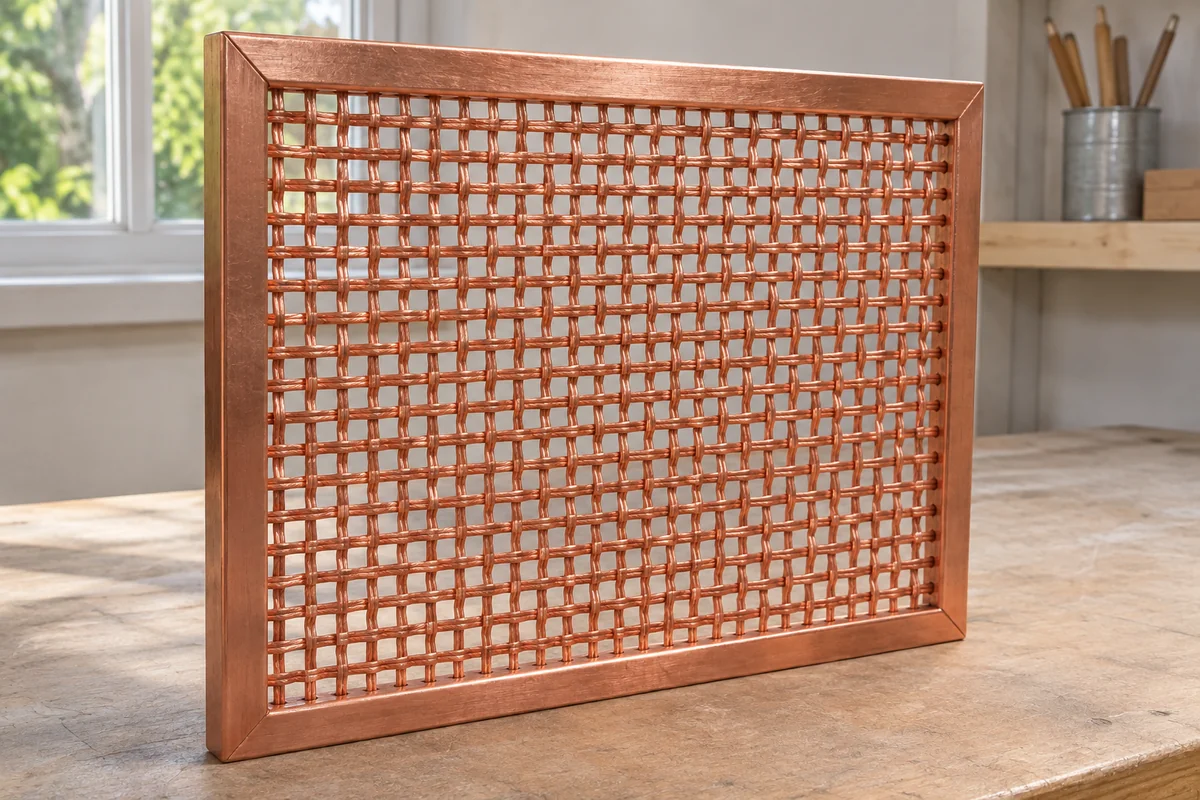
For an EMI or RFI enquiry, state the frequency range, required attenuation and the proposed enclosure. Include doors, seams, perimeter contacts and cable or ventilation penetrations in the review. Specify how electrical continuity and bonding are to be achieved. Safety earthing requirements also need to be addressed by the responsible electrical designer.
Ask for evidence that matches the supplied material or finished assembly. Record the test method, sample or enclosure configuration, frequency range and result. A result for a complete enclosure cannot simply be assigned to a loose screen bought by the square metre.
IEEE’s P299 project scope concerns measurement of shielding enclosures and identifies test frequencies and pass/fail limits as inputs from the enclosure owner. At this research date, the page identifies P299 as an active standards-development project. It should not be presented as a completed product certification.
For an ordinary window or decorative screen, concentrate on aperture, edge capture, cleaning and the appearance under the intended lighting. A screen chosen for appearance should not acquire a shielding claim just because it contains copper.
Where copper mesh is useful, and what to check
Copper mesh is selected for several different reasons. The useful question is which property the application requires and how that property will be verified.
| Application | Start with | Additional check |
|---|---|---|
| Decorative screen or cabinet panel | Colour, weave, opening and support | Approved finish sample and expected weathering |
| Insect screening | Clear opening and wire durability | Target insect, perimeter gaps and attachment |
| Rodent-gap exclusion | Suitable knitted or purpose-made exclusion product | Retention, surrounding repair, drainage and inspection |
| EMI/RFI screen | Conductive material and enclosure design | Frequency-specific evidence for the required assembly |
| Filtration or separation | Aperture, support and process conditions | Chemical compatibility and the actual filtration requirement |
| Expanded conductive layer | Sheet thickness, strand and opening geometry | Application-specific electrical and mechanical requirements |
These uses do not make every copper mesh interchangeable. A soft knitted tube has no single fixed aperture after it has been compressed. A woven screen’s nominal aperture does not establish an absolute filter rating. Check the process and supporting structure before making either claim.
Does copper mesh rust or turn green?
Copper does not develop iron rust, but its surface can tarnish and form patina. Exposure conditions affect the colour and rate of change. An untreated copper screen should not be specified on the assumption that it will keep its original bright finish outdoors.
Darby Wire Mesh’s copper material information describes copper’s malleability, conductivity and natural patina, while also identifying chemical environments that can attack it. A general corrosion-resistance claim therefore needs the service conditions attached.
For visible work, approve a sample that represents the intended finish. Decide whether fingerprints, colour variation and weathering are acceptable. If a clear finish or other treatment is proposed, confirm its compatibility with the mesh and any electrical contact requirements.
Review contact with dissimilar metals where moisture may be present. Specify compatible frames, fixings and isolation details as appropriate. Cleaning should follow the material and finish supplier’s instructions; an aggressive cleaner can change the appearance or affect a coating.
Copper mesh versus stainless steel mesh
Choose copper when its conductivity, formability or colour serves the specification. Consider stainless steel when the job instead calls for a stainless screen or a coordinated fence and railing system. Compare complete products of known dimensions and material; the material name alone cannot rank strength or service life.
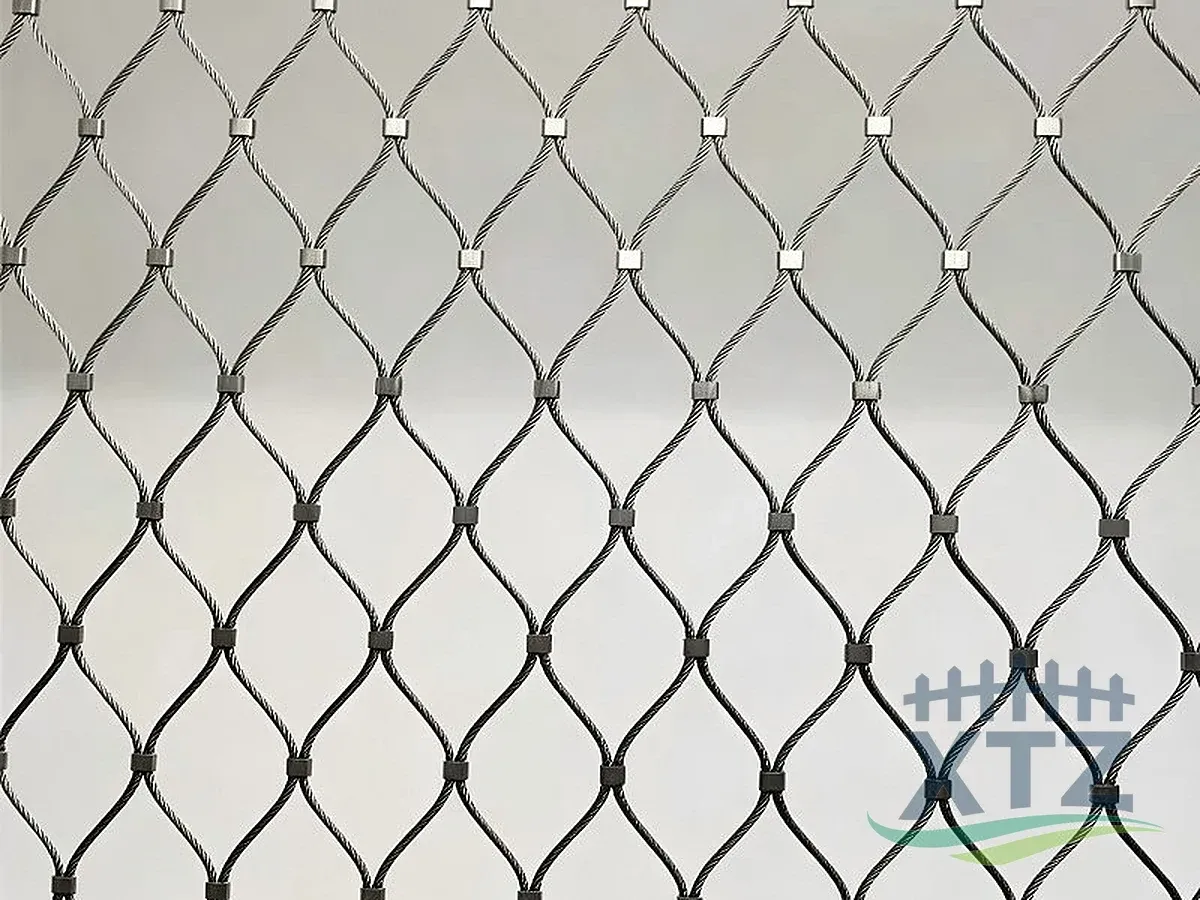
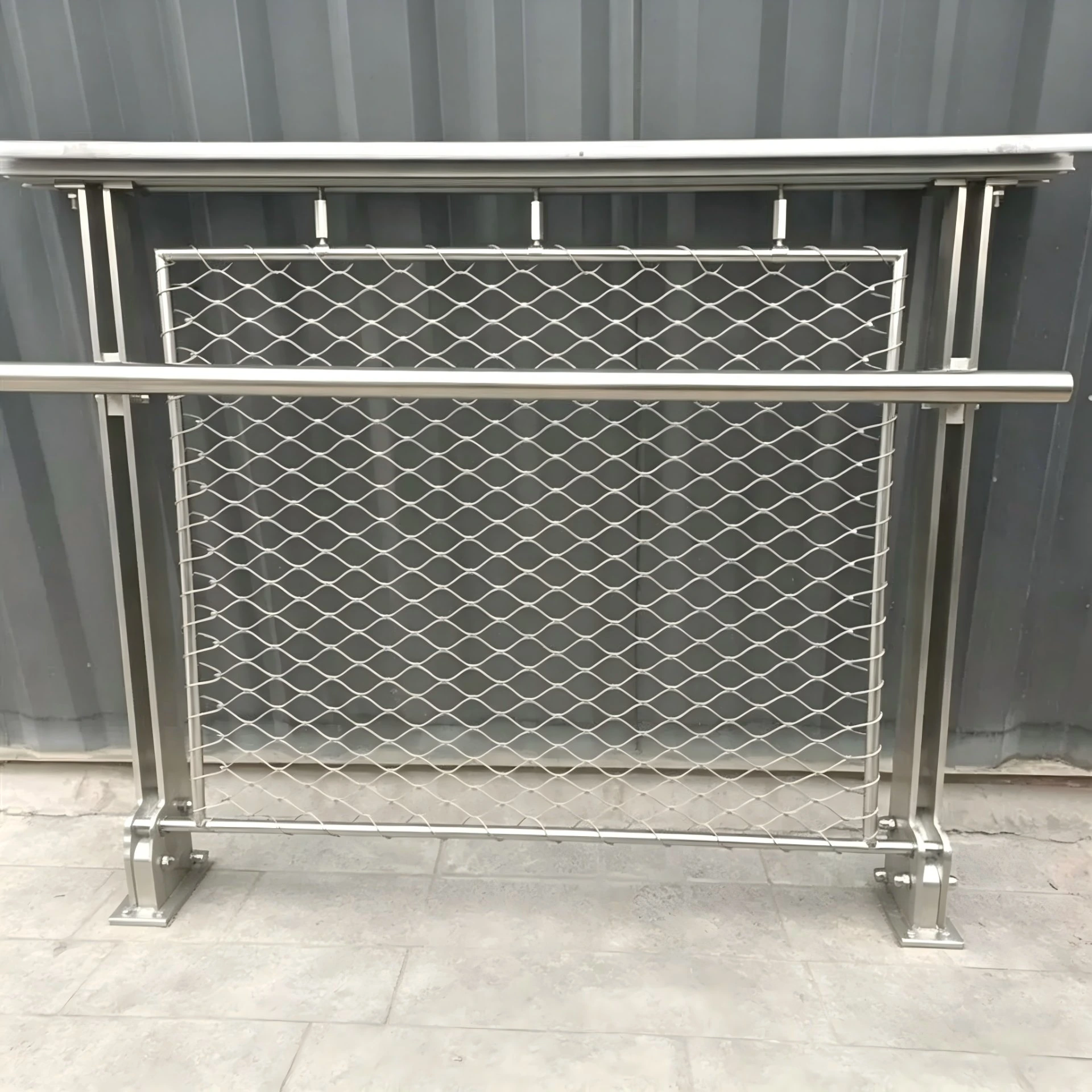
For architectural screens, XTZ Fence offers decorative stainless steel mesh in project-sized forms. Review the pattern, openness, panel direction and perimeter support when comparing that alternative with copper.
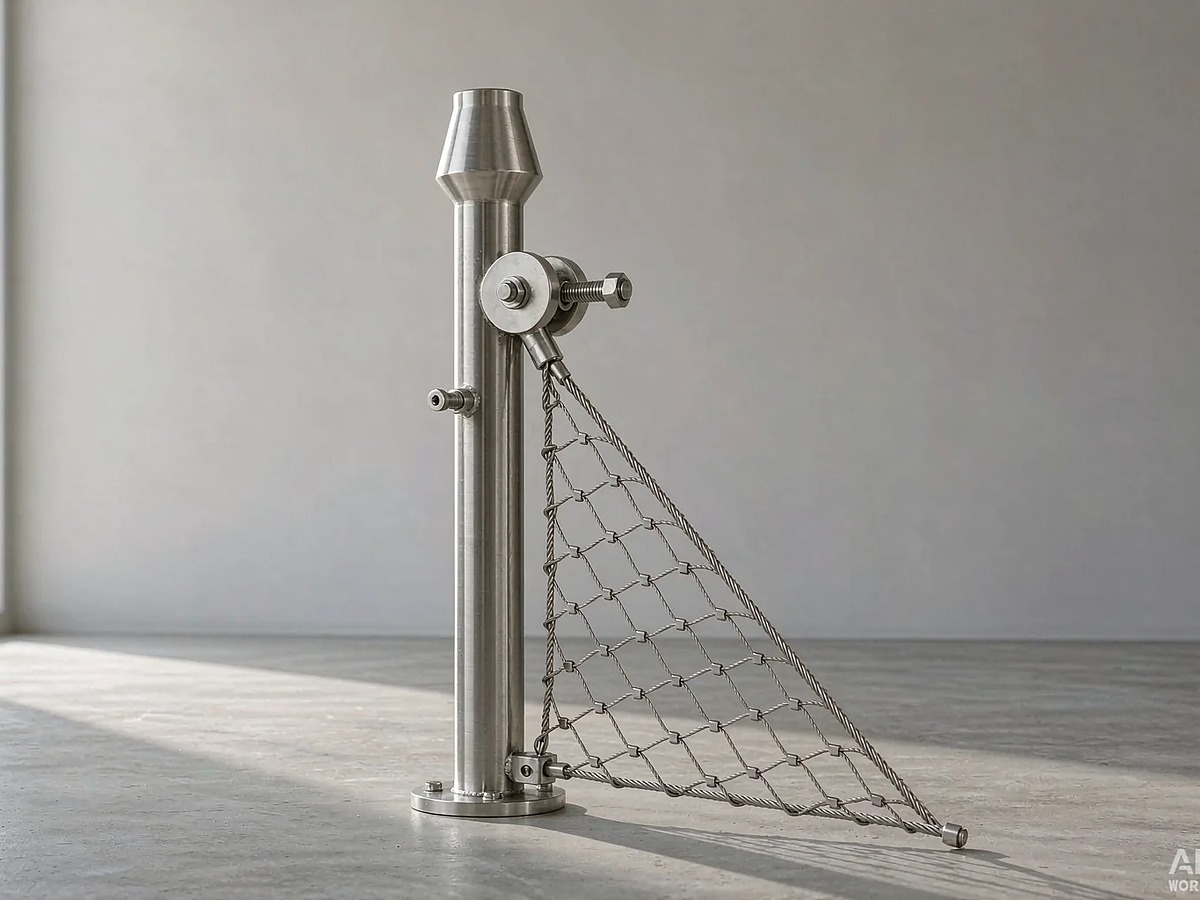
For flexible diamond-pattern infill, XTZ’s stainless steel cable mesh is available in ferrule and interwoven constructions. Where a project requires stainless steel mesh railing, evaluate the framed system, connections and installed geometry against the design requirements. Those products serve different duties from fine copper screening or a compressed rodent-gap filler; their opening sizes must be checked independently.
Copper mesh buying checklist
Send a supplier enough information to quote the actual material and finished form:
- Purpose and exposure: screen, exclusion filler, conductive layer or another defined use; indoor or outdoor conditions.
- Material identity: copper grade or composition, including whether any plating or coating is present.
- Construction: woven, knitted or expanded, with the relevant geometry and measurement convention.
- Dimensions: usable width, length, cut-piece size, orientation and tolerances.
- Edges and installation: retained, bound, framed or otherwise finished; proposed contact materials.
- Acceptance evidence: sample, material record and any application-specific test report.
Compare the price per usable area for flat screen products, allowing for cuts and offcuts. For knitted mesh, supplied width and length need to be considered alongside how the product will be packed and retained. A roll-price comparison across the two constructions is unlikely to describe the same amount of useful work.
If your project calls for a stainless alternative, send XTZ Fence the application, opening requirements, dimensions and mounting detail for a product-specific quotation.
Copper mesh FAQ
Is copper mesh the same as copper wool?
The terms are sometimes mixed in retail listings. Woven copper mesh has defined crossing wires; knitted mesh has interlocking loops. Products sold as copper wool or gauze may have a different wire or fibre construction. Request a close photograph, composition and construction description, particularly when you need a controlled opening or a compressible filler.
Will copper mesh keep mice out?
A suitable copper exclusion product can be part of a repair, but the finished opening and retention determine whether a route remains. Check around and behind the filler and inspect it after installation. The CDC’s guidance emphasises sealing entry points with durable materials. Avoid treating loose copper mesh as a guaranteed solution for every gap.
What copper mesh size is best for EMI shielding?
There is no single best mesh size for all shielding work. Define the frequencies, required attenuation, enclosure layout and test method first. Apertures, seams, doors and penetrations need to be assessed together. Ask for evidence applicable to the material and assembly being supplied instead of inferring performance from mesh count or copper purity alone.
Is copper-coated mesh equivalent to solid copper mesh?
It should be treated as a separate product. The core material, copper layer, exposed cut ends and manufacturing process affect the specification. Ask for the actual composition and coating details. A copper-coloured photograph does not verify solid copper, and a solid-copper material claim does not establish any particular shielding or corrosion performance.
Can copper mesh be used outdoors?
It can be used in appropriate outdoor applications, with weathering and exposure considered. Expect untreated copper to change colour. Check the surrounding materials, water exposure, fixings and cleaning access. For decorative work, agree on the expected finish; for a technical screen, specify the relevant performance and inspection requirements rather than a fixed lifespan.
How do I cut and fit copper mesh?
Use a tool appropriate to the actual wire or strand thickness and follow the supplier’s instructions. Support fine woven mesh to limit distortion, protect hands and eyes, and finish exposed cut edges. Confirm the frame allowance before cutting. A knitted filler and an expanded sheet need different handling, so identify the construction first.
Further reading and related topics
For a related weave construction, read about crimped woven wire mesh. Further topics include Galvanized Hardware Cloth: Sizes, Gauges and Buying Guide, Copper Mesh vs Stainless Steel Mesh for Screens and How to Specify Mesh Open Area Without Confusing Pitch and Aperture.
Sources
- CDC: how to seal up to prevent rodents: entry-point inspection and durable repair materials.
- IEEE SA: P299 project: enclosure measurement scope and project status.
- Darby Wire Mesh: copper wire mesh: material characteristics and woven-screen specifications.
- CThru Metals: expanded copper foil: slit-and-stretched construction.