A hardware cloth chicken run gives hens outdoor space behind a small-opening metal barrier. Its protection depends on the mesh, frame, roof, gate and ground connection working together. Choose the opening and wire diameter for the animals you need to exclude, then plan how every edge will stay attached and accessible for inspection.
Hardware cloth vs chicken wire for a chicken run
Welded hardware cloth has straight wires joined at their crossings. Ordinary chicken wire has a lighter, flexible hexagonal construction. Chicken wire can contain a flock, but its large openings and light construction can leave routes for small predators, reaching paws or damage at unsupported edges.
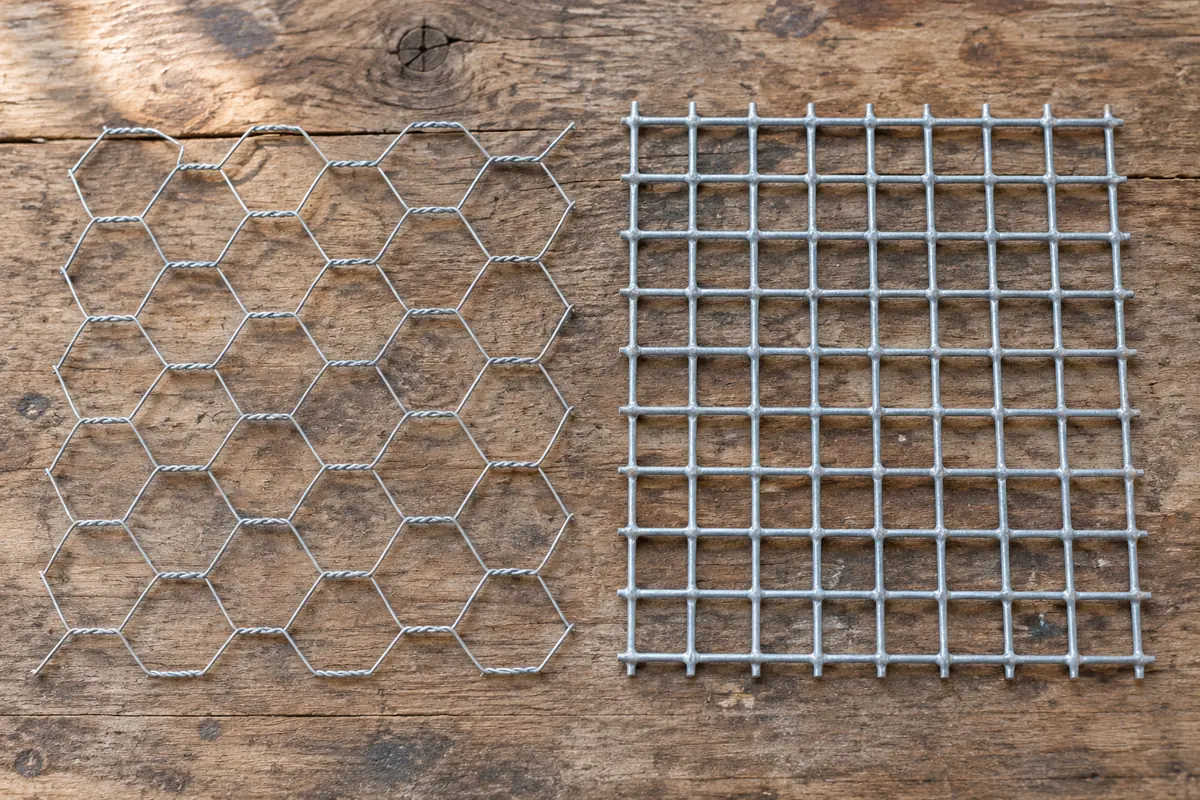
Penn State Extension’s enclosure guidance identifies hardware cloth as the stronger choice and treats the walls, roof and ground perimeter as parts of the same enclosure. A robust mesh roll still needs a sound supporting structure. Replacing the wire while leaving a sagging gate or rotten bottom rail preserves an entry point.
| Material | Useful role | What needs separate attention |
|---|---|---|
| Hexagonal chicken wire | Flock containment and some temporary garden barriers | Opening size, light wires, edge damage and predator access |
| Welded hardware cloth | Small-opening walls, doors and protected openings | Wire diameter, weld condition, frame attachment and corrosion exposure |
| Heavy welded fence panel | A rigid outer barrier or supported enclosure component | Large openings may require a separate fine-mesh layer |
| Bird netting | An overhead deterrent for selected aerial threats | Climbing animals, tears, entanglement and the limits of the supporting frame |
Choose the mesh opening and wire diameter separately
Ask for the clear opening, the actual wire diameter and the construction. A name such as “half-inch hardware cloth” does not fully describe the product. Confirm whether the dimension means the empty opening or the spacing from one wire center to the next.
Half-inch and quarter-inch products are common options to compare. Smaller openings can address smaller entry routes, but a fine grid made with thin wire may deform more easily than a heavier product. The bird’s age, local wildlife, reach-through risk and support spacing all affect the choice. An opening size alone does not establish exclusion of every snake, weasel or rodent.
Gauge is incomplete without its gauge system. Obtain the diameter in millimeters or decimal inches, together with the permitted variation. When comparing wire mesh sizes, record the opening and wire thickness in separate fields. Two listings with similar photographs can describe substantially different meshes.
Inspect a sample before buying a large quantity. Check that crossings remain joined during normal handling, the grid is reasonably consistent and cut edges can be retained without leaving sharp projections. A hand inspection can reveal obvious defects; it does not establish a laboratory strength rating.
Plan the walls, roof, gate and ground as connected zones
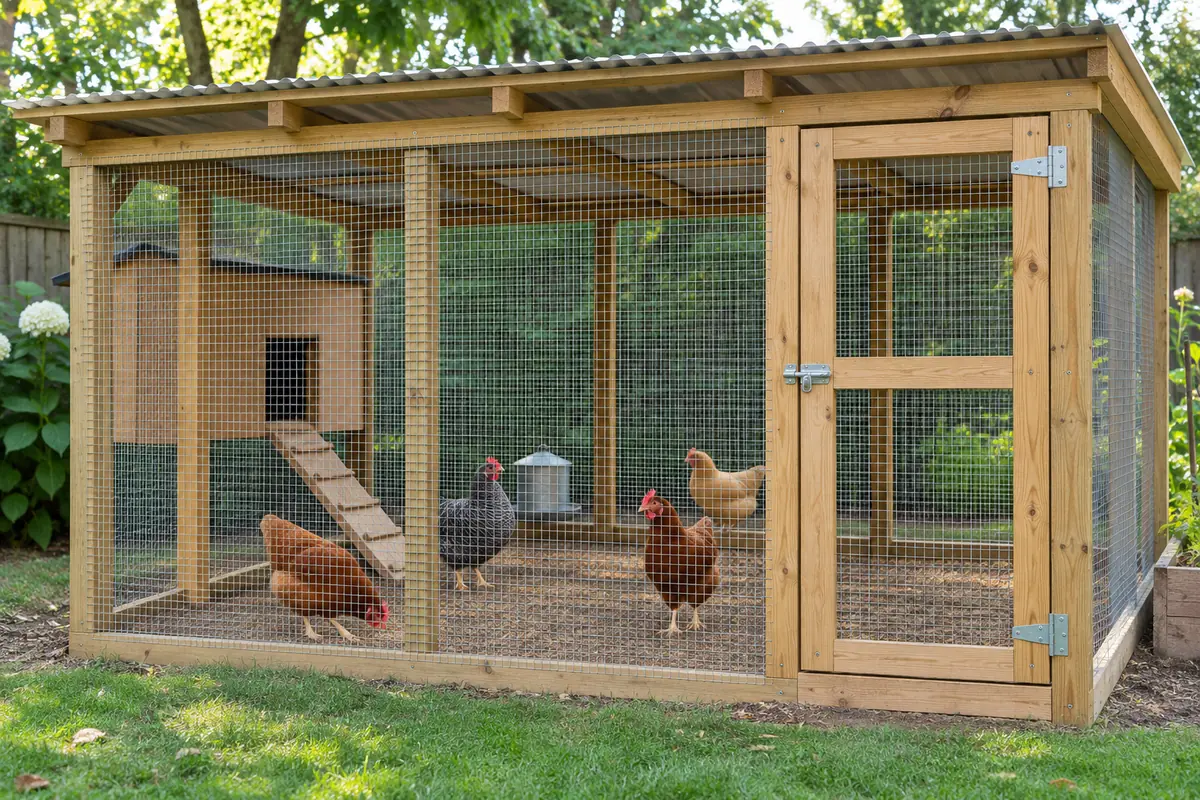
Sketch the complete enclosure before estimating mesh. Mark the ground line, door swing, coop connection, changes in level and every service opening. A continuous barrier must continue through those transitions.
| Run zone | Selection question | Detail to inspect |
|---|---|---|
| Walls and corners | Can the opening and wire withstand the expected access attempt? | Supported joins, restrained edges and continuity around posts |
| Roof and eaves | Does the cover address climbing animals as well as birds? | Gaps under roof sheets, roof-to-wall junctions and weather loads |
| Gate | Will the frame remain square and close consistently? | Hinge edge, latch edge, threshold and a secured latch |
| Ground perimeter | How will digging and uneven ground be addressed? | Continuous return or apron, corners and gate transitions |
| Coop and service openings | Can an animal bypass the main run wall? | Connection to the coop, ventilation openings and pipe routes |
A solid roof can provide weather protection and an overhead barrier, but it also needs framing suited to local wind and snow. Mesh is not a substitute for roof structure. At the eaves, leave the intended ventilation path while closing animal access with the selected screen and retention detail.
Fix hardware cloth to the frame without loose edges
Restrain the wire edge along a sound supporting member. On a timber frame, screws with suitable washers or a screwed timber batten can spread the hold over more wire than a small isolated fastening. Choose corrosion-compatible hardware and enough engagement in sound timber.
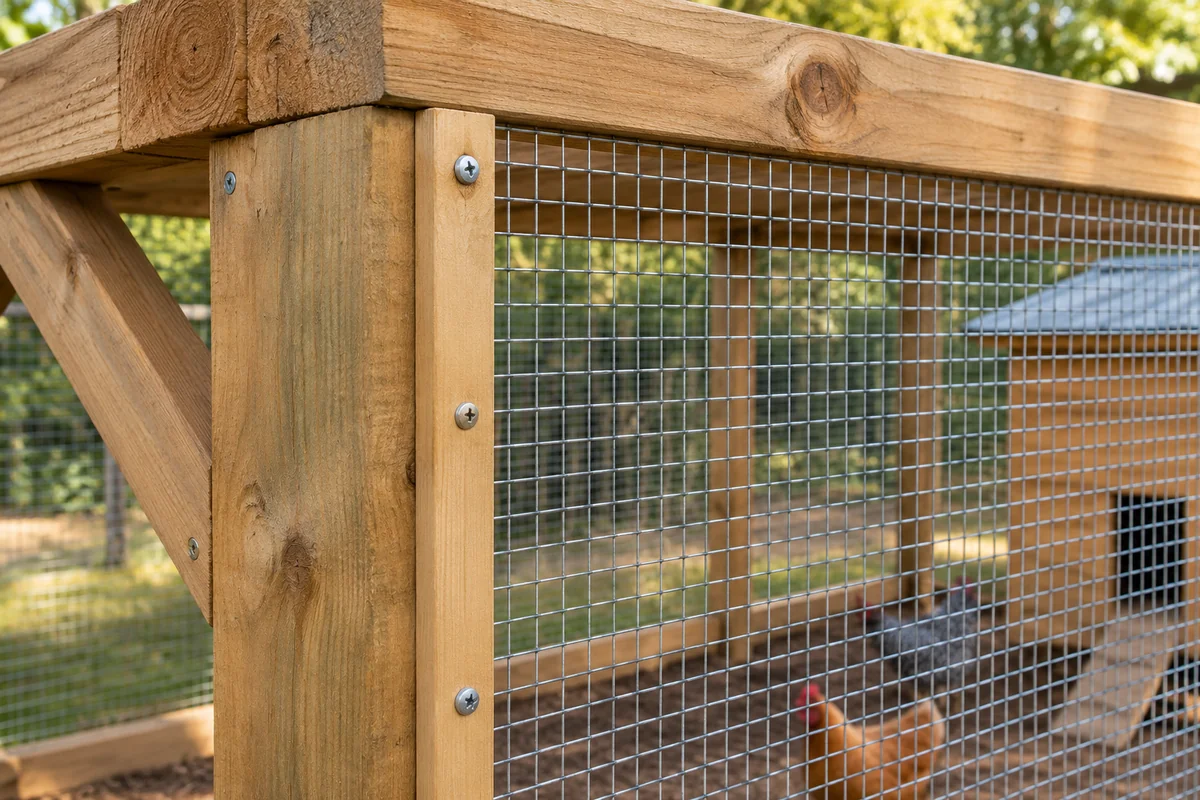
Join mesh sections over framing where practical. Overlapping two loose sheets without supporting their joint can leave a flexible flap. A lap dimension alone says little about security if the two layers can pull apart. Determine the overlap and fastening arrangement together, using the selected mesh and frame.
Before birds enter, run a visual and gloved-hand check along the inside perimeter. Cover or retain cut ends, remove wire offcuts and check that no opening can catch a bird’s head. Penn State’s poultry housing guidance discusses sharp edges, secure screening and bird injury alongside predator protection. It also emphasizes access for cleaning and normal husbandry.
Small craft staples, temporary ties and a few widely spaced fixings deserve particular scrutiny. Their suitability depends on the fixing, substrate and expected force. Use an attachment detail that remains secure when the mesh is pushed and pulled during a controlled inspection.
Keep the digging barrier continuous beneath gates and corners
Ground protection can involve buried mesh or a planned outward return. Soil, roots, buried services, drainage and the animals present influence the detail. A continuous return that stops at the gate still leaves an unprotected strip.
The University of Maryland’s poultry predator guidance describes a buried fence with an outward turn. Its dimensions belong to that published arrangement; they should not be mixed casually with a shallow surface apron from another design. Resolve one complete perimeter detail for the site.
At a corner, show how the pieces cover the outside area without an open diagonal slot. At the gate, check both the closed threshold and the ground beneath it. Inspect again after heavy rain, digging activity or landscaping work that disturbs the edge.
Keep normal bird walking areas comfortable and maintainable. An exposed wire floor is a different husbandry decision from a perimeter digging barrier. Do not lay sharp or damaged mesh where birds must stand on it.
Calculate mesh quantities with corners and cut layout included
Calculate walls, ground protection and any mesh roof separately. Deduct an opening only if that opening will not need mesh elsewhere. A mesh-covered gate consumes material too.
For an estimating example, take a rectangular run 3 m wide, 4 m long and 2 m high, with four mesh walls and a solid roof. Suppose its chosen design includes a continuous 0.5 m outward apron. These are hypothetical takeoff dimensions, not a recommended predator-barrier specification.
| Component | Calculation | Net area |
|---|---|---|
| Walls, including the mesh-covered gate | 2 × (3 + 4) × 2 | 28 m² |
| Apron including four outside corners | (3 + 2 × 0.5) × (4 + 2 × 0.5) − 3 × 4 | 8 m² |
| Total mesh before laps and cutting losses | 28 + 8 | 36 m² |
| Illustrative 10% estimating allowance | 36 × 1.10 | 39.6 m² |
Multiplying the 14 m perimeter by the 0.5 m apron width gives only 7 m². It misses 1 m² across the four outside corner squares. If a mesh roof is also needed, its 12 m² must be added before applying a suitable allowance.
Turn the area estimate into a cutting layout before ordering. Roll width, vertical sheet height, seam locations and reusable offcuts determine how many rolls are required. A nominal 40 m² roll does not guarantee that a 39.6 m² takeoff can be cut from it. Obtain a price for the actual roll or panel schedule.
Compare material, coating and supply scope before ordering
Galvanized hardware cloth uses a zinc coating on steel. Stainless mesh relies on the specified stainless alloy for its corrosion resistance. They are different material routes. Ask when a zinc coating is applied relative to welding and inspect the crossing areas and cut edges.
Outdoor moisture, washdown, soil contact and the retention detail can affect service conditions. Avoid a blanket “rustproof” promise or a fixed lifespan from a material name alone. Replace or repair mesh that has broken welds, damaged wires or corrosion that compromises the barrier.
For a custom stainless component, discuss the required opening, diameter, panel size, edges and support conditions with a stainless steel welded wire mesh manufacturer. Confirm the actual supply scope: mesh only, cut panels, framed components and complete installed runs involve different responsibilities.
Inspect the enclosure before use and after damage
- Check the material label against the ordered opening, diameter and finish.
- Inspect welds, corners, seams and every retained cut edge.
- Close the gate and inspect its full perimeter from both sides.
- Check the roof junction, ground return and connection to the coop.
- Remove sharp scraps and verify cleaning, feed and water access.
- Record damage and repairs so that repeat weak points are visible.
Close and secure the housing at night and manage spilled feed. The backyard poultry Extension resource combines fencing improvements with husbandry precautions. Mesh selection is one part of that routine.
Hardware cloth chicken run questions
Is half-inch hardware cloth enough for every chicken run?
It is a common option, but opening size alone cannot establish protection. Confirm the actual clear opening, wire diameter, welds and attachment, then consider the birds and local predators. Small chicks, small entry routes, reaching animals and damaged frames can change the design. Check gates and ground transitions as carefully as the main walls.
Should I choose 19-gauge or 16-gauge wire?
Compare the actual wire diameters under the stated gauge system. A thicker wire generally resists deformation better in an otherwise similar mesh, but welds, openings and frame support still matter. Ask suppliers for diameter, construction and tolerances. Do not assume that a gauge number alone qualifies a run against a particular predator.
Does the top of the run need hardware cloth?
The top needs a barrier suited to the risks and to its supporting structure. A properly detailed solid roof can provide overhead protection and weather shelter. A mesh top has different weather and loading implications. Bird netting may address selected aerial threats while leaving climbing animals or tears unresolved. Inspect the entire roof-to-wall junction.
Can I fasten hardware cloth with staples?
The answer depends on the staple and the supporting material, but small temporary staples are a poor basis for an attachment expected to resist pulling. Screwed washers or retaining battens provide practical options for timber frames. Select a complete fastening arrangement, check substrate condition and inspect every seam. No single fixing spacing suits all meshes and frames.
How much extra mesh should I buy?
Start with a cutting schedule that includes gates, returns, outside corners, joins and any mesh roof. Add an allowance appropriate to the actual roll widths and planned cuts. The example here uses 10% only to show the arithmetic. Awkward dimensions or numerous overlaps may require more material, while reusable offcuts can reduce waste.
Can stainless cable mesh replace hardware cloth for chickens?
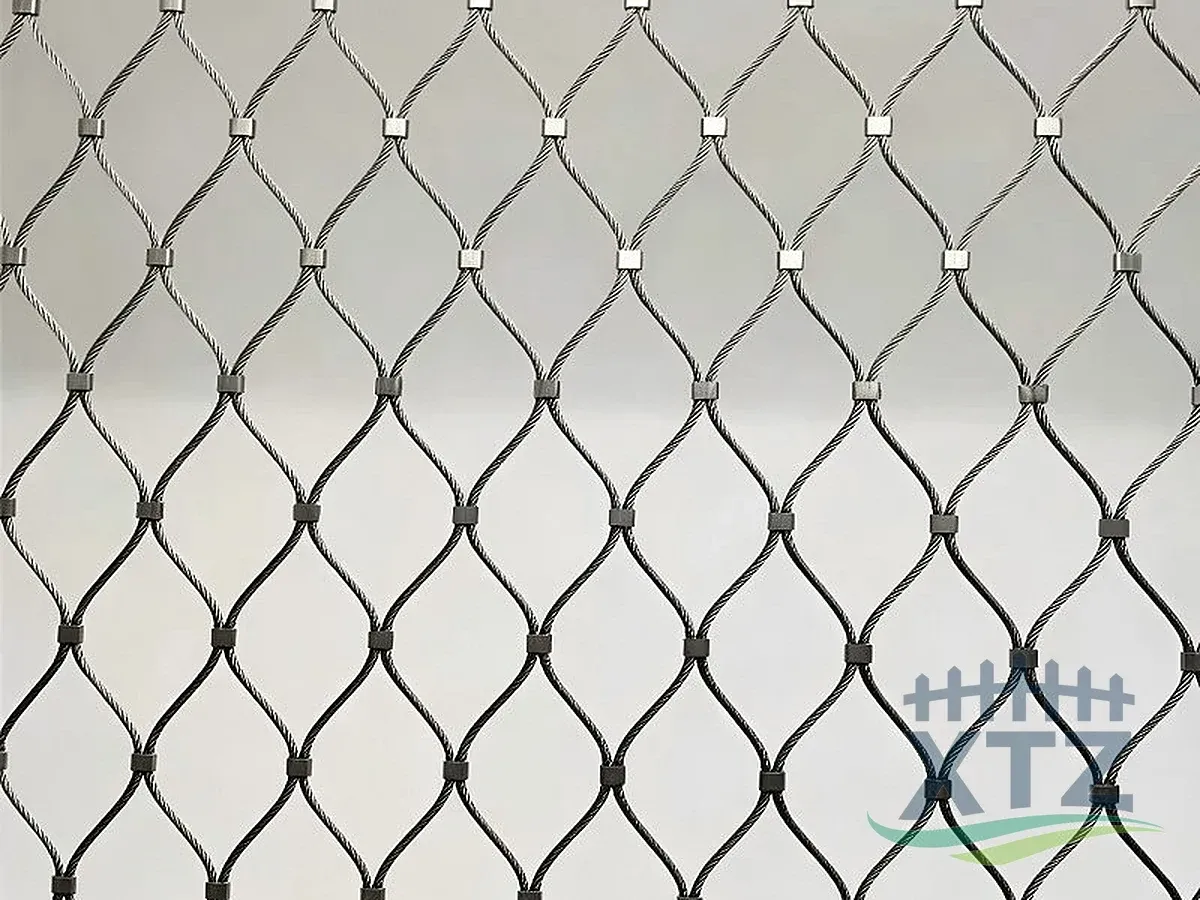
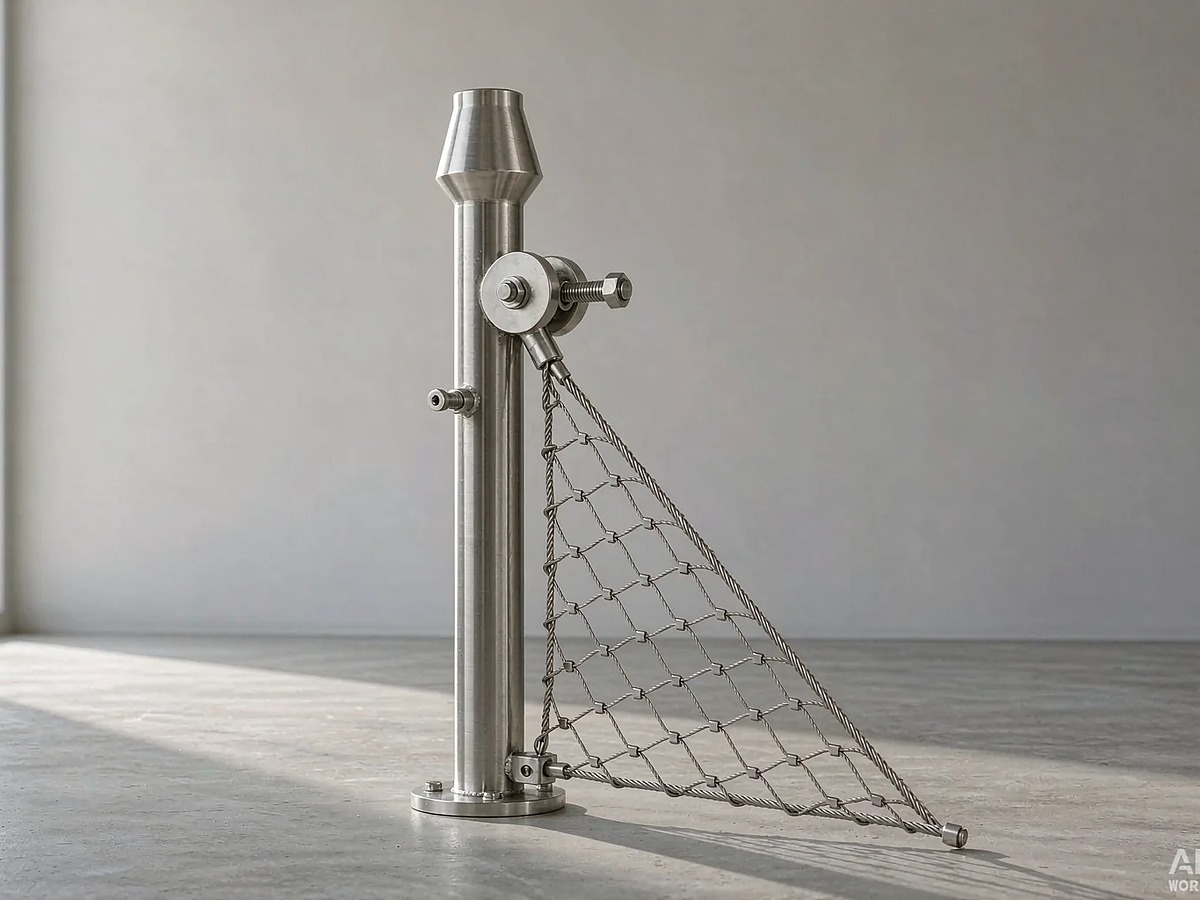
Do not make the substitution from the material name. Flexible cable mesh has different opening geometry and edge tensioning. A panel suited to a larger aviary or architectural enclosure may leave openings unsuitable for chickens or the predators present. Specify the required animal barrier first, then check the complete mesh and frame system for that use.
Discuss separate mesh scopes with XTZ Fence
For a stainless mesh enquiry, send the site exposure, animal and predator concerns, required clear opening, wire diameter, finished dimensions, quantity and fixing sketch. Include photographs of existing frames if the work is a repair.
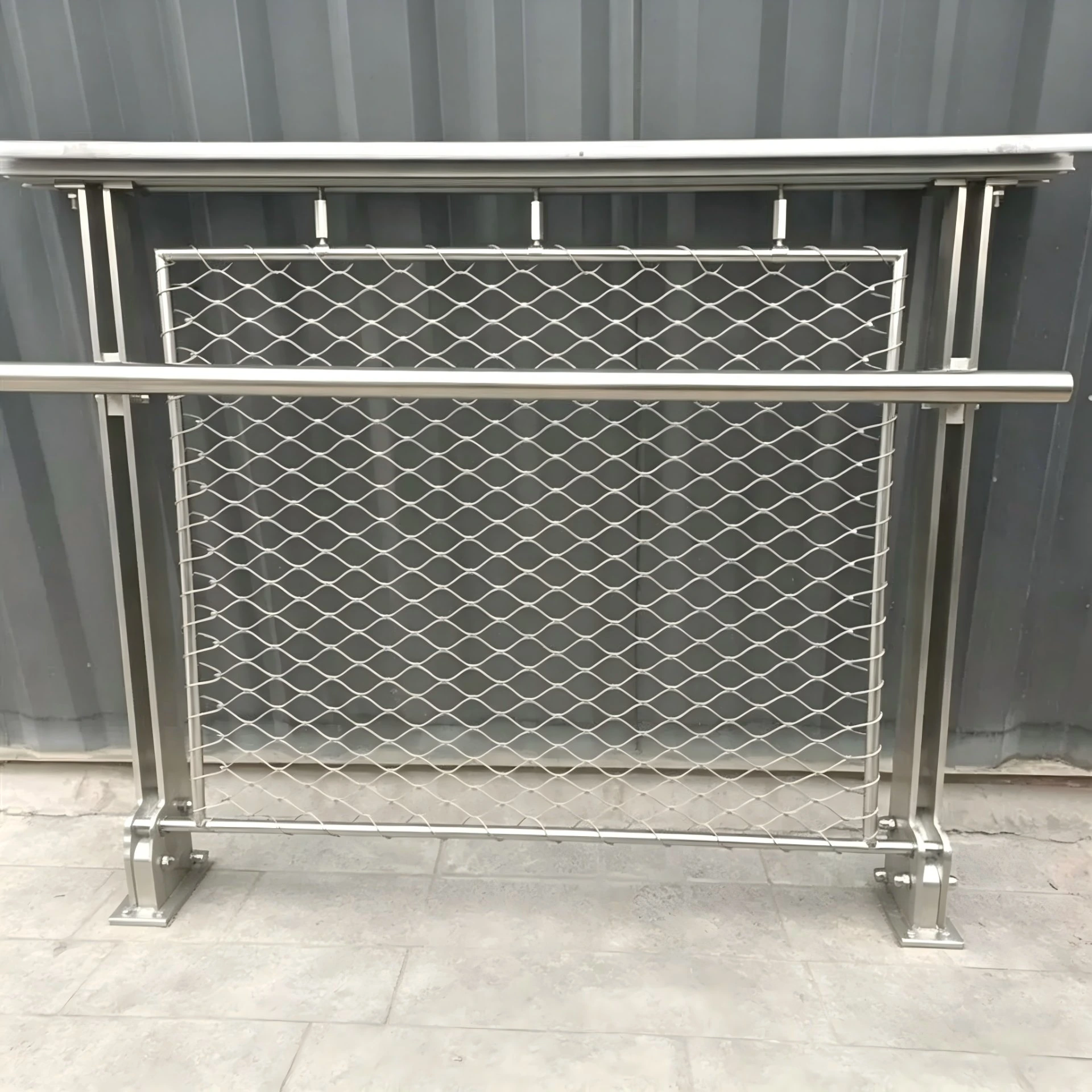
Where a wider project also includes a larger enclosure or architectural barrier, XTZ Fence’s stainless steel cable mesh is a separate flexible infill option. Its stainless steel mesh railing range also requires coordinated supports and connections. Specify those systems separately from fine chicken-run screening.
Further reading and topics to explore
XTZ Fence’s existing Galvanized Hardware Cloth: Sizes, Gauges and Buying Guide covers the underlying mesh specification. Useful follow-up topics include calculating rolls from a panel cutting plan, checking gate gaps after timber movement and comparing buried returns with surface apron details for a specific site.