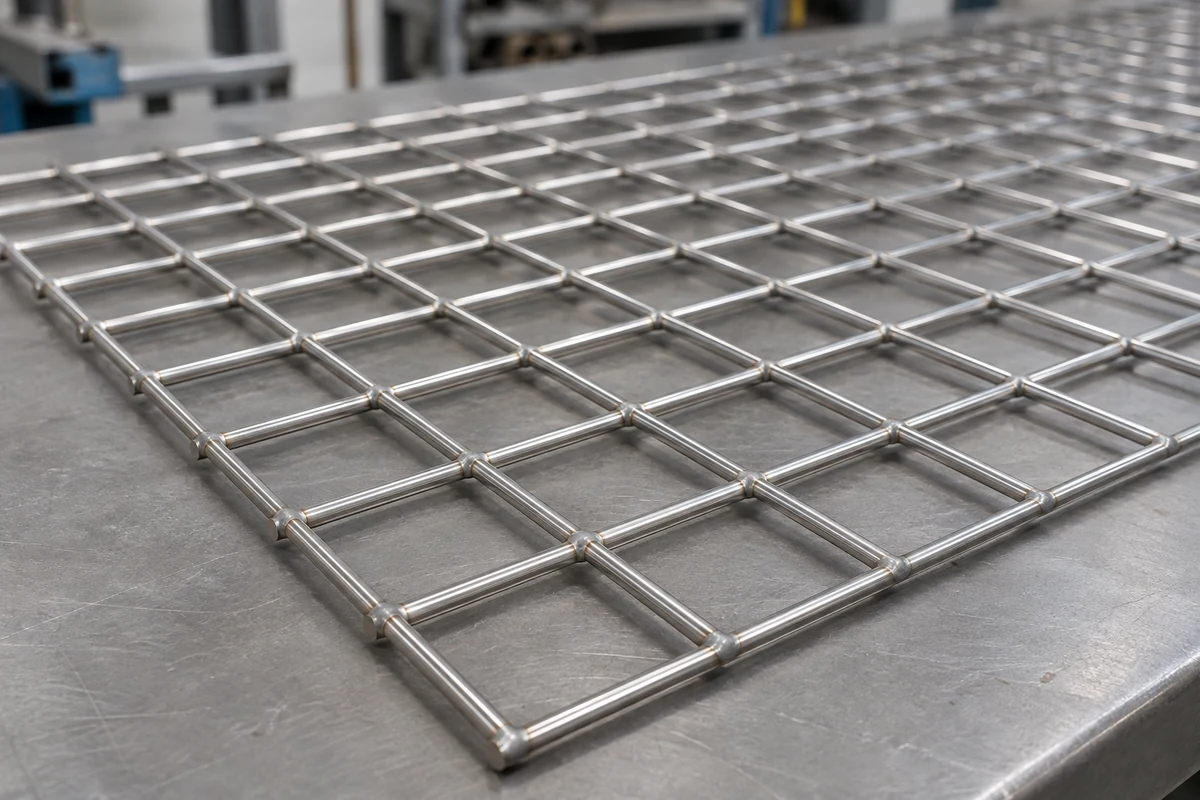
Welded wire mesh is a grid of wires joined at their intersections, usually by electric resistance welding. Select it by the job it must perform, then specify material, wire diameter, opening or pitch, finished dimensions and edge condition. A mesh size alone leaves too much of the purchase undefined.
How is welded wire mesh made?
Longitudinal wires and cross wires are positioned at right angles. Resistance welding joins the contacting wires under pressure, fixing their relative positions. The resulting grid can be supplied as a flat panel or, for suitable specifications, a roll. Wire size and construction govern how flexible the finished mesh feels.
The term welded wire fabric also appears in purchasing and technical descriptions. For concrete construction, welded wire reinforcement, or WWR, identifies a reinforcement product with its own material and mechanical requirements. A visually similar industrial screen should not be assumed to satisfy a concrete reinforcement specification.
Welded intersections make fabrication convenient because the grid does not depend on an interlaced weave to remain together. The panel still needs suitable supports and edges. Cutting through wires, bending a panel or attaching it to a frame can change the finished component’s behavior.
Welded wire mesh specifications: opening, pitch and wire diameter
State whether the quoted mesh dimension is the clear opening or the center-to-center spacing. They describe different distances. The McNICHOLS specifying guide treats opening, material, construction, dimensions and trim condition as separate ordering decisions.
| Item | What to put on the order | What an incomplete description misses |
|---|---|---|
| Material | Alloy or steel designation and required documentation | “Steel mesh” does not identify the material grade |
| Wire size | Diameter in millimeters or decimal inches, in both directions | Gauge names vary; the two wire directions can have different diameters |
| Grid geometry | Clear aperture or center spacing, with the measurement basis stated | “25 mm mesh” can describe different clear openings |
| Finished format | Roll width and length, or panel width and height | Nominal stock size does not define a cut component |
| Edges | Trimmed, equal tails or another dimensioned termination | Wire projections can interfere with a frame or fixing |
| Finish | Coating or surface treatment, with the process and acceptance requirements | Color alone does not identify coating thickness or corrosion performance |
| Tolerances | Agreed limits for dimensions, grid spacing, shape and relevant tests | A sample photo supplies no measurable acceptance limits |
A worked example of clear opening and pitch
For straight parallel round wires of equal diameter, clear opening equals center-to-center pitch minus wire diameter. Consider an illustrative square mesh with a 25 mm pitch and 2.5 mm wires. Its clear opening is 22.5 mm. If the order instead requires a 25 mm clear opening with the same wires, the pitch becomes 27.5 mm.
The approximate projected open area of a regular square grid is (clear opening ÷ pitch)² × 100. The first example gives 81%; the second gives about 82.6%. These are geometry calculations for the stated examples, excluding frames, local weld shape and other obstructions. They do not establish airflow, impact resistance or load capacity.
For rectangular grids, calculate both clear openings separately and use the product of their opening-to-pitch ratios. The guide to wire mesh sizes develops the dimensional terminology further.
Which welded mesh material and finish fit the exposure?
Decide what the mesh will contact, where moisture can collect and how it will be cleaned or maintained. The cheapest uncoated panel and a finished stainless component represent different supply scopes.
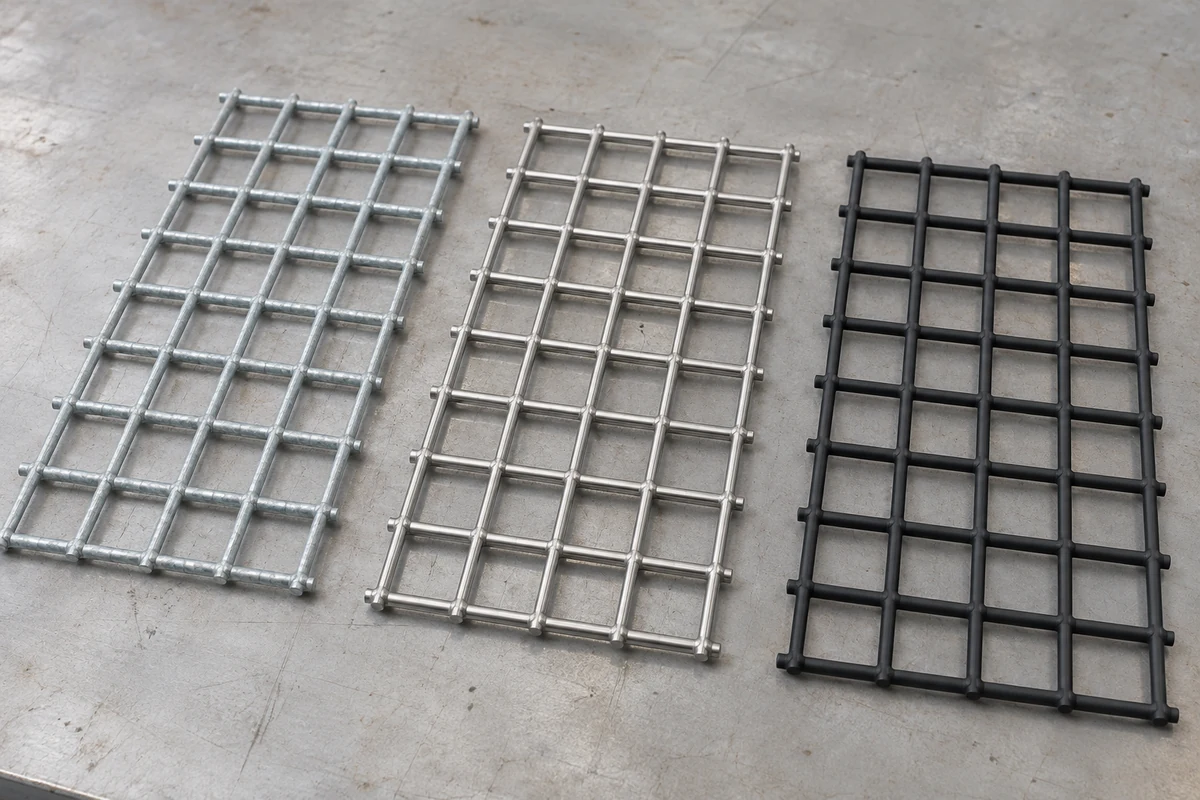
| Material or finish route | Questions for the specification | Inspection focus |
|---|---|---|
| Plain carbon steel | Will it remain indoors, be embedded in concrete or receive a later finish? | Specified wire properties, surface condition and the scope of subsequent treatment |
| Pre-galvanized wire welded into mesh | What protection is required at welds, ends and fabricated edges? | Coating continuity and the agreed treatment of locally affected areas |
| Mesh galvanized after welding | Which coating process and acceptance criteria apply to the completed mesh? | Coverage, buildup, clear apertures and the condition after handling |
| Stainless steel | Which grade suits the exposure and how will fabrication and cleaning be controlled? | Material records, surface condition and contamination from other metalwork |
| Polymer-coated mesh | What is the base wire, coating system and repair procedure? | Both the underlying wire size and the finished coated dimensions |
A coating changes the outside dimension of a wire. Ask whether a diameter refers to the steel core or the finished coated wire. A caliper reading over the coating cannot, by itself, establish the core size. Likewise, a bright surface does not prove a stainless grade.
For stainless rolls, sheets or cut components, XTZ Fence’s stainless steel welded wire mesh product page provides a starting point for a specification enquiry. Confirm the actual grade, opening, wire diameter and finished format for the order.
How to inspect welded wire mesh before accepting a delivery
Inspect against the approved drawing and purchase specification. Record the batch and the sampled pieces so observations can be traced back to the delivery. Agree on the inspection plan before production when dimensional or performance requirements are important.
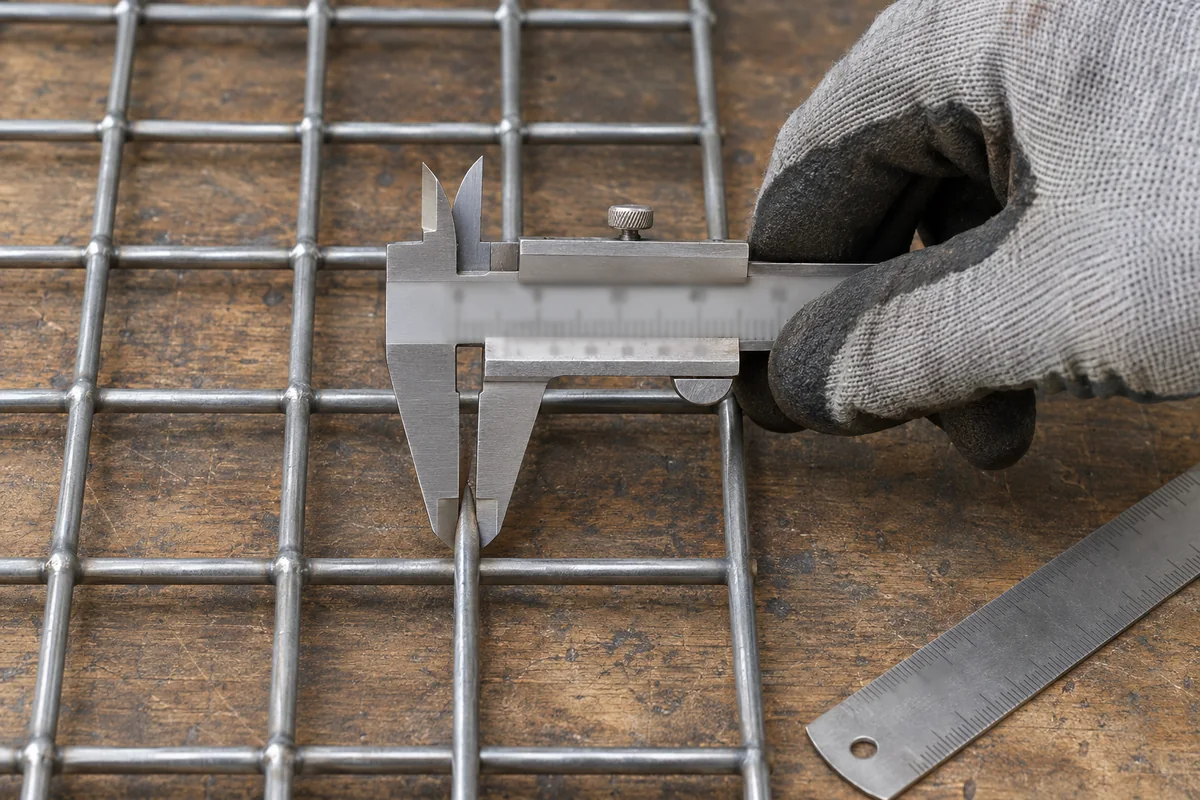
| Check | Practical method | Record or decision |
|---|---|---|
| Identity and quantity | Match tags, order references and supplied formats | Batch, material designation, piece count and drawing revision |
| Wire diameter | Measure representative straight segments away from welds | Readings in both directions and whether the coating is included |
| Aperture or pitch | Check edge and central locations using a consistent basis | Individual readings and observed variation |
| Panel dimensions and shape | Measure overall dimensions and diagonals; assess flatness without forcing the panel straight | Comparison with the agreed dimensional and shape limits |
| Weld condition | Look for loose crossings, missing joints and visibly damaged wires | Locations for review and any required mechanical test reports |
| Edges and finish | Check wire projections, sharp ends, handling damage and surface condition | Acceptance, repair or segregation under the agreed procedure |
Visual inspection can find obvious defects. It cannot certify weld shear strength, wire tensile properties or coating performance. Where these matter, specify the test method, sampling and acceptance criterion. A panel that looks straight can still lack the documentation required for its application.
Measure plain round wire with a suitable calibrated instrument and avoid the enlarged weld zone. The WRI nomenclature guidance explains the mass-based nominal area assessment for deformed reinforcement wire. A caliper across its ribs is not a substitute for that material verification.
Which standards apply to welded wire mesh?
Choose standards by the product’s function. One standard does not cover every screen, fence panel and reinforcing mat. The purchase order should name the applicable document, edition and any additional project requirements.
ASTM A1064/A1064M covers carbon-steel wire and welded wire reinforcement for concrete, including material, dimensional and mechanical requirements. It is not a general approval for stainless screens or any panel described as welded mesh.
ISO 14315 addresses technical requirements and testing for industrial wire screens. Confirm the scope of any proposed standard against the actual screen. Fence systems, machine guards and other assemblies can also have application-specific requirements beyond those for the mesh itself.
Do not treat a supplier’s certificate for its quality-management system as a batch test result. Ask for the records that identify the delivered material and the checks required by the order. No particular standard compliance should be assumed from a product name or catalog photograph.
Match welded mesh to the complete application
The surrounding assembly often determines the specification. Mesh inside a frame, mesh wrapped around a cage and reinforcement inside a slab encounter different loads and use different connection details.
- For guards and partitions, check the hazard, opening, panel supports, fixings and finished edges.
- For animal enclosures, identify the species, contact conditions and how the mesh is retained around the perimeter.
- For architectural infill, coordinate appearance, permitted openings, structural requirements and the frame connection.
- For screening, consider the particle or object being separated, wear, cleaning and the support beneath the screen.
- For concrete, follow the reinforcement schedule and specified WWR properties instead of selecting a general-purpose panel by appearance.
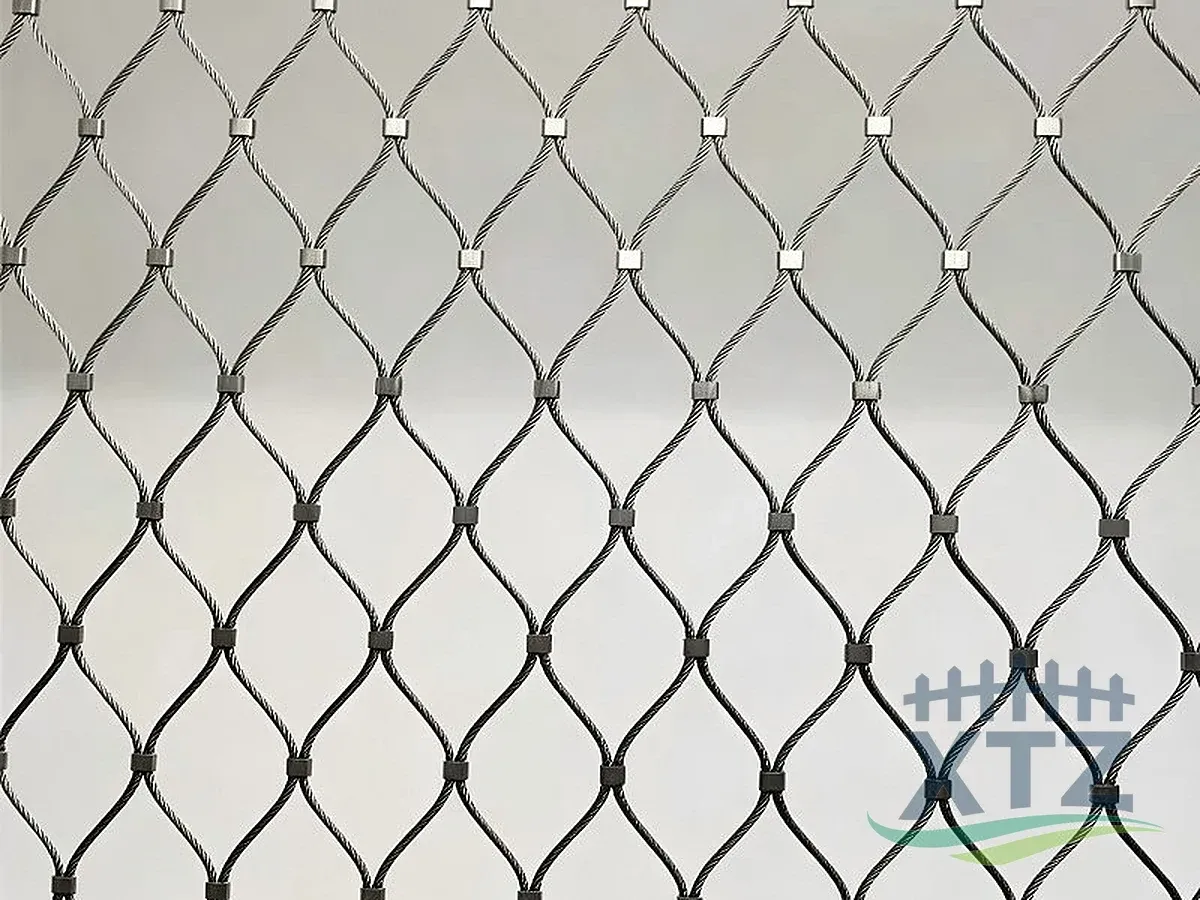
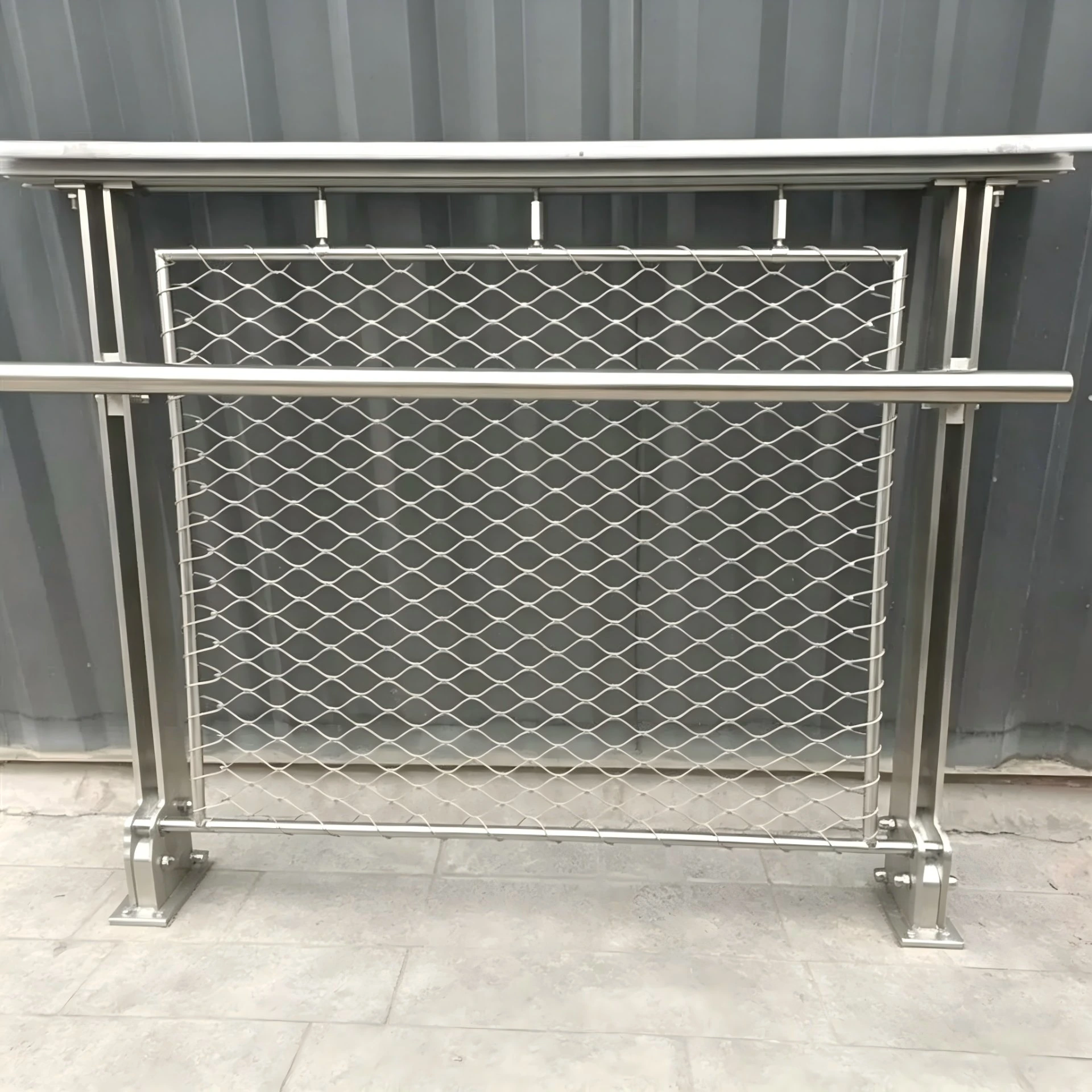
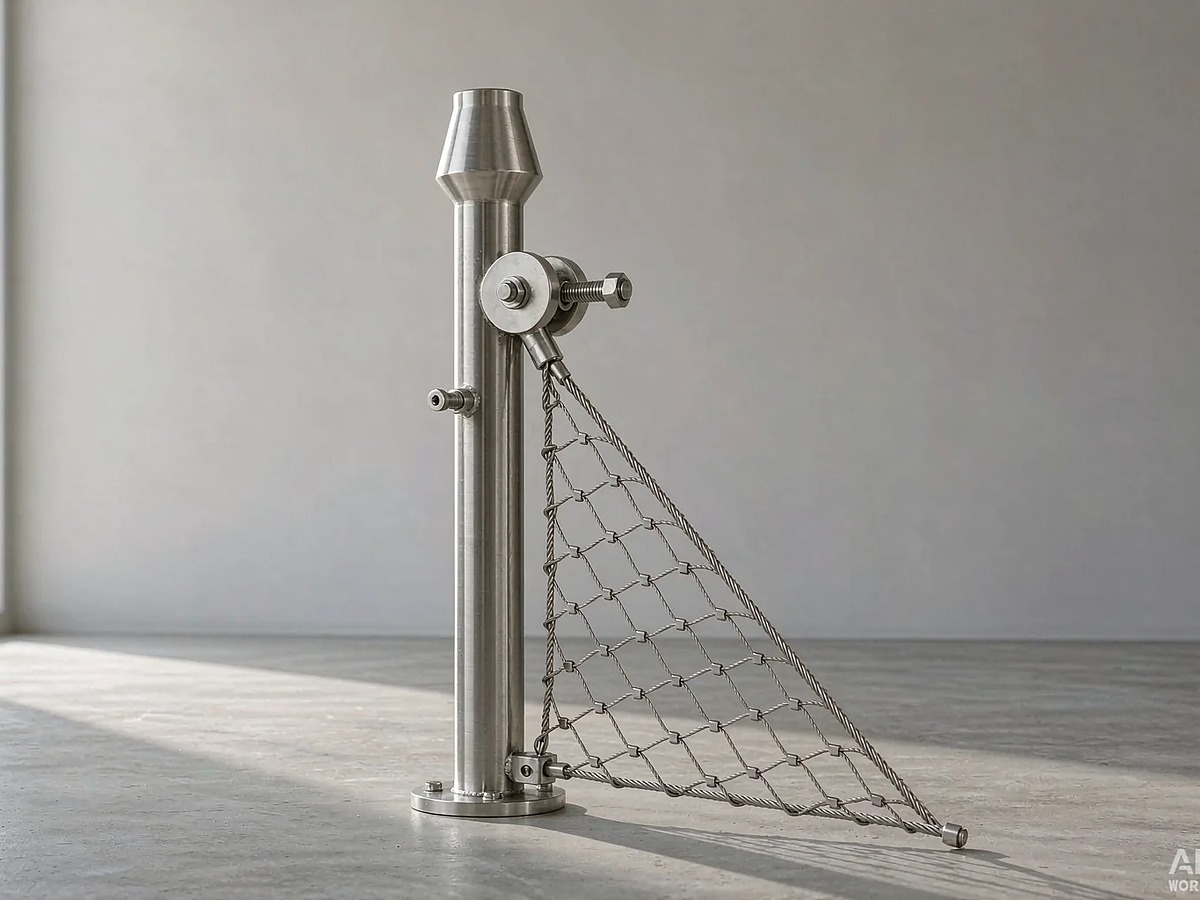
If a project calls for a flexible wire-rope infill rather than a welded grid, XTZ Fence’s stainless steel cable mesh is a separate construction family. Its stainless steel mesh railing options need to be specified with the supporting components. State the intended system clearly before comparing quotations.
A welded wire mesh quotation template
A useful enquiry can be short while still defining the finished item:
Application and service conditions: [describe]. Material and required records: [specify]. Grid: [clear openings or center spacings] in each direction. Wire diameters: [specify each direction and coating basis]. Finished panel or roll dimensions: [specify]. Edge termination and fixing sketch: [attach]. Finish, tolerances and inspection requirements: [specify]. Quantity, packing and delivery location: [state].
The bracketed fields are a form to complete for an actual enquiry. Include the drawing revision if one exists. Ask the supplier to identify exceptions in its quotation so a different wire size, edge or finish does not disappear inside a similar-looking product description.
Compare total finished cost: material, cutting, edge work, finishing, testing, packing and transport. A low price for a stock sheet can become a different figure after it is cut and prepared for a frame. Keep those operations consistent across the quotes.
Welded wire mesh questions
Is welded wire mesh stronger than woven wire mesh?
The answer depends on material, wire size, geometry, weld condition, supports and the kind of loading. Welded intersections fix the grid, which can help a panel retain its shape. Woven constructions have their own behavior and applications. Compare the required performance of the finished component rather than treating either construction name as a strength rating.
Does 25 mm welded mesh mean a 25 mm clear opening?
It can mean either a clear opening or a center-to-center pitch, depending on the supplier’s convention. With 2.5 mm round wires, a 25 mm pitch gives a 22.5 mm clear opening. Put the measurement basis on the drawing and order, and identify both directions if the grid is rectangular.
Can galvanized welded wire mesh rust?
It can deteriorate as its protection is consumed or damaged. Service conditions, coating specification, fabrication and maintenance affect the result. Review weld areas, cut edges and handling damage, and confirm the permitted repair procedure. The word “galvanized” alone does not define a service life or show that a particular exposure has been assessed.
Can a general welded mesh panel reinforce concrete?
Only when the product satisfies the concrete design and its specified reinforcement requirements. Industrial mesh, hardware cloth and WWR can have different wire properties, joints and documentation. Obtain the reinforcement designation, grade, dimensions and acceptance records required by the project. A similar grid pattern does not make an unscheduled panel an approved substitution.
How should welded wire mesh be cut?
Select a cutting method for the material, diameter and required edge finish. Mark the finished dimensions and specify whether wire tails remain. Support the material during fabrication and check for sharp ends, distortion and finish damage afterward. If the panel is part of a specified assembly, follow the approved fabrication detail and any restrictions on field alterations.
What should a welded mesh inspection report contain?
Include the order and drawing revision, batch identification, sample quantity, measurement methods, readings and acceptance limits. Record wire diameter, aperture or pitch, finished dimensions, shape, edge condition and finish observations. Add the specified mechanical or coating test results where required. Photographs help locate observations, while the measurements and criteria explain the acceptance decision.
Preparing a stainless mesh order with XTZ Fence
Send the application, environment, required grade, grid dimensions, wire diameters, quantity and a fixing or fabrication sketch. Ask XTZ Fence to confirm the finished supply scope and the inspection records before production. Keeping those details on the quotation makes the eventual delivery easier to check.
Further reading and related topics
Related XTZ Fence guides cover welded versus woven construction, wire mesh dimensions and welded wire fence installation. Further article topics worth developing include measuring panel flatness, defining trimmed mesh edges and writing an incoming-inspection plan for cut welded panels.
Sources
- McNICHOLS: Wire Mesh Specifying & Ordering.
- ASTM International: A1064/A1064M-24, Carbon-Steel Wire and Welded Wire Reinforcement for Concrete.
- ISO: Industrial wire screens, technical requirements and testing, ISO 14315.
- Wire Reinforcement Institute: Manual of Standard Practice, 2021, wire-size nomenclature.