Stainless steel hardware cloth is wire mesh used for screening, enclosures, ventilation covers and fabricated panels. Choose 1/4 or 1/2 inch openings according to what must be kept out or retained, then check wire diameter, construction, alloy and fastening. The opening size alone does not establish strength, corrosion resistance or suitability for a particular animal.
What is stainless steel hardware cloth?
Hardware cloth is a trade name for relatively small-opening wire mesh. It is often supplied as welded square mesh in rolls, although woven versions are also sold. A request for stainless hardware cloth should therefore identify the construction as well as the dimensions.
In welded hardware cloth, crossing wires are fused at the intersections. In a woven product, the wires pass over and under one another. That changes how the mesh handles, how cut edges behave and how it should be secured. The guide to welded wire fabric explains those construction differences.
The name also covers different materials. Galvanized hardware cloth uses zinc-coated steel wire; stainless steel hardware cloth relies on the stainless alloy’s corrosion resistance. A bright silver appearance does not reliably identify the material. Ask for the specified grade and supporting material information when it matters to the project.
1/4 vs 1/2 inch stainless steel hardware cloth
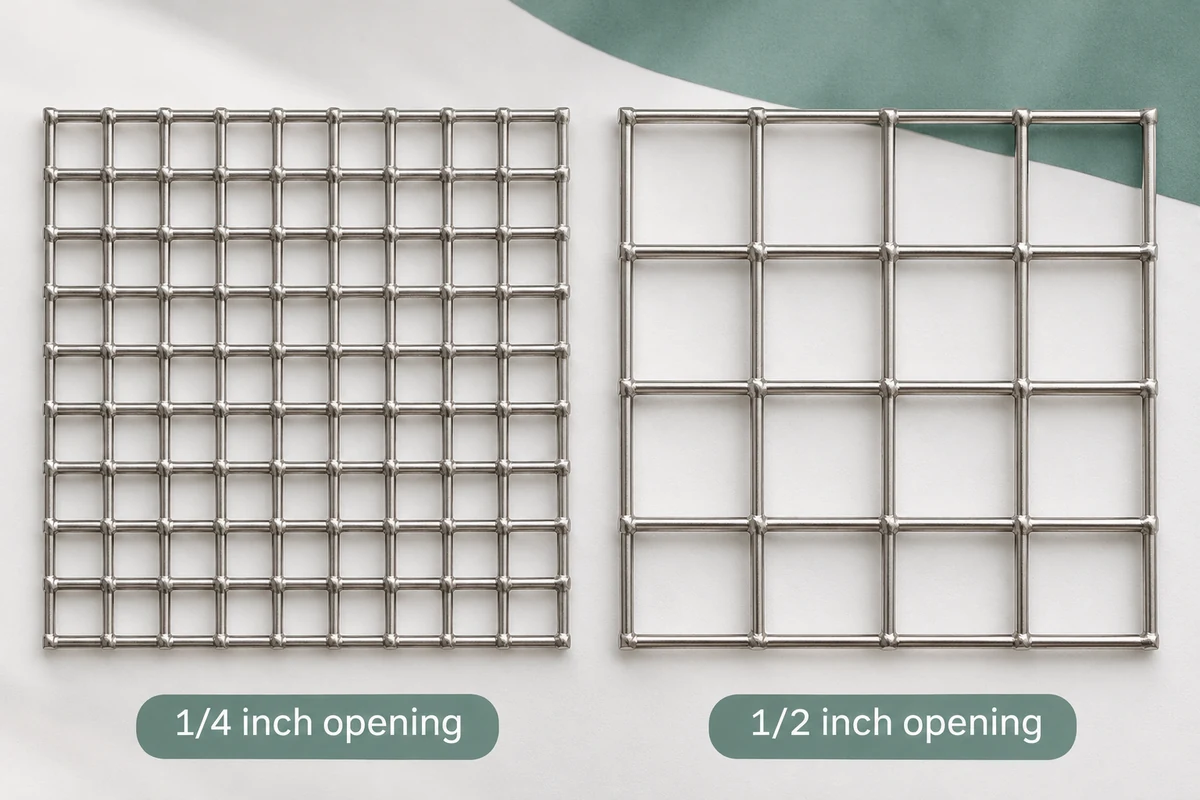
A 1/4 inch opening is smaller and retains objects that can pass through a 1/2 inch opening. A 1/2 inch opening generally leaves more open area when wire diameter is held constant. The suitable choice depends on the barrier’s purpose, cleaning access and the required wire strength.
| Question | 1/4 inch hardware cloth | 1/2 inch hardware cloth |
|---|---|---|
| If specified as a clear opening | 6.35 mm between adjacent wires | 12.7 mm between adjacent wires |
| Separation duty | Retains smaller objects than a 1/2 inch opening | Suitable where the larger opening meets the containment requirement |
| Airflow and cleaning | At equal wire diameter, lower open area and more closely spaced wires | At equal wire diameter, higher open area and larger spaces to clean |
| Mechanical selection | Confirm wire diameter, weld quality, span and edge support | Confirm the same details; larger openings do not establish greater strength |
Decide what must pass through before selecting a size. A garden debris screen, an enclosure and a building-vent cover have different requirements. Do not treat a mesh chosen for one as a universal replacement for the others.
Is 1/4 inch hardware cloth suitable for keeping mice out?
Mice can pass through surprisingly small gaps. CDC guidance notes that an opening about 1/4 inch wide can admit a mouse and recommends closing potential entry routes. A nominal 1/4 inch product label therefore needs careful interpretation: verify the maximum opening and the finished perimeter gaps against the exclusion requirement. [1]
For small-rodent exclusion, 1/2 inch openings are too large to assume mouse protection. Ask a pest-control professional for a species-appropriate specification when exclusion is the objective. Loose edges, pipe penetrations and damaged fixings can defeat an otherwise suitable screen.
Check clear opening, mesh pitch and wire diameter
Confirm whether a supplier’s stated size means the clear opening or centre-to-centre spacing. Those measurements differ by the wire diameter. A label such as “1/2 inch mesh” does not always give the same clear gap across different catalogues.
For example, a square grid with a 12.7 mm pitch and 1.0 mm wire has a clear opening of about 11.7 mm. If the required clear opening is 12.7 mm, the corresponding pitch with that wire is 13.7 mm. These are calculated examples, not XTZ Fence stock specifications. The guide to wire mesh sizes covers how to record the dimensions.
Use a wire diameter in millimetres or inches on the purchase order. A gauge number needs its gauge system identified before it can be converted reliably. Also ask for opening and diameter tolerances, the usable roll width and how the edges are trimmed. Clear opening, mesh count and wire thickness are separate specification fields in industrial mesh ordering guidance. [2]
Wire diameter, welded joints and edge quality
Evaluate the whole panel, including its supports. A thicker wire can improve stiffness under otherwise comparable conditions, but opening size, weld condition, span and fastening all affect performance.
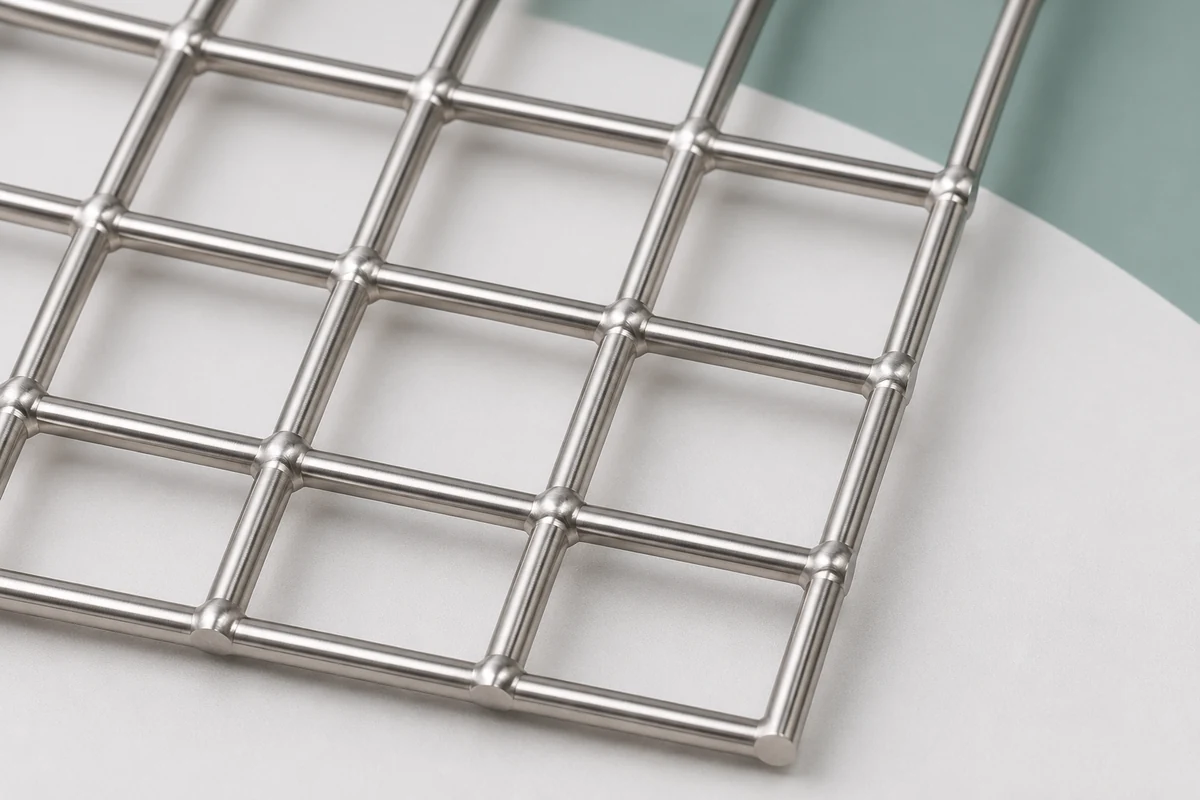
Check a sample for missing or damaged welds, distorted openings, loose wire ends and sharp projections. Ask how the mesh will arrive: tightly coiled, loosely rolled, flattened or supplied as cut panels. Residual roll curvature can add installation time when the finished panel must lie flat.
For impact, animal containment or machinery access control, specify the actual duty and an appropriate acceptance method. A small-opening grid does not automatically qualify as a machine guard or a structural barrier. The frame and mounting details need to suit that application too.
Stainless steel versus galvanized hardware cloth
Compare the exposure and the cost of replacement. Galvanized mesh can suit many general projects, while stainless steel merits consideration where coating damage, wet conditions or difficult access make replacement more troublesome.
| Material | Selection consideration | Question for the supplier |
|---|---|---|
| Galvanized steel | A zinc coating protects the underlying steel; coating condition matters at welds and cut edges | Was the mesh galvanized before or after welding, and what finish is specified? |
| 304 stainless steel | A candidate for many relatively mild indoor and outdoor exposures | Are the grade, surface condition and cleaning access suitable for the site? |
| 316 stainless steel | A candidate where chloride exposure raises corrosion concerns | Does the actual exposure require 316 or a more resistant material? |
Grade selection also depends on humidity, contaminants and cleaning. Neither stainless grade is immune to corrosion. The British Stainless Steel Association’s external-use guidance considers local exposure, surface finish, fabrication and maintenance alongside alloy choice. [3]
Inspect after cutting or fabrication and avoid contaminating stainless surfaces with carbon-steel debris. For a specified finish, ask whether cleaning or other post-fabrication treatment is included. Confirm any requested documentation before placing the order.
Where hardware cloth works, and where a different mesh is needed
Use hardware cloth for a defined screening or containment task. For ventilation covers, check the required free area and the effect of accumulated dust or leaves. For enclosures, consider the animal’s size, behaviour and ability to damage the wire, then check the complete boundary and access doors.
For fabricated baskets, trays and partitions, confirm bend radius, cut size and edge protection. Fine insect screening needs openings chosen for the target insect; a quarter-inch hardware cloth opening is much larger than a typical mosquito screen opening.
Structural concrete reinforcement, plaster backing, walking surfaces and fall-protection barriers have different specification and system requirements. Select the relevant product and supporting evidence for those uses instead of treating hardware cloth as a general structural mesh.
Cutting, framing and installation
Design the fixing before cutting the roll. A continuous clamping strip or a suitable framed edge can spread the attachment load and cover exposed wire ends. The fixing type and spacing depend on the wire, opening, substrate and loads.
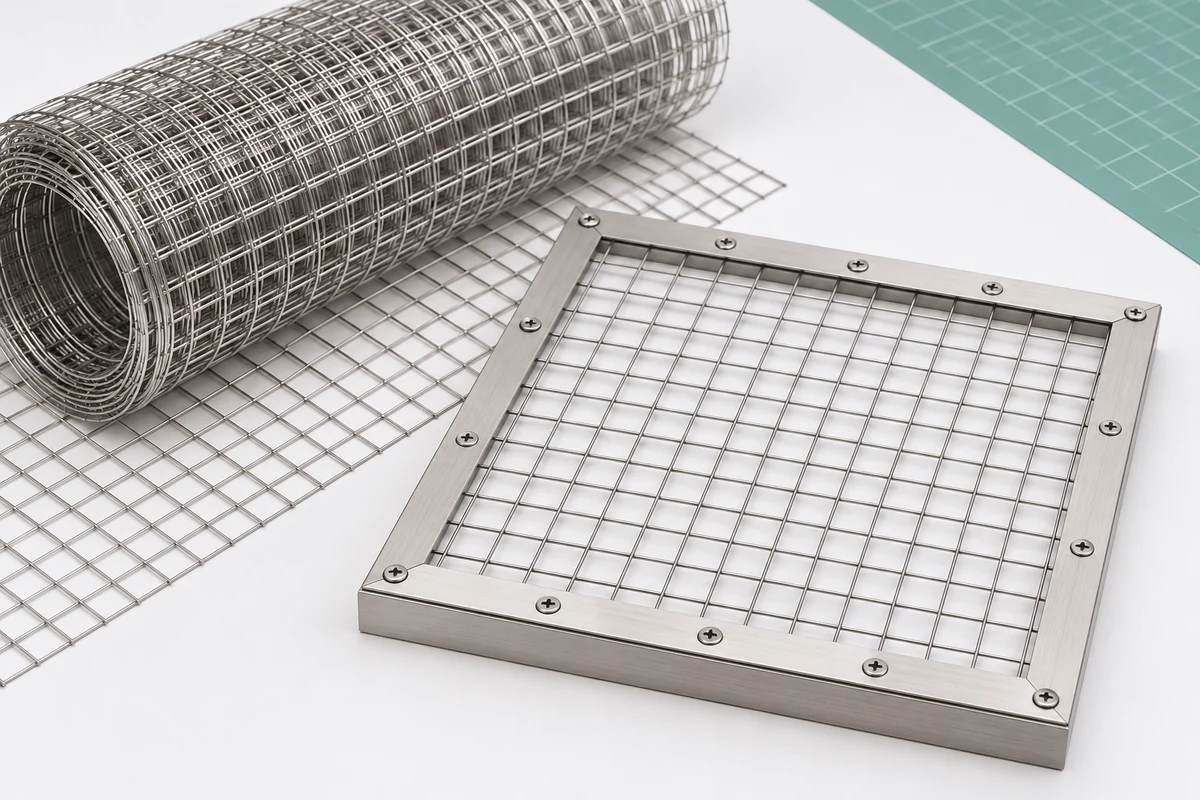
- Measure the finished opening, including the area needed for edge capture and any seams.
- Mark the mesh and cut with a tool suited to the wire diameter. Use eye protection and gloves appropriate for sharp wire.
- Prepare the frame, remove hazardous projections and capture the cut ends.
- Install compatible fasteners and check corners, joins and penetrations for unintended gaps.
- Confirm airflow, access and the finished barrier’s condition before putting it into service.
Do not cover a flue, dryer outlet or other safety-related vent without checking the equipment and local installation requirements. Added mesh can collect debris or restrict flow. Leave access for inspection and cleaning wherever a cover is approved.
How to order stainless steel hardware cloth
Specify the construction, grade, clear opening, wire diameter and tolerances. Include roll width and length or individual panel sizes, quantity, edge treatment, finish and intended use. A simple drawing is useful when fixing holes, folded returns or frames are involved.
XTZ Fence supplies stainless steel welded wire mesh as custom rolls, sheets and cut panels in project-specified 304 or 316 grades. Confirm the requested 1/4 or 1/2 inch opening convention, wire diameter and available supply format for the specific enquiry.
For a woven version, state the weave on the drawing. The construction guide to plain weave wire mesh can help identify the difference before a sample is ordered. Send XTZ Fence the dimensions, quantity and service conditions so the mesh and finished format can be reviewed together.
Stainless steel hardware cloth FAQ
Is hardware cloth the same as chicken wire?
They usually describe different products. Hardware cloth commonly has small square welded or woven openings. Chicken wire generally has a hexagonal netting construction. Compare the opening, wire diameter, material and fixing arrangement for the intended enclosure; the product name alone does not establish protection against a particular animal.
Is 1/4 inch mesh stronger than 1/2 inch mesh?
Opening size alone cannot answer that. Wire diameter, material condition, welded or woven construction, support span and fixing details affect the finished panel. A sample or application-specific verification is more useful than comparing the two opening labels without the rest of the specification.
Can stainless hardware cloth rust outdoors?
Stainless steel can stain or corrode when the grade, surface condition or maintenance does not suit the exposure. Chlorides, trapped deposits and carbon-steel contamination deserve attention. Select the material for the site and provide cleaning access rather than relying on an “outdoor” label.
Should I choose welded or woven hardware cloth?
Choose according to handling, edge behaviour and the finished part. Welded intersections hold the grid together during many cutting and fabrication operations. Woven cloth interlaces separate wires and needs suitable edge capture. Confirm both the construction and its dimensions when ordering, especially if replacing an existing screen.
Can 1/4 inch hardware cloth stop mosquitoes?
A quarter-inch opening is much too large to assume mosquito exclusion. Hardware cloth and fine insect screens serve different screening duties. Choose an insect screen specified for the target insects, then check the finished frame, seals and ventilation requirements.
What affects the cost of stainless steel hardware cloth?
Grade, wire diameter, opening, width, length, quantity and finishing work all affect a quotation. Cutting, flattening, edge preparation and framing can also change the supplied cost. Compare offers against one complete specification, including the usable dimensions, rather than price per roll alone.