
Aluminum mesh is a lightweight screen available as woven wire cloth, expanded sheet or perforated sheet. It is used in ventilation, insect screening and architectural panels, including suitable exterior applications. Choose the alloy, thickness, finish and fixings for the exposure and load; stainless steel is an alternative where higher stiffness or a different corrosion profile is needed.
Aluminum can reduce assembly weight and simplify handling. The important purchasing questions are which alloy and format are supplied, how the panel is supported, and whether its surface treatment and connections suit the environment. A thin insect screen and a framed expanded-metal panel should not be judged as the same product.
Three Primary Forms of Aluminum Mesh
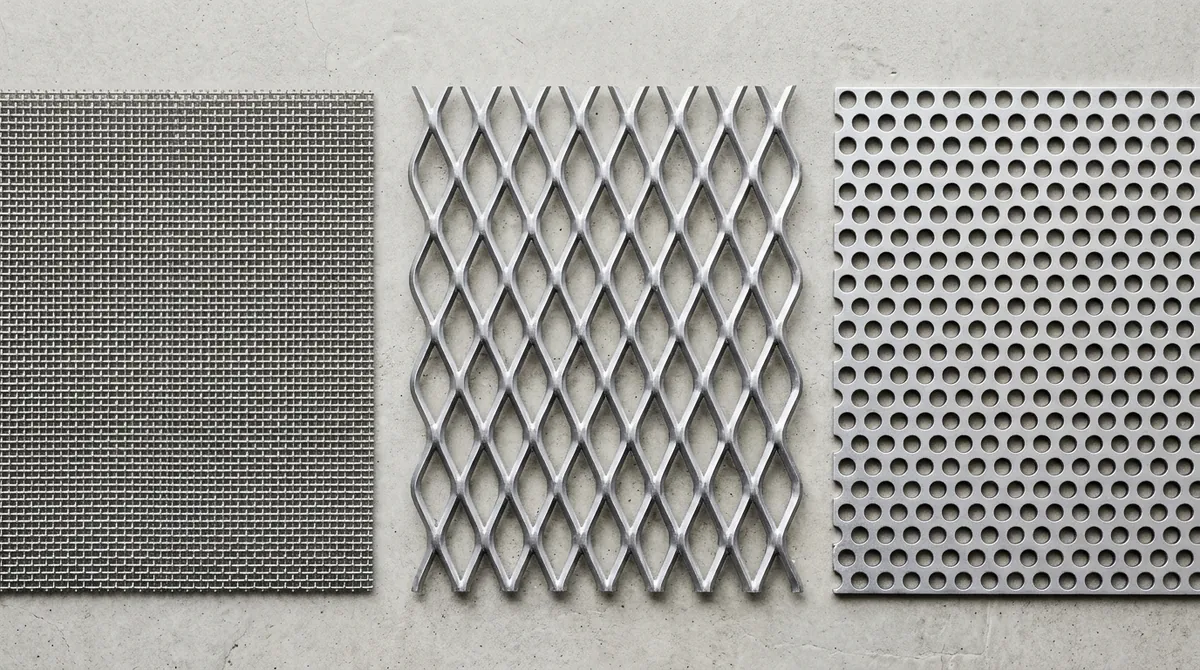
“Aluminum mesh” covers three distinct manufacturing geometries with very different load profiles and open-area ranges:
| Mesh Format | How It Is Made | Typical Alloys | Structural Rigidity | Primary Applications |
|---|---|---|---|---|
| Woven Aluminum Wire Cloth | Interlaced warp and weft aluminum wires (plain or twill weave) | 5056 (corrosion-resistant wire), 5154 | Low (flexible roll; needs perimeter tension) | Insect screens, light air pre-filters, soffit vents, EMI/RFI shielding |
| Expanded Aluminum Mesh | Single aluminum sheet slit and stretched into diamond openings | 3003, 5052 | Moderate (self-supporting in framed panels) | Decorative sunscreens, equipment vent covers, lightweight ceiling baffles |
| Perforated Aluminum Sheet | Solid aluminum sheet mechanically punched with round, square, or slotted holes | 3003, 5052, 6061 | Moderate to High (flat sheet stability) | Acoustic backing, facade cladding, cleanroom airflow diffusers |
Specification Boundary Note
For industrial woven wire cloth; whether woven in aluminum or stainless steel; ASTM E2016-22 defines wire diameter and aperture tolerances for industrial cloth while explicitly excluding insect screening and hardware cloth. Always call out exact alloy, wire diameter (or sheet thickness), and clear opening on project drawings.
Aluminum Mesh vs. Stainless Steel Mesh: Corrosion, Strength, and Lifecycle Trade-Offs
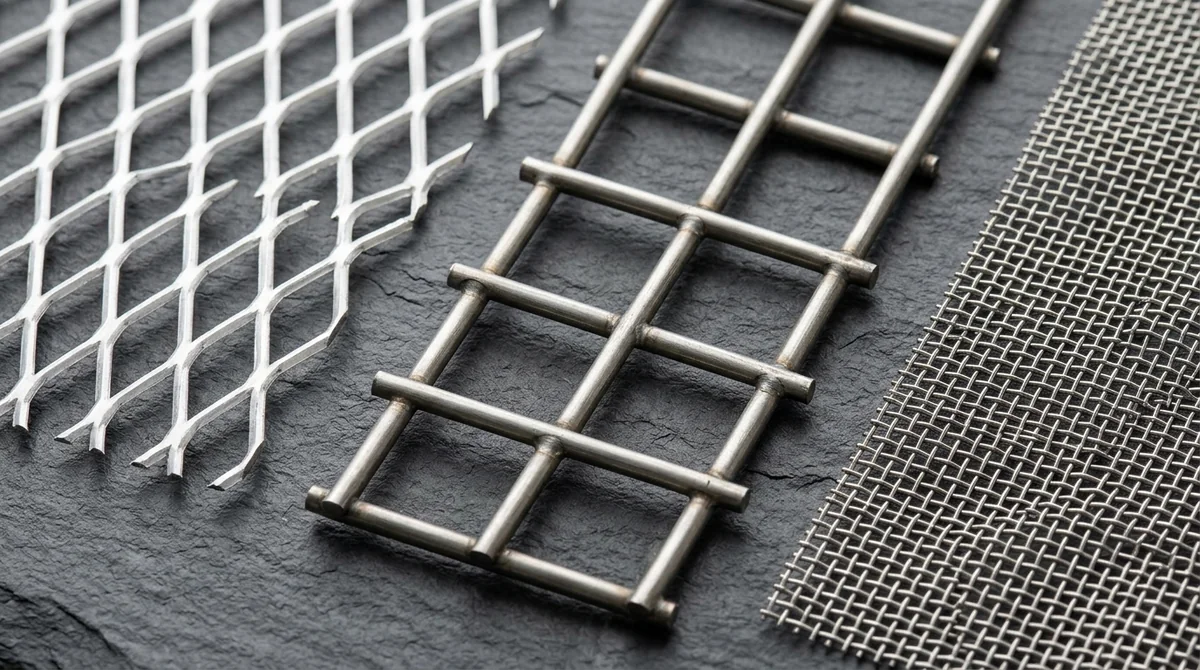
Aluminum develops a protective oxide film, and suitable alloys can perform well outdoors. Hydro identifies 5052 as a corrosion-resistant alloy used in marine applications. This does not establish the performance of every mesh product: alloy, temper, surface finish, crevices and dissimilar-metal contacts still matter.
| Engineering Parameter | Aluminum Mesh (5052 / 5056) | 304 Stainless Steel Mesh | 316 Stainless Steel Mesh |
|---|---|---|---|
| Density / Weight | ~2.7 g/cm³ (about one-third of steel) | ~7.9 g/cm³ | ~8.0 g/cm³ |
| Impact & Cut Resistance | Low; bends, creases, and tears under force | Higher stiffness at comparable geometry; security performance requires assembly testing | Higher stiffness at comparable geometry; security performance requires assembly testing |
| Marine / Salt-Spray Resistance | Can be good with suitable alloy and detailing; avoid crevices and assess pitting risk | Moderate (surface tea-staining near coast) | High (molybdenum resists chloride pitting) |
| Alkaline / Masonry Contact | Poor (wet cement and mortar aggressively attack aluminum) | Good | High |
| Galvanic Risk with Steel/Copper | Depends on metal pairing, electrolyte and exposed area ratio; isolate where required | Low when paired with stainless fasteners | Compatible stainless fixings reduce mixed-metal concerns; inspect other metal contacts |
| High-Temperature Service | Strength retention depends on alloy, temper, temperature and exposure duration | Retains strength at elevated industrial temperatures | Retains strength at elevated industrial temperatures |
Four Design Checks Before Choosing Aluminum or Stainless Steel
- Galvanic Corrosion in Mixed-Metal Assemblies: Wet contact with a more noble metal, particularly copper or stainless steel, can promote galvanic attack on aluminum. Assess the actual metal pairing and area ratio; do not assume galvanized steel behaves identically to copper. Specify suitable isolation and drainage.
- Alkaline Runoff from Concrete and Stucco: Rainwater washing across fresh mortar or concrete balconies carries high pH runoff that dissolves aluminum’s oxide layer.
- Physical Impact, Rodent Chewing, and Security Loads: In ground-level vents, food plants, or residential security doors, aluminum wire stretches and tears easily. Projects requiring cut-resistant window or door protection routinely step up to tested security-screen assemblies or suitable stainless steel diamond mesh products or evaluate 304 stainless steel mosquito mesh pricing for long-term insect screening.
- Structural Guarding and Load-Bearing Spans: Ordinary insect mesh should not be used as structural guarding. Aluminum and stainless assemblies both require load verification for fencing, balustrades or machine guards. For rigid flat guards, engineered stainless steel welded wire panels can provide rigid infill when wire diameter, span and fixing details are engineered; for tensioned architectural fall protection, stainless steel cable mesh delivers high breaking strength with minimal visual obstruction.
Where Aluminum Mesh Makes Engineering Sense
- Weight-Restricted HVAC & Aviation/Transport Ducts: Keeping total assembly mass low reduces hanger loads and simplifies filter-cartridge handling.
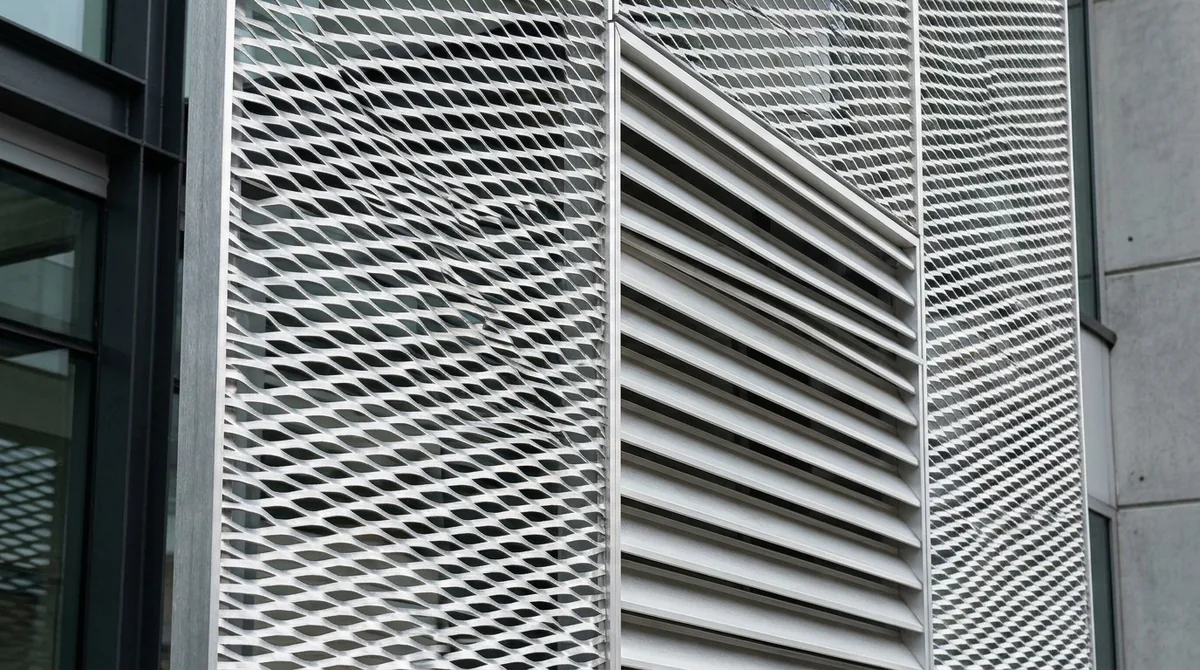
- Dry Interior Acoustic & Decorative Panels: Anodized expanded or perforated aluminum sheets deliver clean visual uniformity inside climate-controlled lobbies and offices.
- EMI/RFI Shielding Enclosures: Aluminum cloth can be part of a conductive enclosure; verify shielding by frequency, joints, bonding and complete-assembly testing.
- Sheltered Soffit & Eave Vents (Inland): In non-coastal, dry climates away from masonry runoff, 5056 aluminum woven cloth prevents leaf and insect ingress at low initial cost.
Quick Selection Rules
- If total frame weight is the hard constraint and the environment is dry, sheltered, and impact-free, specify anodized or 5056 aluminum mesh with matching aluminum fasteners.
- If exposure or loading is demanding, compare suitable aluminum alloys with 304, 316 or another stainless grade using the actual service conditions and product data from stainless steel wire mesh.
- If an exterior facade needs verified load resistance, compare engineered aluminum panels, stainless cable systems and welded panels using project calculations and test evidence.
Specifying Replacement or Upgrade Stainless Mesh for Existing Aluminum Frames
When retrofitting failing aluminum screens to stainless steel, check three mechanical details before ordering:
- Frame Load Capacity: Stainless steel weighs roughly three times as much as aluminum for the same wire gauge; verify that existing spline grooves, rivets, or sub-frames can support the higher mass.
- Galvanic Isolation: If reusing existing aluminum extrusions outdoors with 304/316 stainless steel mesh, install EPDM or nylon thermal/electrical isolation strips to interrupt electrical contact, with suitable drainage and compatible fasteners.
- Open Area Parity: Match clear opening and wire diameter rather than nominal mesh count alone so HVAC or exhaust airflow stays within design limits.
If your project requires custom-engineered 304 or 316 stainless steel mesh panels, rolls, or architectural cable systems to replace underperforming aluminum screens, submit your aperture dimensions, panel drawings, and environmental exposure to the XTZ Fence engineering team for material and fabrication confirmation.
Frequently Asked Questions
Does aluminum mesh rust outdoors?
Aluminum does not form red iron rust, but it does oxidize and pit; especially in coastal salt air, industrial acid rain, or wet alkaline contact with concrete; leaving chalky white corrosion that weakens thin wires.
Which aluminum alloy is best for woven wire mesh?
5056 aluminum is widely used for woven wire cloth and insect screening because its magnesium content improves corrosion resistance and workability compared with softer pure-aluminum grades.
Can you use stainless steel screws on aluminum mesh?
In dry indoor environments, the risk is minor. Outdoors or in humid/coastal zones, direct contact between stainless steel fasteners and aluminum mesh accelerates galvanic corrosion of the aluminum unless isolated with non-conductive washers or gaskets.
When should I switch from aluminum mesh to 304 or 316 stainless steel?
Consider stainless steel when the required strength, stiffness, temperature resistance or chemical compatibility is not met by the proposed aluminum product. Assess 316 for chloride exposure, but verify cleaning chemicals and site conditions; it is not a universal solution for pools or chemical service.
Is aluminum mesh strong enough for security screens or animal enclosures?
Ordinary woven aluminum insect mesh is not a security-rated barrier. Security screens and animal enclosures need an assembly selected and, where required, tested for the expected loads and species. Mesh thickness, openings, frame and fixings matter as much as the material name.