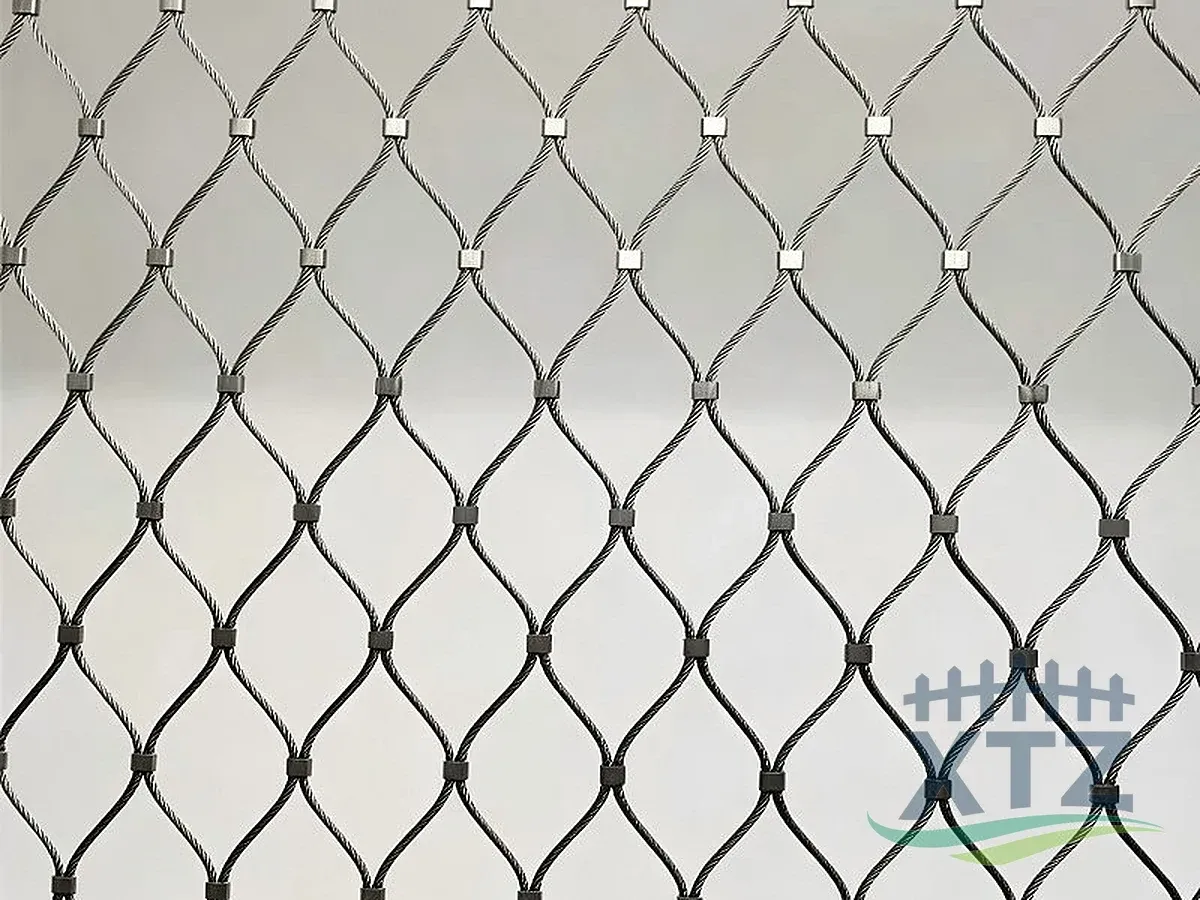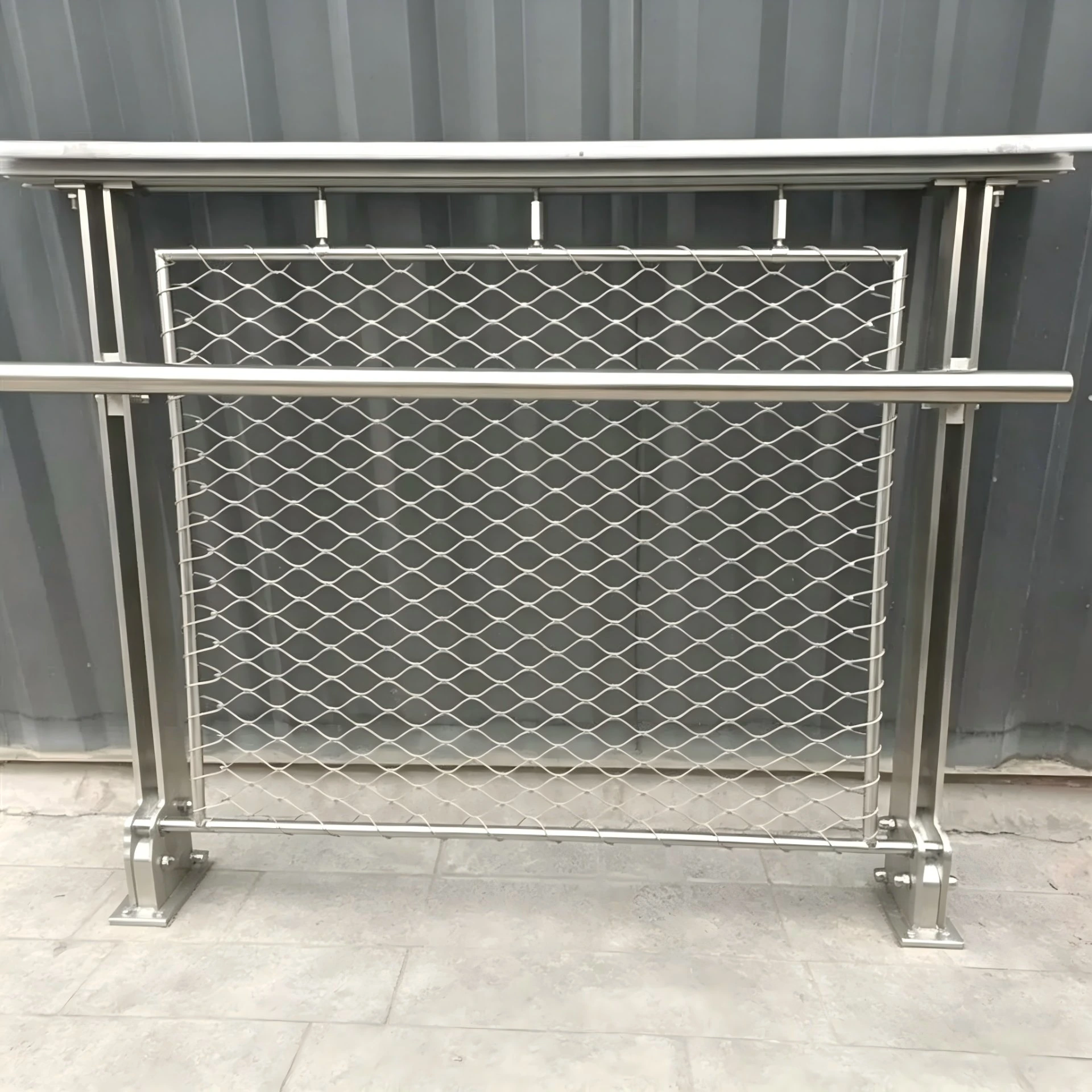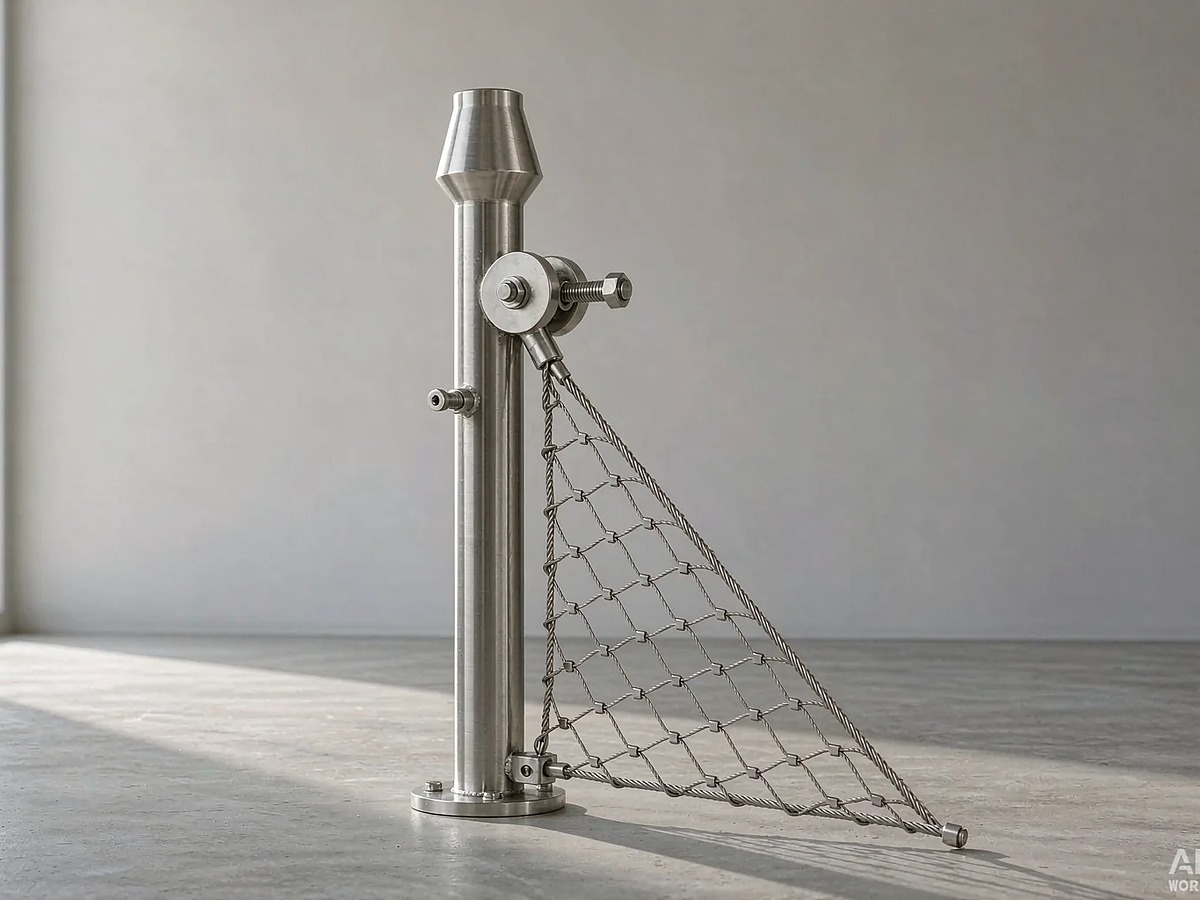
Metal grating is an open surface made from connected metal bars or formed sheet. It lets water, air and light pass through while providing a surface for access, drainage or screening. For walkways and platforms, the specification must match the load, unsupported span, opening size, exposure and fixing arrangement.
If you searched for “grated metal,” suppliers will usually describe the product as metal grating, bar grating or a metal grate. These terms cover several constructions. A drainage cover, a factory walkway and an architectural screen can look similar in a photograph but need quite different specifications.
What is grating in construction?
In construction, grating is commonly used to cover an opening or form an access surface while keeping part of that surface open. Typical locations include maintenance platforms, stair treads, plant walkways, trenches and service areas. The openings provide drainage and ventilation; the supporting frame and panel carry the specified loads.
Bar grating is one member of this wider product family. It uses parallel bearing bars held in position by cross bars. Expanded metal, formed safety planks and perforated sheets achieve an open surface through different manufacturing methods. Wire mesh belongs in the comparison when the job involves screening or guarding, although an ordinary mesh panel should never be assumed suitable as flooring.
At XTZ Fence, the relevant product page covers Stainless Steel Bar Grating & Mesh Panel. It distinguishes bearing-bar panels for access surfaces from welded mesh panels for guarding and separation. Use the load-bearing configuration when specifying a walkway; the shared word “panel” does not make the two forms interchangeable.
How bar grating carries a load
The bearing bars carry the main load between supports. Their direction must be marked on the panel layout, and the span used for selection must agree with the supplier’s load-table definition. Rotating a rectangular panel can change how it performs even when its outside dimensions remain the same.
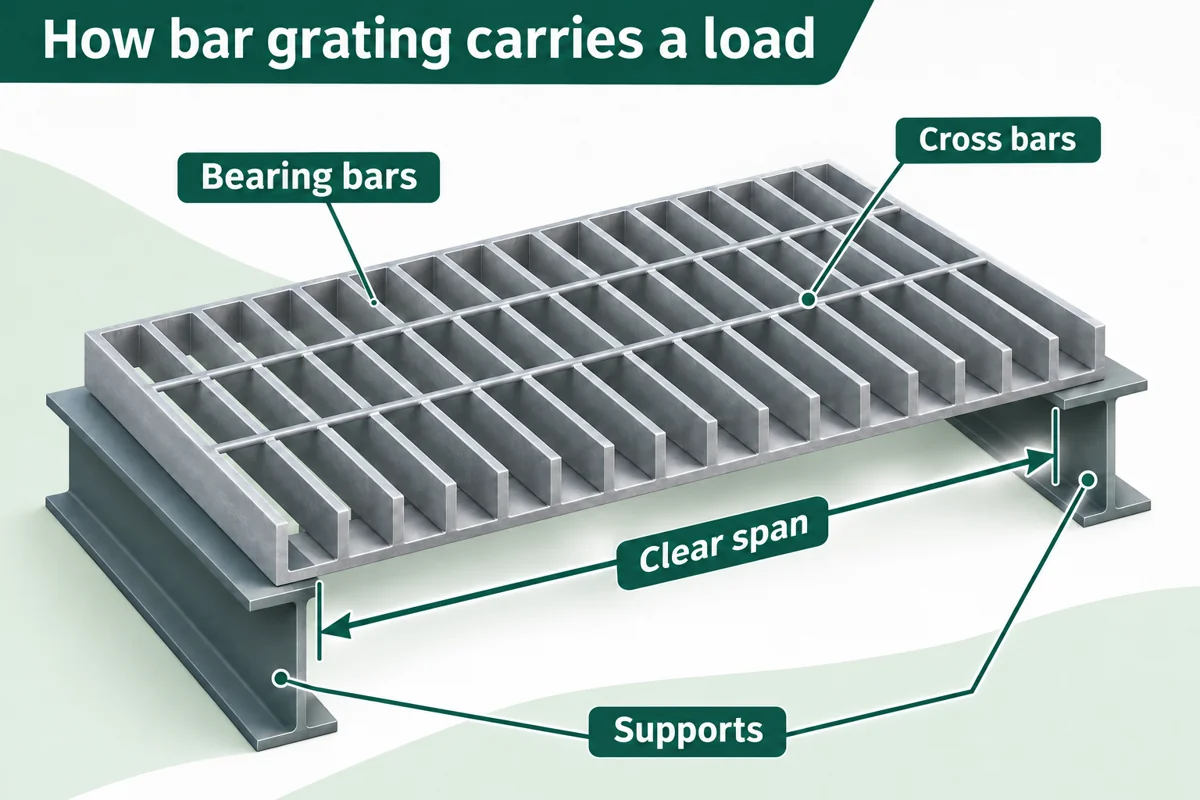
Three dimensions are easy to confuse:
- Panel size: the overall size of the fabricated piece.
- Clear span: the unsupported distance between effective supports.
- Bearing: the length of panel seated on a support.
A panel that fits the opening can still have inadequate bearing or an excessive unsupported span. Cross bars keep the grid assembled and maintain spacing; they should not be treated as an interchangeable set of bearing bars. The Direct Metals grating glossary distinguishes these components and the span direction.
Request load and deflection data for the actual bar section, spacing, material and surface. Identify whether the requirement involves a distributed load, a concentrated load or wheels. A general statement such as “heavy-duty steel grating” leaves too much unspecified for an engineering decision.
Metal grating types: construction, surface and duty
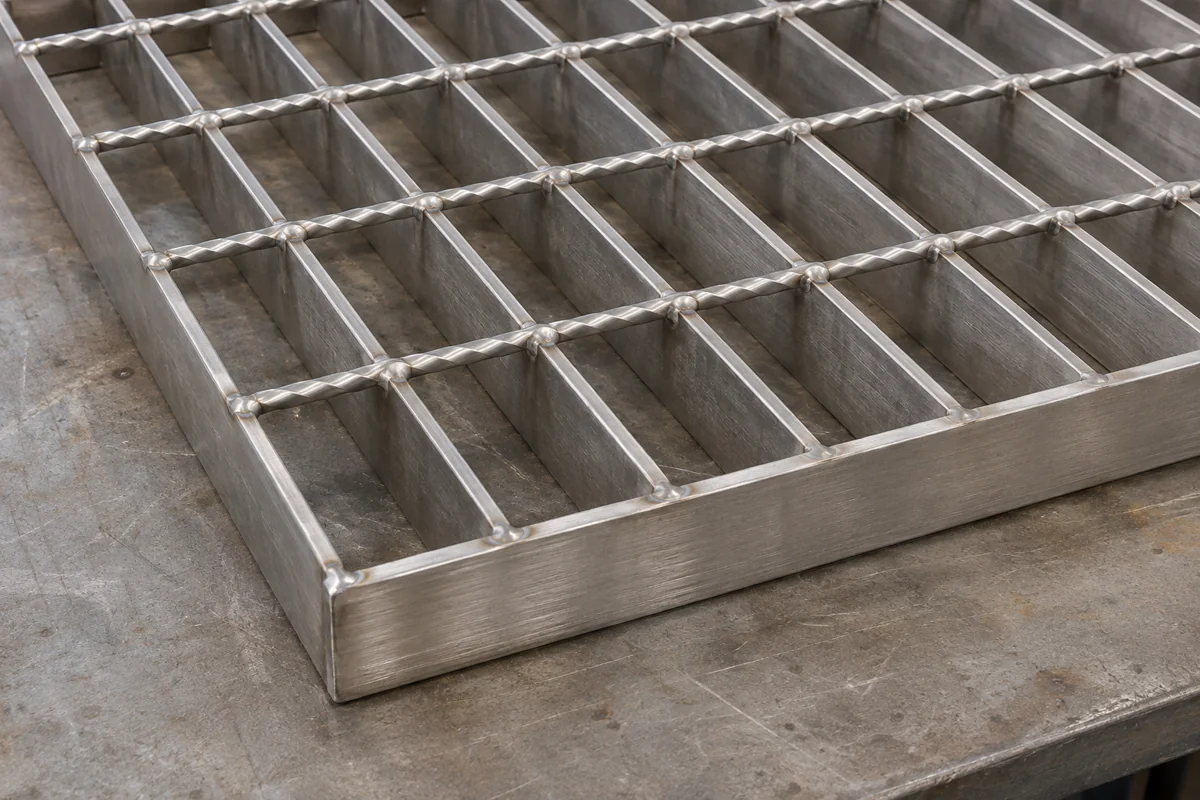
Describe construction, material and surface separately. “Welded,” “stainless” and “serrated” answer different questions and can all apply to the same panel.
| Construction or product family | How it is formed | What to check |
|---|---|---|
| Welded bar grating | Bearing bars and cross bars joined by welding | Load-table basis, weld condition, bar section and span |
| Press-locked grating | Intersecting members mechanically pressed together | Actual joint system, spacing, appearance and rated capacity |
| Swage-locked grating | Cross members mechanically locked into bearing bars by deformation | Material, bar profile and manufacturer’s load data |
| Riveted grating | Members joined with rivets | Project loading, vibration and the specified connection arrangement |
| Expanded metal grating | Sheet slit and stretched into a connected lattice | Grating-grade section, diamond direction and supported span |
| Formed safety grating | Sheet punched and formed into textured planks or sections | Traction surface, plank geometry, loading and attachment |
Plain and serrated describe the walking surface. Stair tread describes a fabricated component, usually with its own edge and support details. Heavy-duty describes an intended duty that still needs a defined load case. FRP grating is a non-metal alternative worth considering in some environments; its material properties and design data require a separate comparison.
Bar grating, expanded metal or perforated sheet?
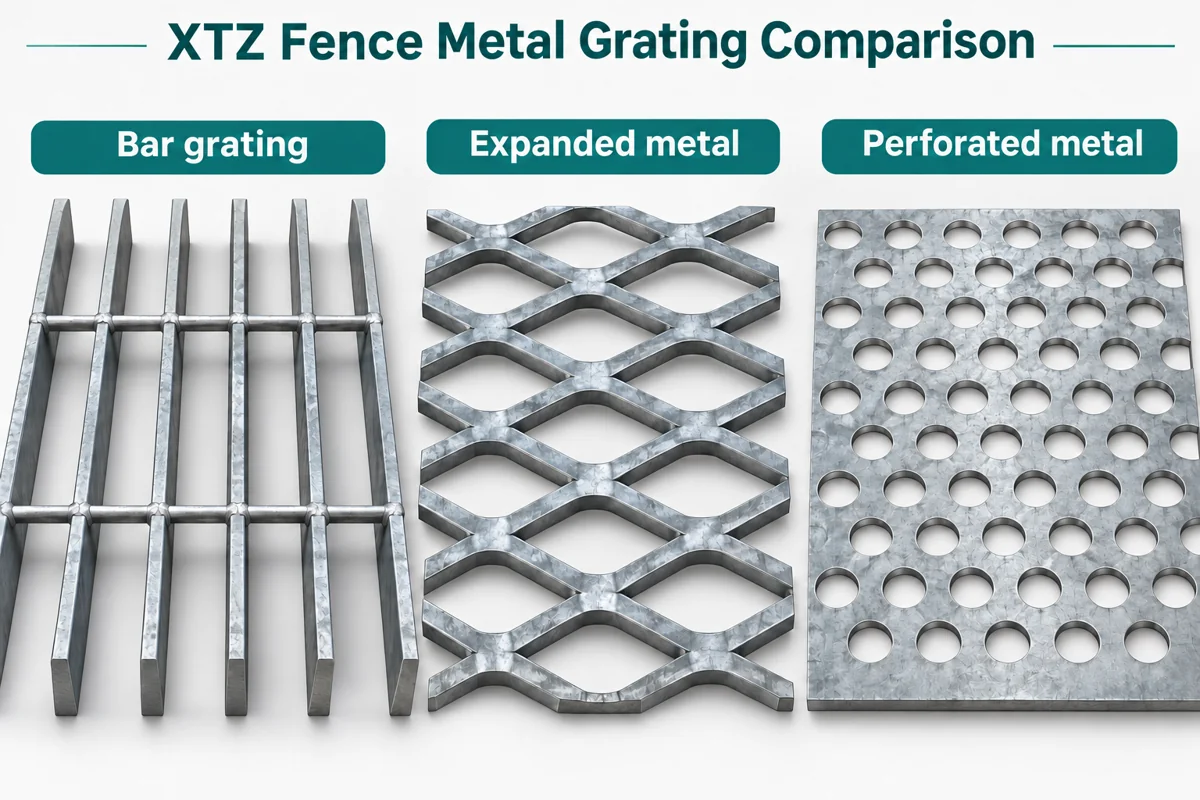
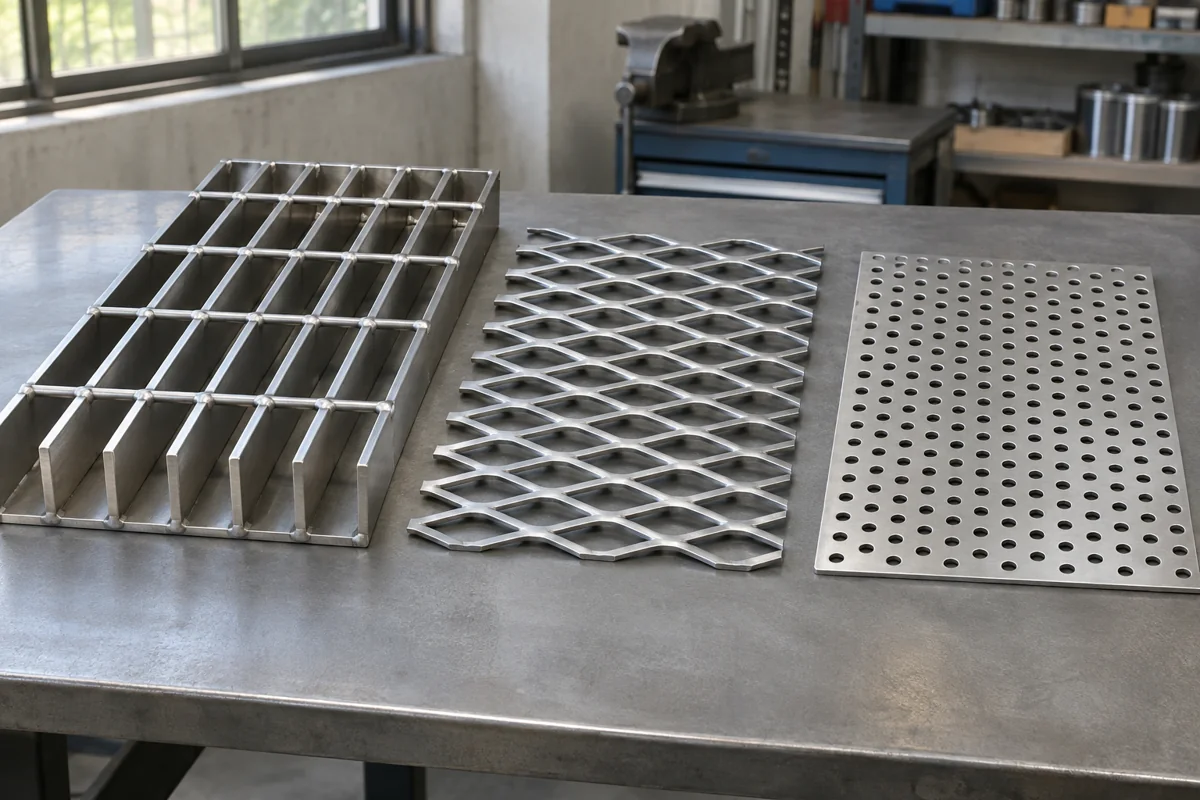
Choose the product family around the job it must perform. Bar grating is a common starting point for open access floors. Expanded metal and perforated sheet offer different opening patterns for screens, guards and selected engineered access applications.
| Selection question | Bar grating | Expanded metal | Perforated sheet |
|---|---|---|---|
| Basic structure | Separate bars connected into a grid | A slit-and-stretched sheet | A sheet with punched or otherwise cut openings |
| Opening pattern | Commonly rectangular | Commonly diamond-shaped | Round, square, slotted or specified patterns |
| Typical design focus | Bearing direction, span and bar section | Strand dimensions, mesh direction and raised or flattened form | Sheet thickness, hole size, pitch and supporting frame |
| When used underfoot | Select a rated configuration for the loading and support | Require an appropriate grating specification and load data | Require a specifically designed walking surface and support system |
For diamond-pattern sheet, XTZ Fence’s stainless steel expanded metal mesh page covers the strand and opening variables to include in an inquiry. For controlled hole patterns, the perforated stainless steel mesh page provides the corresponding sheet specification route.
A thin decorative sheet or ordinary welded-wire screen is not a substitute for a floor panel selected against load data. For façades and partitions, decorative metal screen mesh may be more relevant because openness, appearance and edge support become the main design questions. A fuller manufacturing comparison is available in our expanded metal vs perforated metal guide.
Which material and finish suit the environment?
Start with the exposure: indoor or outdoor service, chlorides, cleaning chemicals, temperature and the opportunity to inspect and maintain the panel. Material names alone cannot establish service life.
Carbon steel is widely used for industrial grating and may be supplied with a specified protective finish. Hot-dip galvanized steel combines a steel substrate with a zinc coating; it remains a different specification from stainless steel. Coating requirements and repair of damaged areas should be agreed with the supplier.
Stainless steel is a relevant option where corrosion exposure or cleaning requirements influence the choice. XTZ Fence lists 304/304L and 316/316L grades on its bar-grating product page. Select among them against the actual environment. A coastal location or chloride-bearing cleaning process needs a more detailed review than the phrase “outdoor use.” Stainless steel still needs suitable detailing and cleaning.
Aluminum can be useful where panel handling and weight matter. It needs its own section and load data; exchanging steel for aluminum without redesigning the panel is not a valid weight-saving calculation. Where dissimilar metals meet, include the connection materials and isolation details in the project review.
Openings, slip resistance and public access
Opening size affects more than drainage. Consider footwear, wheelchair casters, small wheels, dropped objects and the direction in which people cross the surface. A smaller opening may help one requirement while changing the panel’s weight, available open area or cleaning behavior.
For U.S. accessible floor and ground surfaces within the relevant ADA scope, the U.S. Access Board guidance limits openings so that a ½-inch-diameter sphere cannot pass through. It also addresses the orientation of elongated openings relative to travel. Check the applicable project requirements instead of treating a catalogue label such as “heel-safe” as proof of complete accessibility compliance.
Serrations and formed traction features can help address slipping, but water, grease, footwear, wear and cleaning all affect the result. An open panel can drain and still be slippery. Where slip performance is specified, request evidence for the relevant surface, test method and service conditions.
In U.S. workplaces, OSHA 1910.22 addresses intended loads, surface hazards and inspection of walking-working surfaces. These are responsibilities for the installed surface; a grating product name does not establish compliance by itself.
Where metal grating is used
On a maintenance walkway, access, drainage and the distance between supports usually drive the first selection. On a stair, the tread support, nosing and connection to the stair structure need their own details. Removable trench covers introduce handling weight and secure seating as well as loading.
Drainage covers exposed to vehicles require the relevant wheel or axle loading and frame arrangement. A pedestrian rating should not be extrapolated to a forklift route. Equipment feet and small hard wheels can also produce concentrated effects that a general area-load description misses.
For machine guards and ventilation screens, specify opening size, stand-off, access requirements and frame connections. A panel intended to exclude contact or contain material must be assessed for that task. Its suitability cannot be inferred from its similarity to a walkway grate.
What changes the cost of metal grating?
Comparable quotes need the same material grade, bar dimensions, spacing, surface, finish and fabrication scope. Price per square metre is useful only after those fields match.
Cutouts, edge banding, stair-tread details, small custom panels and special finishes can change fabrication time and packing. Panel weight affects handling and freight. A lower panel price may also involve more site cutting or a different support layout, so compare the installed arrangement as well as the purchase price.
For replacement work, record the actual supports and remaining clearances before requesting a like-for-like panel. An old panel’s outside dimensions do not document its original load rating or the condition of the supporting steel.
What to send with a grating inquiry
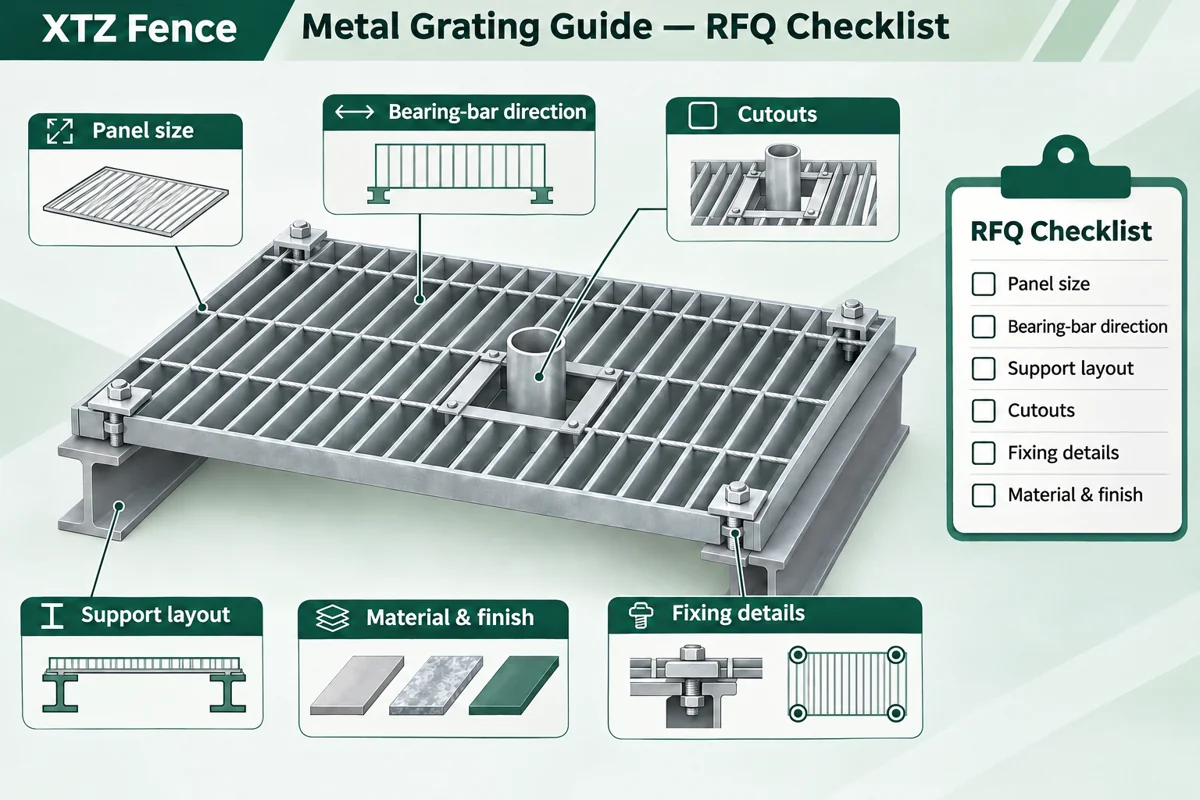
A useful inquiry shows how the panel will be supported and used. Start with a marked-up plan and a panel schedule; add project specifications where they exist.
- Application, destination and applicable project requirements.
- Panel dimensions, quantity, identification marks and bearing-bar direction.
- Support layout, clear span and required bearing.
- Design loads, concentrated or wheel loads, and deflection criteria.
- Material grade, surface, finish and exposure conditions.
- Opening restrictions, cutouts, banding, stair nosings and fixing requirements.
- Required drawings, material documentation, inspection and packing scope.
Keep field cutting under control. Removing bearing bars around a pipe can interrupt the load path, so the opening may need a designed band or additional support. Fixings also need to suit the supporting structure and the intended removability. Four clamp symbols on a sketch are not an installation specification.
Inspection and maintenance after installation
Inspect for loose fixings, movement, damaged bearing ends, corrosion, blocked openings and changes in level at joints. Recheck panels after equipment changes or site modifications that introduce a different load. Clean in a way that suits the material and the contamination present.
Where damage affects structural integrity, arrange a competent technical assessment before continued use. Repair details must address the panel and its supports; adding an unapproved patch over a damaged grate can conceal the original problem.
Frequently asked questions
Are grated metal and metal grating the same thing?
“Grated metal” is an informal search phrase that often leads to metal grating. For an inquiry, name the product family: bar grating, expanded metal grating or formed safety grating. Add the application and support layout so the supplier can identify the intended construction.
What are gratings used for in construction?
Common applications include access platforms, walkways, stair treads, trenches and drainage covers. Open-metal products are also used as guards and screens. Each application needs its own loading, opening and attachment criteria; a panel suitable for screening may have no flooring rating.
How much weight can metal grating hold?
There is no single load capacity for metal grating. Capacity depends on the material, bar section, spacing, span, support condition and load type. Request the supplier’s data for the exact configuration, including the applicable deflection limit and any concentrated or wheel-load checks.
Is serrated grating always better than plain grating?
Serrations can help provide traction, but the choice depends on footwear, contamination, cleaning and use. Obtain the appropriate load data for the serrated configuration as well as slip-related evidence where required. A more aggressive surface may be unsuitable for some users or equipment.
Can expanded metal replace bar grating?
It can be considered when an appropriate expanded-metal grating specification meets the same loading, span, opening and fixing requirements. Ordinary expanded sheet used for a screen should not be substituted for a rated floor panel. Obtain a project-specific comparison before changing the material family.
Does stainless steel grating need maintenance?
Yes. Inspect connections and supports, remove deposits and use a cleaning method suited to the grade and environment. Stainless steel can still be affected by contamination, trapped deposits and unsuitable chemicals. Grade selection and detailing reduce risk but do not eliminate inspection.
What is the difference between a grate and grating?
A grate often means one finished cover or panel, such as a drain grate. Grating commonly describes the open-grid material or assembly used to make it. Supplier terminology varies, so drawings, material, dimensions and load requirements are more useful than the noun alone.
Discuss a stainless steel grating project with XTZ Fence
XTZ Fence’s published range includes stainless steel bar-grating and mesh panels for access, drainage and guarding applications. Send the panel layout, support dimensions, required loads, grade, quantity and destination with your inquiry. Ask for confirmation of the proposed construction and the supporting technical data before approving the order.