
Choosing a wire mesh screen material starts with exposure, mechanical load, aperture and required flow. Stainless steel suits many demanding screens; aluminum reduces weight; galvanized steel can be economical for suitable indoor and outdoor conditions. Fiberglass is an alternative for insect screening. Grade, construction, frame design and maintenance determine performance together.
Specifying screen mesh by material name alone frequently leads to premature corrosion, sagged frames, or unexpected airflow restriction. Two screens made from the same alloy behave very differently once wire diameter, aperture geometry, and construction method change. This engineering guide breaks down the main metal screen materials and fiberglass alternatives, explains how open area governs performance, clarifies ASTM E2016-22 specification boundaries, and provides an actionable RFQ checklist for project procurement.
Comparing Core Wire Mesh Screen Materials
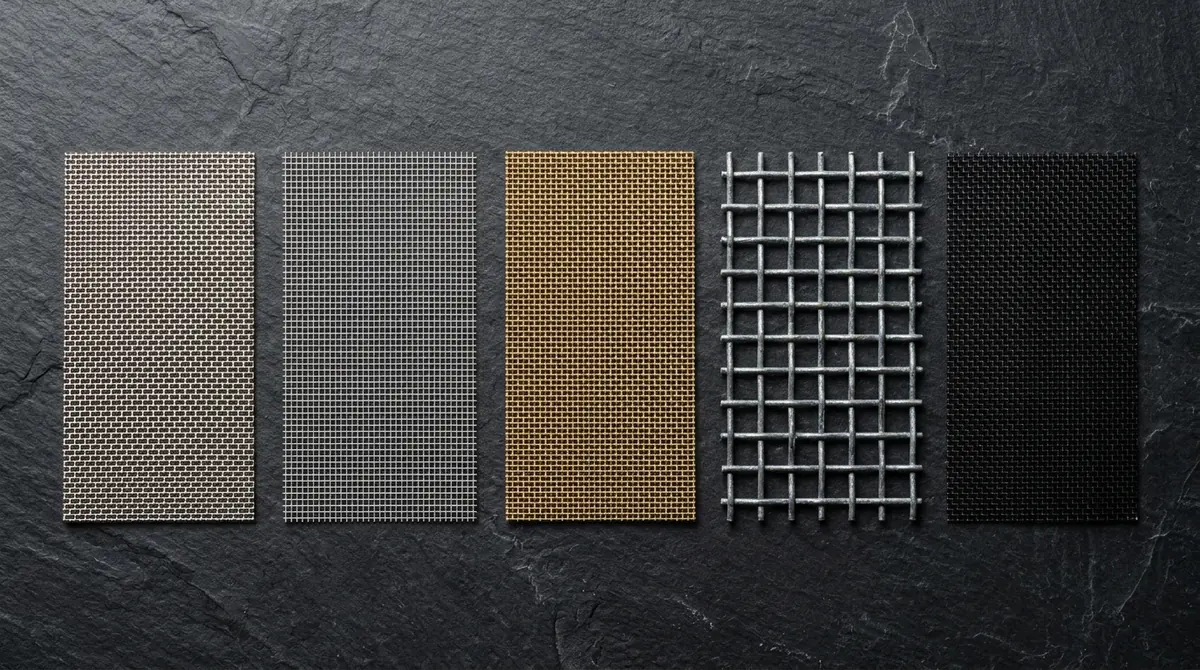
Every screening alloy trades off tensile strength, corrosion mechanism, weight, and fabrication cost. Before locking in a drawing, evaluate the actual operating atmosphere; especially chloride exposure (coastal salt spray or de-icing salts), galvanic contact with dissimilar frames, and thermal cycling.
| Material | Corrosion Protection / Behavior | Relative Tensile Strength | Thermal Tolerance | Best-Fit Applications | Key Limitation |
|---|---|---|---|---|---|
| 304 / 304L Stainless Steel | Passive chromium-oxide film; resists general oxidation | High | Temperature limits depend on grade, load and atmosphere | Industrial sifting, architectural screens, security insect mesh, dry-to-moderate outdoor guards | Susceptible to pitting in direct marine salt spray or high-chloride washdowns |
| 316 / 316L Stainless Steel | Molybdenum-enhanced passive film; resists chloride pitting | High | Temperature limits depend on grade, load and atmosphere | Coastal buildings, marine vents, chemical processing, wastewater, food-contact screens | Higher upfront material cost than 304 or galvanized steel |
| Aluminum (e.g., 5052 / 5056) | Natural oxide layer; lightweight | Low to Moderate | Moderate | Lightweight HVAC louvers, non-security insect screens, weight-restricted enclosures | Impact resistance depends on section and temper; wet alkaline contact and unsuitable metal pairings can cause corrosion |
| Galvanized Carbon Steel | Sacrificial zinc coating over carbon steel core | Moderate to High | Limited by zinc coating | Dry indoor machine guards, temporary utility screens, agricultural partitions | Service life depends on zinc thickness and exposure; persistent salts and damage can accelerate corrosion |
| Copper / Brass | Surface patina slows atmospheric corrosion | Moderate | Moderate | EMI/RFI shielding, heritage architectural grilles, decorative acoustic panels | Soft wire dents easily; runoff patina can stain adjacent light-colored masonry |
| PVC-Coated Fiberglass | Inert polymer-coated glass yarn | Very Low | Low | Standard residential window insect screens | Limited cut and impact resistance; durability depends on coating quality, UV exposure and handling |
When Stainless Steel Justifies the Upgrade
Stainless steel can improve durability where impact, cleaning or corrosion are important. Forced-entry protection depends on a tested complete assembly, including mesh, frame and fixings. Compare grade, wire diameter and 304 stainless steel mosquito mesh pricing without assuming a guaranteed service life.
Alloy Decision Rules
- If chloride exposure is significant, assess 316 or 316L alongside the actual salt deposition, cleaning chemicals and maintenance plan. Distance from the coast alone is not a grade-selection rule; aggressive conditions may require another alloy.
- If the screen is mounted inside an aluminum or galvanized frame in a wet outdoor zone, isolate dissimilar metals with non-conductive gaskets or match fastener and mesh alloys to prevent galvanic corrosion.
- If high-temperature exhaust or spark containment is involved, rule out fiberglass, PVC-coated mesh, and thin aluminum immediately; specify uncoated stainless steel with verified wire gauge.
Woven, Welded, Expanded, and Cable Structures: How Construction Changes Performance
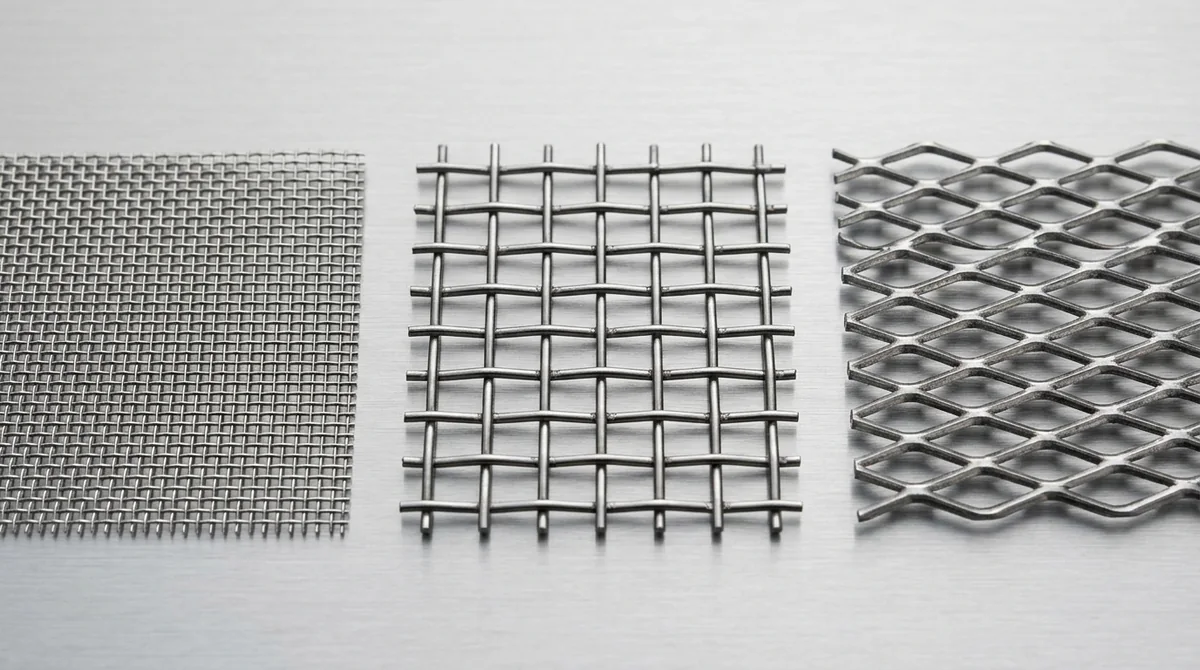
Alloy and wire condition affect strength and corrosion behavior. The manufacturing method, panel dimensions and frame also control stability and edge retention.
- Woven Wire Cloth (Plain, Twill, or Crimped Weave): Interlaced warp and weft wires produce precise, uniform apertures down to fine micron ratings. Plain weave is standard for insect screens, ventilation grilles, and industrial sizing. Note that ASTM E2016-22 establishes wire diameter and opening tolerances for industrial woven wire cloth; while explicitly excluding Dutch weave filter cloth, hardware cloth, insect screening, and test sieves; so commercial buyers should state exact mesh count, wire diameter, and tolerance class directly on purchase drawings rather than citing a single catch-all standard.
- Welded Wire Mesh: Crossing wires are resistance-welded at every intersection, locking aperture geometry without relying on frame tension. Rigid panels cut cleanly without unraveling, making them the standard choice for equipment guards, structural partitions, and stainless steel welded mesh panels where flat panel rigidity is mandatory.
- Expanded & Security Diamond Mesh: Expanded metal is slit and stretched from a single sheet with no loose wire ends, while stainless steel diamond mesh can refer to expanded, chain-link or cable constructions. Verify the product type rather than assuming that a diamond opening establishes security performance.
- Flexible Cable Mesh: Interwoven or ferruled stainless steel wire ropes flex under dynamic impact loads rather than bending permanently. For zoos, balustrades, and architectural fall-protection screens where transparency matters more than fine filtration, stainless steel cable mesh can suit applications requiring flexibility, subject to project load calculations.
Calculating Open Area, Wire Diameter, and Airflow Balance
A common specification error is increasing wire diameter for durability without recalculating percentage of open area. Thicker wire narrows the clear aperture and raises static pressure drop across HVAC intakes, dryer vents, and sifting decks.
For square-aperture woven or welded mesh, open area is calculated directly from clear opening (w) and wire diameter (d): Open Area (%) = [w / (w + d)]² × 100.
- 18 × 16 mesh with 0.28 mm wire yields a 1.13 × 1.31 mm clear opening and approximately 66% open area; balancing airflow and standard insect exclusion.
- 18 × 16 mesh with 0.35 mm wire narrows the clear opening to 1.06 × 1.24 mm and drops open area to roughly 59%, trading a modest airflow reduction for noticeably higher puncture resistance.
- 30 × 30 mesh with 0.28 mm wire tightens the clear opening to 0.57 × 0.57 mm (~45% open area), retaining smaller particles than the coarser examples, subject to the target particle or insect dimensions while requiring larger intake surface area if fan pressure is constrained.
For rectangular mesh, use Open Area (%) = [w1 / (w1 + d1)] × [w2 / (w2 + d2)] × 100. With dimensions in millimeters, clear opening in each direction is 25.4 / mesh count − wire diameter. The examples assume straight, uniform wires and omit frame blockage.
Practical Engineering Rule: Whenever you thicken wire gauge for security or animal exclusion, verify whether your mechanical ventilation system requires a larger screen frame area to preserve the same net free airflow.
Matching Wire Mesh Screen Material to Real-World Applications
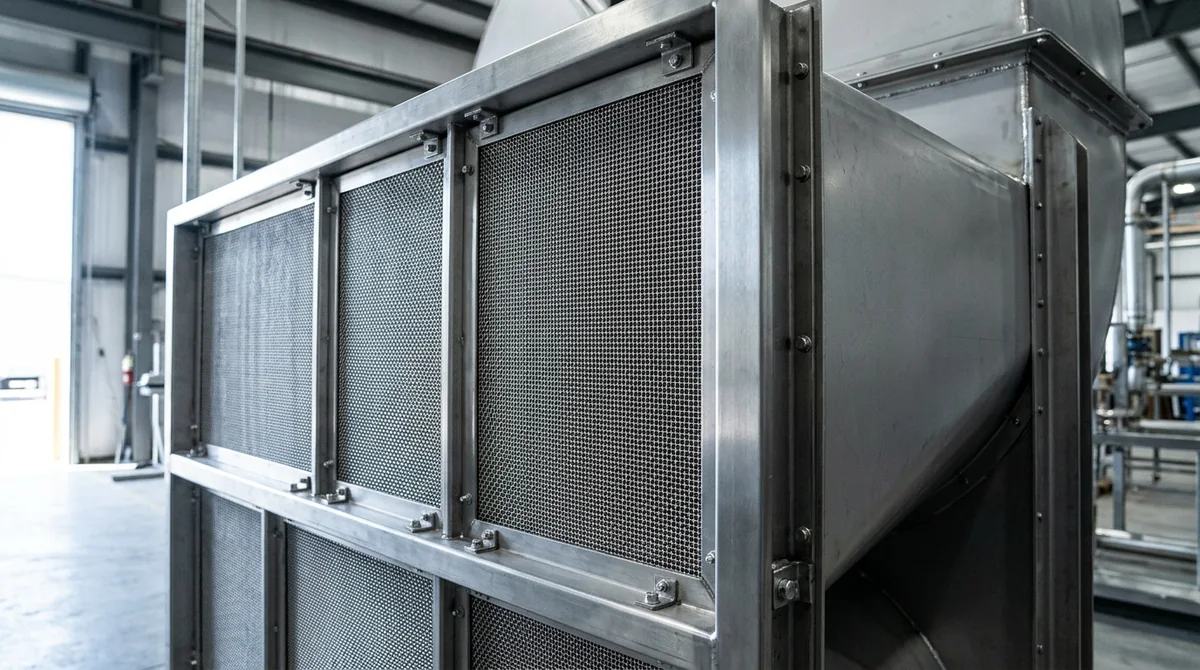
- Architectural Ventilation & Security Screens: Pair 304 or 316 stainless steel woven cloth (0.60–0.90 mm wire for security screens; 0.25–0.35 mm for high-airflow insect screens) with powder-coated matte black finishes to reduce solar glare and improve outward visibility.
- Industrial Filtration, Separation & Machine Guarding: Select 304/316 woven cloth for calibrated particle sizing, or rigid welded panels from experienced stainless steel wire mesh when framing safety enclosures around rotating equipment and conveyors.
- Marine, Coastal & Chemical Facilities: Evaluate 316/316L or a more resistant alloy for the actual chemistry, and select compatible mesh, retaining strips and fasteners. Avoid mixing carbon steel clips with stainless screens, as iron contamination triggers localized rust staining.
- High-Visibility Safety Barriers & Facades: Where screens must act as load-bearing fall protection or green-wall trellises without blocking daylight, specify 316 stainless steel cable mesh or heavy welded panels engineered to project structural drawings.
B2B Procurement Checklist: What to Confirm Before Requesting a Quote
To avoid mismatched samples or costly re-fabrication, include these seven items in your RFQ package:
- Alloy & Grade: Specify exact grade (e.g., AISI 304, 304L, 316, or 316L) and whether mill test certificates are required for incoming material verification.
- Construction Type: Woven (plain/twill/crimped), welded, expanded, perforated, or cable mesh.
- Aperture & Wire Diameter: State both clear opening (mm or inches) and wire diameter (mm or gauge), rather than mesh count alone.
- Roll vs. Cut-to-Size Panel: Define roll width/length or exact flat panel tolerances, plus edge finish (selvedge, flush-trimmed, or U-channel framed).
- Surface Finish: Mill bright, pickled/passivated, or blackened/powder-coated for anti-glare architectural use.
- Operating Environment: Indoor/outdoor, coastal distance, chemical contact, or thermal exposure.
- Packing & Labeling: Moisture-proof paper, wooden cases/pallets, and project tag labels for site staging.
Need project-specific stainless steel wire mesh screens manufactured to drawing? Send your aperture specs, panel sizes, and site conditions through the XTZ Fence project contact desk for engineering review and confirmation of wire diameter, finish, and packing details.
Frequently Asked Questions
What is the best wire mesh screen material for outdoor use?
304 stainless steel is often suitable for inland outdoor screens; 316 offers improved resistance to chloride pitting. Neither grade is corrosion-proof. Select for the actual atmosphere, deposits, surface finish and cleaning schedule.
How does stainless steel mesh compare to aluminum mesh for screens?
At comparable geometry, stainless steel generally provides greater stiffness and strength, while aluminum offers lower weight. Alloy, temper, wire diameter and assembly design matter. Either material can be suitable outdoors when specified for the exposure; material alone does not establish security performance.
Does wire diameter affect screen airflow even when the mesh count stays the same?
Yes. Increasing wire diameter at a fixed mesh count shrinks the clear opening and lowers the percentage of open area. For example, moving from 0.28 mm to 0.35 mm wire in an 18×16 screen reduces open area from roughly 66% to 59%, which should be factored into HVAC or exhaust sizing.
Should I specify woven or welded wire mesh for rigid screen panels?
Choose welded wire mesh when panels must stay flat, resist unraveling at cut edges, and handle structural or machine-guarding loads. Choose woven wire cloth when fine, calibrated apertures (such as insect exclusion or particle sizing) are required.
Does ASTM E2016-22 apply to every wire mesh screen?
No. ASTM E2016-22 covers industrial woven wire cloth tolerances and explicitly excludes insect screening, hardware cloth, Dutch weave filter cloth, and test sieves. Always state explicit alloy, wire diameter, and clear opening dimensions on project drawings.