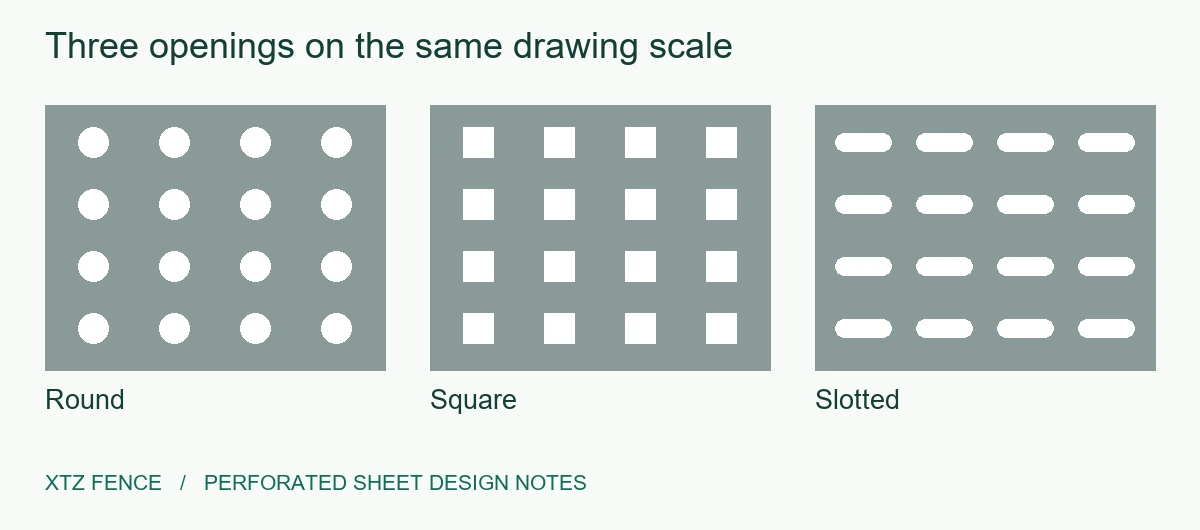
Choose round holes for a regular screen with openings that measure the same in every direction. Choose square holes when the panel needs to line up with an architectural grid. Choose slots when the opening needs a narrow width and a longer passage, or when the screen should draw the eye in one direction.
Compare the three patterns at the same scale
Put samples side by side against the background they will cover. A small round hole can disappear against a dark enclosure but stand out against a lit window. Turn each sample through 90 degrees. A round opening keeps its shape, but the rows can still look different. A slot changes the appearance of the whole screen when you turn it. For drawing terminology, see Europerf’s definitions of hole size and pitch.
| Pattern | When it earns its place | What to specify |
|---|---|---|
| Round | A vent cover or screen with a regular array of openings. Diameter gives the shop one clear aperture dimension. | Diameter, center pitch and row arrangement. |
| Square | A partition or cabinet insert whose openings should follow the frame lines. | Side length, pitch in both directions, orientation and acceptable corner radius. |
| Slotted | A screen with a directional appearance, or a process where the narrow dimension controls what can pass. | Clear width, overall length, end shape, pitches and slot direction on the finished panel. |
Round holes: specify the rows as well as the diameter
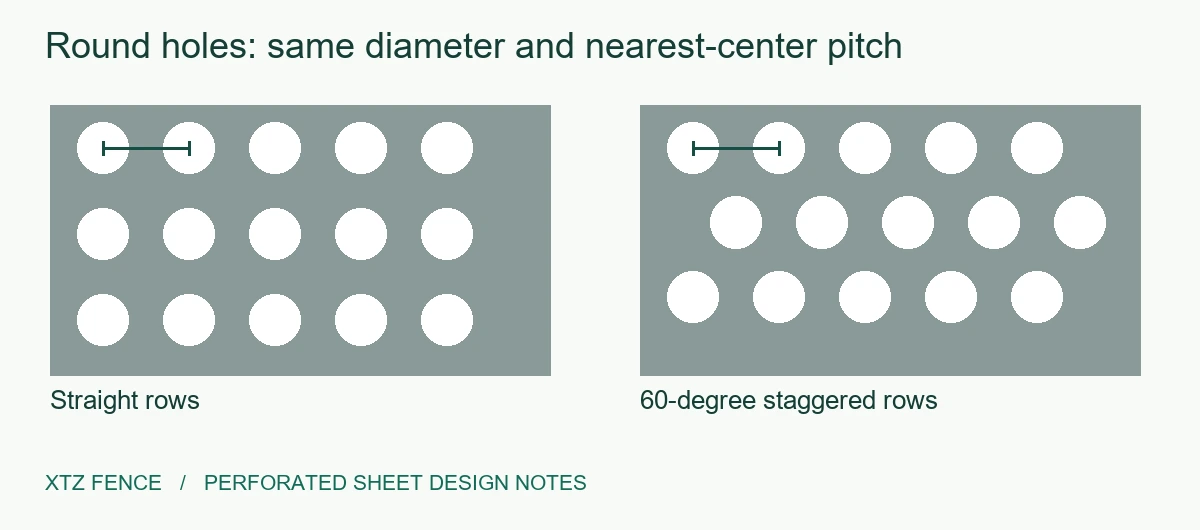
“6 mm round holes” leaves a fabricator several decisions. On straight rows, the hole centers line up in two directions. In a 60-degree staggered layout, alternate rows sit between the holes in the neighboring row. With the same diameter and nearest-center pitch, the staggered arrangement fits more holes into a given patterned area.
Consider a 6 mm hole on a 10 mm pitch. Each hole has an area of about 28.27 mm². A straight square grid assigns 100 mm² to each opening, giving about 28.3% open area. An equilateral staggered grid assigns about 86.60 mm² per opening, giving 32.6%. These are calculated examples for a repeating field. A solid border reduces the open percentage of the complete panel. The Industrial Perforators Association handbook gives the formulas for both layouts on page 49.
Square holes: start at the joint between panels
A square pattern makes a slight mismatch easy to see. Two sheets can meet neatly at a frame while one row lands half a hole above the next. Draw the row centerline across the joint and measure the first hole from the same finished edge on both panels. If the border must look symmetrical, show the intended border on all four sides.
For a square hole on a straight square grid, divide the hole side by the pitch and square the result. A 6 mm square on 10 mm centers gives a nominal 36% open area, assuming sharp corners. A rounded corner slightly reduces the opening. Request a sample when the corner shape matters to the design or to what can pass through.
Slotted holes: mark the long direction on the drawing
Write “4 mm wide × 20 mm overall, round ends” and add an arrow for the long axis. A shop drawing that says only “4 × 20 slots” can leave room for disagreement about whether 20 mm includes the rounded ends. Dimension the spacing both along each row and across rows. Also identify the top edge after the panel has been bent or turned for installation.
In a sorting screen, an elongated piece may pass when it rotates into alignment with a slot. A width alone cannot predict separation in service. In a decorative screen, take the same sample to the installation position and turn it: horizontal slots can carry the eye across adjacent panels, while vertical slots can emphasize the height of a narrow bay.
Match the pattern to the job behind the screen
Ventilation. Start with the free area the equipment designer requires. If a perforated field occupies 80% of the face and that field is 32.6% open, the whole face is about 26.1% open before a frame, backing or filter obscures any holes. Actual airflow also depends on pressure drop, sheet thickness and the assembly behind it. For a fan intake, ask for performance at the operating flow.
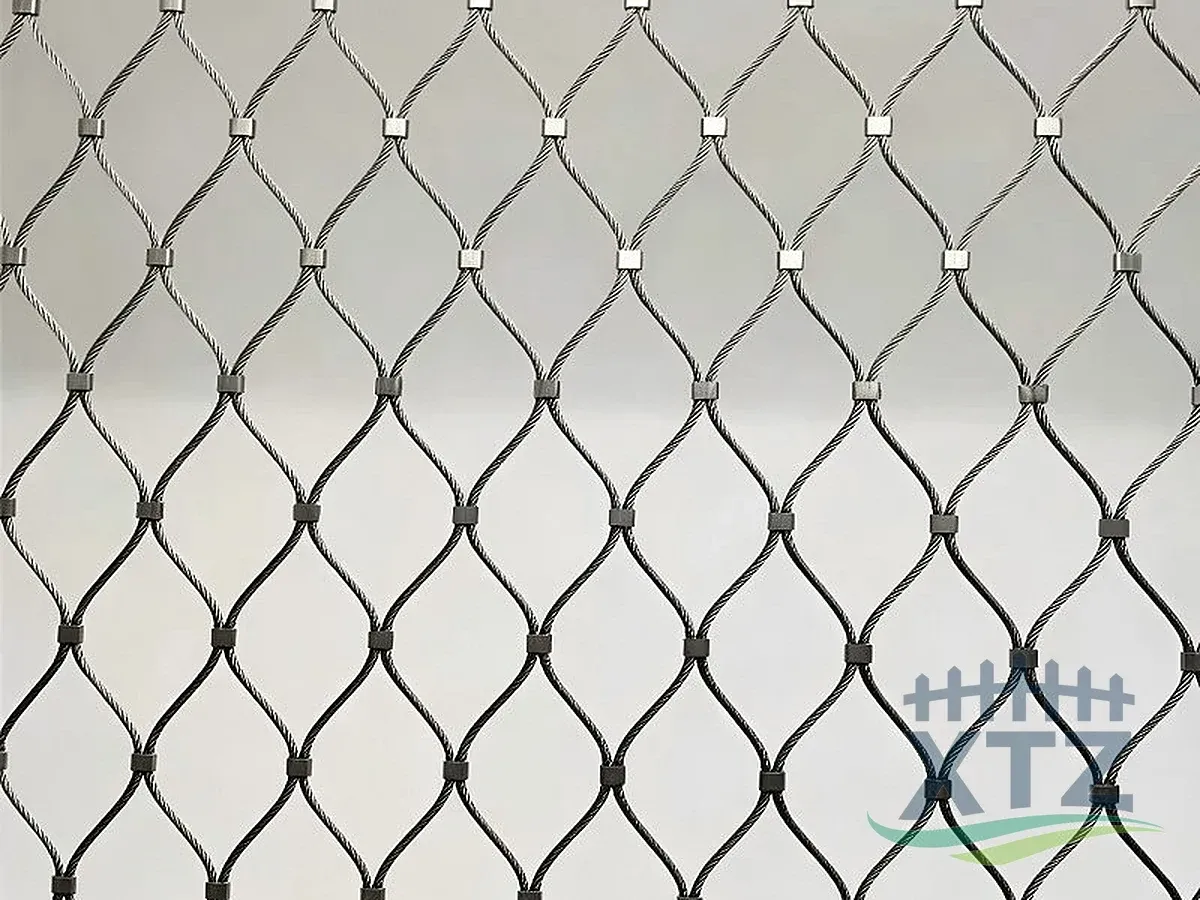
Privacy and appearance. View a full-size sample straight on and from the approach angle. Test it with the intended lighting on both sides. When a design calls for a woven surface, compare decorative stainless steel mesh alongside the punched sample. Wire crossings and a flat sheet scatter light differently even if they look equally open in a drawing.
Guards and removable covers. Identify the hazard, distance behind the opening, accessible edges and the way the panel fastens. A hole size or open-area percentage alone cannot establish that a guard is suitable. Keep fastener holes and fold lines clear of the pattern where the design calls for solid material. Ask the fabricator to flag a narrow strip of metal between the last hole and a cut edge before production.
Give the fabricator one dimensioned pattern
A useful enquiry for perforated stainless steel mesh contains enough information for two estimators to quote the same panel. State the alloy and finish, actual sheet thickness, finished dimensions and quantity. Include the hole detail, solid margins, visible face, bend lines and the edge condition after cutting. For stainless steel, agree on the finish after forming and which face will be exposed.
For example, a drawing might read: “Interior screen, 304 stainless steel, 1.5 mm sheet, 600 × 900 mm finished flat panel. Round holes Ø6 mm on 10 mm centers, 60° stagger. Minimum 25 mm unperforated border all around. Align rows to the marked top edge. Deburr accessible edges. Confirm first-hole position on shop drawing.” These dimensions illustrate a specification; tooling, tolerances and support need confirmation for the actual job.
Ask for the sample to include a finished edge. A swatch cut from the middle can settle the pattern choice but tells you little about the border, burr direction or the appearance of partial holes at the frame. If the panels repeat across a wall, approve a drawing showing two adjoining panels before ordering the run.
Frequently asked questions
Which hole pattern gives the most open area?
Compare the actual dimensions and row layout. In the examples above, a 6 mm square and a 6 mm circle yield different percentages on the same straight pitch. Changing the row arrangement also changes the result. Use a percentage calculated for each proposed pattern, then account for solid borders.
Does pitch mean the gap between two holes?
Pitch measures center to center. For adjacent 6 mm round holes on 10 mm centers, the metal bridge between their nearest edges measures 4 mm along the line joining the centers. Calling that bridge “10 mm spacing” on a drawing would produce a different sheet.
Can two screens with the same open area offer different privacy?
Yes. A thick sheet can screen the view more strongly at an angle than a thin sheet with the same face pattern. Hole size, slot orientation, frame depth and the contrast between front and background matter. Examine both samples from the actual sightline.
Is a perforated screen the same as expanded metal?
A perforated screen has discrete openings through a sheet. In stainless steel expanded metal mesh, slits open into a connected pattern as the sheet stretches. If your drawing calls for a flat solid border around a field of round holes, specify perforated sheet.
What determines the cost of a custom pattern?
Ask whether the hole and pitch fit existing tooling. Compare quotes for the same material, thickness, quantity, border, finish and secondary operations. A standard hole in a custom panel size can have different cost drivers from a new punch shape or a pattern that must register across several bends.
Send XTZ Fence your panel drawing, application and quantity with the pattern direction marked. If two patterns are still under consideration, identify what will decide between them: appearance at the joint, required free area or the opening that a particular part must pass through.